

A comfortable speaking voice
Give a short thought room to finish in an ordinary voice. Change a difficult environment or an overlong phrase before adding force.
The listener needs the last important word as well as the beginning. The speaker needs a way to finish it without pushing through discomfort.
Speaking rule
Finish a shorter thought on an easy breath
Say “The east gate is open until six.” Then add “After six, use the main entrance” as a second thought. If you feel short of breath, let the first thought end and take an easy breath before you start the second.
Listen back. Could you finish “main entrance” comfortably? A listener should still hear when the route changes.
Try another text. Try the same approach with a sentence from another text. Choose a place where one useful thought ends, then read it at speaking volume.
Short exercise
Give the ending room
We can move the chairs now, but the tables have to stay until the floor is dry.
- Say the line once at a comfortable volume. Stop if you feel strain.
- Say the first decision as a short thought. Take an easy breath if you need one, then say what must stay and when that changes.
- Read the linked passage and give its last thought the same room.
Check. What stays until the floor is dry? Notice separately whether the ending took more or less effort.
Compare after trying
The tables stay until the floor is dry. The chairs can move now. Keep both facts, even if you split the line.
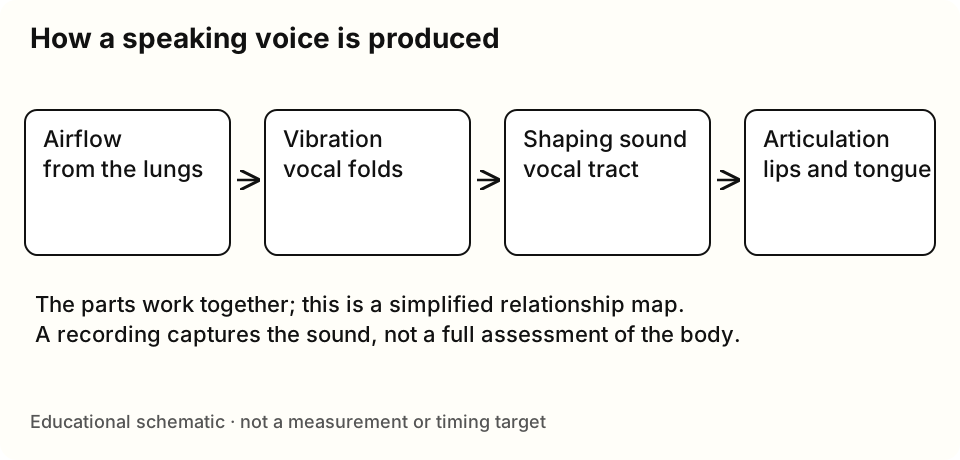
Airflow, vocal-fold vibration and the shaping of sound in the vocal tract contribute to speaking. A recording captures the resulting sound; it does not reveal a complete breathing technique or diagnose what the larynx is doing.
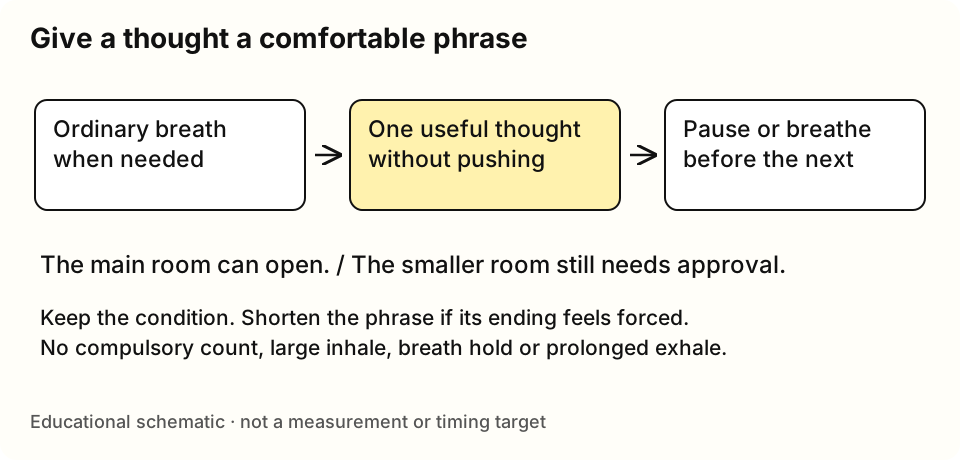
In practice, start smaller than a breathing system: choose a quiet place, a comfortable position and one useful thought. Allow a normal breath when needed. There is no target breath-hold, lung volume or compulsory number of words on one breath.
A worked contrast
The main room is ready and the volunteers are available but the smaller room still needs approval so we can only open the main room on Saturday.
The main room can open on Saturday. / The smaller room still needs approval.
The second version reduces the load of the phrase while preserving the limitation. The slash is an editorial boundary, not a required silence duration.
Practise one change
- Read one sentence in your usual voice.
- If the end feels forced, stop and shorten the thought without removing a condition.
- Repeat the shorter version, then listen for the ending.
- Retell the same point without the text and judge effort separately from accuracy.
What to listen for
- Was the last important word audible?
- Did shortening the phrase change the facts?
- Did the repeat feel easier, unchanged or more effortful?
Do not take a large breath before every sentence or turn normal breathing into a test. A comfortable shorter phrase is a practice choice, not a treatment.
Four texts to work through
Read for meaning first. Record with your usual recorder if you want audio. Use the rehearsal to try one change in a short excerpt. Close the full-text disclosure for recall. Use the anchors if you need a cue, and open the answers after your attempt.
01 · A quieter place to speak
Read the full text · close it for recall
Meaning to preserve: Keep the cause and the change distinct: the room was noisy; moving reduced the need to compete with it. Read in a comfortable voice.
The café was a poor place for our conversation. Every time the coffee machine started, we raised our voices and repeated the last sentence. We moved to a quieter table near the window. Nothing about the explanation changed, but we no longer had to compete with the room. I could finish a short thought, pause, and hear the reply. Before deciding that my voice needed more power, I needed to change the place where I was using it.
Rehearse one line
We moved to a quieter table near the window.
Try. Let the sentence end after “window.” Take an easy breath there if you want one before you continue.
Listen back. Did “window” finish comfortably, and could you start the next thought without pushing?
Recall anchors · less support
- noisy café
- quieter table
- same explanation
Check meaning after your retelling
Equivalent wording is welcome. These are checks against the fictional source, not automatic scores or proof that a listener understood.
What changed after the move?
The speakers no longer had to compete with the coffee machine and repeat the last sentence; the explanation itself stayed the same.
Why is more vocal power not the first solution in this case?
The immediate difficulty was the noisy place. Moving changed that condition without requiring a more forceful voice.
02 · A thought that leaves room to breathe
Read the full text · close it for recall
Meaning to preserve: Separate plan, reason and condition into comfortable phrases. Breathe normally when needed; do not hold your breath or force a longer phrase.
I had put the whole explanation into one long sentence. It contained the plan, the reason, the exception and the next step. Near the end, I was trying to finish words that no longer had enough room. I stopped and divided the message. First, the plan. Then the reason. Finally, the condition that could change it. I did not need to prove that I could say more on one breath. I needed to give each useful thought enough space.
Rehearse one line
It contained the plan, the reason, the exception and the next step.
Try. Keep “the exception and the next step” together. If it feels crowded, pause after “the reason” and finish the list as a second thought.
Listen back. Can you hear all four items without the last two becoming more effortful?
Recall anchors · less support
- one overloaded sentence
- plan / reason / condition
- shorter thoughts
Check meaning after your retelling
Equivalent wording is welcome. These are checks against the fictional source, not automatic scores or proof that a listener understood.
Which parts were originally crowded into one sentence?
The plan, the reason, the exception and the next step.
What did the speaker change instead of trying to say more on one breath?
The speaker divided the explanation into useful thoughts and gave each enough space.
03 · Emphasis without pushing
Read the full text · close it for recall
Meaning to preserve: Make the Friday–Thursday correction audible through relative emphasis. Keep the rest conversational; more force is not the goal.
The note said that the side entrance would be open on Friday, not Thursday. My first reading gave almost every word the same weight. On the next reading, I made the correction easier to hear: Friday, not Thursday. I did not need to shout the whole sentence. The useful difference was between the two days. After listening, I checked whether the correction was audible and whether the sentence still sounded like something I would say to a person.
Rehearse one line
On the next reading, I made the correction easier to hear: Friday, not Thursday.
Try. Say the part before the correction easily. Give “Friday” room by making the words around it lighter.
Listen back. Which day came through as the correction, and did it take more effort to say?
Recall anchors · less support
- side entrance
- Friday / Thursday
- relative emphasis
Check meaning after your retelling
Equivalent wording is welcome. These are checks against the fictional source, not automatic scores or proof that a listener understood.
Which day is correct?
Friday; Thursday is the alternative being corrected.
Why would shouting the whole sentence miss the point of the exercise?
The useful distinction is between the two days. Giving every word more force need not make that contrast clearer.
04 · A repeat is not a race
Read the full text · close it for recall
Meaning to preserve: Preserve the difference between familiar reading and a faithful explanation from memory. In your retelling, retain the missing-condition check.
After several readings, the passage felt easy because I knew which words came next. That was useful practice, but it did not tell me whether I understood the idea. I closed the text and explained the point in different words. One important condition disappeared. I opened the original, found the condition and tried again. Later, before reading the passage once more, I would try to recall it. The aim was a faithful explanation, not the fastest performance of a familiar paragraph.
Rehearse one line
That was useful practice, but it did not tell me whether I understood the idea.
Try. Finish “useful practice” as one thought. Leave a small space before “but” so you can begin the limit comfortably.
Listen back. Can you hear both what the repetition helped with and what it left open?
Recall anchors · less support
- familiar words
- hidden text
- missing condition
- later recall
Check meaning after your retelling
Equivalent wording is welcome. These are checks against the fictional source, not automatic scores or proof that a listener understood.
What disappeared in the first own-word explanation?
An important condition from the passage.
What does a fluent familiar reading fail to establish here?
Whether the speaker understands and can faithfully explain the idea without the source.
Check what carries over
- Repeat without the cue. Return to 02 · A thought that leaves room to breathe. Read once in your usual voice with the rehearsal closed.
- Change the text. Try 01 · A quieter place to speak before opening its cue. Can someone recover what changed when the speakers moved? Separately, could you finish the last thought at your usual speaking effort?
- Come back later. Retell the second passage before rereading it on another day. Then check which details survived.
If you already know the second passage, treat it as a familiar repeat. Check what the listener understood and how much effort it took as two separate things.
Practising alone? Close the passage, listen to your take once, and answer the listener question from playback before opening the reference. Without a recording, retell the passage from memory and use the reference to check which ideas you kept.
Compare after listening or retelling
Moving to a quieter table made it easier to finish a thought and hear the reply. The explanation itself stayed the same. Note your speaking effort separately.
If the distinction disappears. Try the final thought on its own at a comfortable volume. Then put it back after the move and check that both ideas survived.
Your recording and Voice Trail
In the desktop development build, open Library → Ptichi Academy → A comfortable speaking voice. Every take belongs to its text and source version. Reopen its recording and supported Voice Trail for review. Missing observations remain unavailable; this website does not record or calculate personal voice metrics.
Exercise identity and content version → lesson item → attempt → immutable recording/hash → supported observation and source-time trail. Missing or mismatched evidence stays unavailable. A web schematic is never a measured Voice Trail.
Use an ordinary, comfortable voice and ordinary breath opportunities. Stop voiced practice for pain, unusual hoarseness, dizziness or breathing difficulty. Persistent voice changes need an appropriate clinician. This is speech practice, not diagnosis, a prescribed breathing treatment or a promise to remove every voice problem.
Sources and limitations
NIDCD — Taking Care of Your Voice · Basic voice production, vocal-care context and avoiding overuse or force. Does not validate this curriculum, a daily vocal dose, a breath diagnosis from audio or a universal pitch/loudness target.
ASHA — Voice Disorders · Clinical assessment and treatment are condition- and person-dependent; respiratory/phonatory coordination is not inferred from an ordinary microphone trace. A clinical practice portal is not approval to prescribe its treatment protocols as universal self-directed lessons.
Whitling and colleagues — Effects of warm-up exercises on self-assessed vocal effort (2022) · Twenty-six vocally healthy adults reported effort before and after short reading or semi-occluded exercises and periods of silence. An immediate self-report experiment, not evidence for long-term harm, a prescribed rest duration, or Academy efficacy. No significant between-group difference at individual time points.
Ellis and Beltyukova — Compliance monitoring and vocal function exercises (2011) · Twenty young women with normal voices practised a taught vocal-function protocol for 28 days; monitored and unmonitored groups improved selected phonatory measures, with larger improvements in the monitored group. Abstract access only; no untreated group is described there. Selected physiological outcomes are not everyday speech, English ability or a reason to prescribe maximum-duration exercises to every learner.