

Understand it. Read it. Say it without the text.
Practise breathing, intonation, clear speech and spoken reasoning in 16 modules with 64 prepared English texts. Each module starts with a speaking rule you can try aloud before reading a passage.
Adults who understand English texts and can already retell them, but want clearer, more expressive and more comfortable speech.
The web course is readable without an account. Use your usual recorder for optional audio work. The desktop Academy keeps recordings and supported observations on your device; a public desktop installer is not released.
Find your first practice
Pick the closest problem. Try the cue, then open the first module in that route.
I run out of breath before I finish a thought
Say one short thought at a comfortable volume. If the ending takes effort, split it into two thoughts and take an easy breath between them.
My voice makes questions and statements sound alike
Say “You booked the smaller room” twice. Use it first to tell someone, then to ask for confirmation. Listen for the change in intention.
People miss key words or numbers
Say “Each packet holds fifteen seeds.” On the repeat, give “fifteen” a little more room and check whether the count comes through.
I bury the point when I explain
Give the listener the decision in one sentence. Then give the reason and the condition that could change it.
I lose my thread when someone pushes back
Before you answer, restate the other person’s concern in one sentence. Then give the part of your answer that addresses it.
Short exercises
Try one example aloud, then apply the same skill to its linked lesson.
Quick English speaking sprints
Three optional five-minute speaking exercises. Try a short answer, listen back with your own recorder if you wish, change one thing and try different words. These are manual drills, not extra Academy modules or a test of fluency. The website does not record you.
Word Connections · up to 5 minutes
Connect words through meaning: what caused the change, what it affects and what happens next.
Prompt. Imagine a project handoff is delayed because one approval is missing.
First attempt. 10 seconds to prepare, then speak for up to 45 seconds. Choose three anchors — cause, consequence and next action. Connect them in a short explanation; do not just list synonyms.
Listen or recall. Can you recover the cause, the consequence and the next action from what you said?
Change one thing. Replace one vague link with a precise 'because', 'so' or 'unless' relationship; keep the same facts.
Worked example · open after your first answer
The approval has not arrived, so the handoff is delayed. We will ask the owner for confirmation before updating the schedule.
Try a new situation · different words
A meeting changes rooms because the original room is unavailable. Explain the reason and next action in new words.
Continue in Academy: Thought groups · Point, reason and condition
Explain in 60 Seconds · up to 5 minutes
Give a listener the decision, reason, relevant condition and next step in one minute.
Prompt. In a fictional community event, the start time must move because venue access is restricted. Explain the change to volunteers.
First attempt. 10 seconds to prepare, then speak for up to 60 seconds. Use one sentence for what changed, one for why, and one for the next check. Keep any condition that could change the plan.
Listen or recall. Could someone tell you what changed, why and what needs confirmation? Did you invent any missing detail?
Change one thing. Put the decision first, or restore one missing condition, and give a second one-minute explanation.
Worked example · open after your first answer
The event will start later because we cannot access the room at the original time. We will confirm the new entry time with the venue before asking volunteers to arrive.
Try a new situation · different words
Your team chooses a simpler solution because the first approach is hard to maintain. Explain the trade-off in new words.
Continue in Academy: Point, reason and condition · Trade-offs and uncertainty · Explain a complex idea
Answer Without Preparation · up to 5 minutes
Give a direct answer to an unexpected question, then make the reasoning and its limit clear.
Prompt. What is the strongest reason not to follow your preferred plan?
First attempt. Begin after reading the question; then speak for up to 60 seconds. Read the question once and answer aloud immediately. State your answer, one reason and the condition that might change it.
Listen or recall. Did you answer the question itself? Can a listener name the reason and the condition without guessing?
Change one thing. Keep the first sentence direct. Remove one digression rather than trying to speak faster.
Worked example · open after your first answer
The strongest reason is the risk of extra maintenance. I would still choose this plan if the team can support it, but I would reconsider if support becomes uncertain.
Try a new situation · different words
What new evidence would make you change your recommendation? Answer in a different context.
Continue in Academy: Clear answers and repair · Dialogue and disagreement · Trade-offs and uncertainty
How this course works
Start with a short ordinary reading and a retelling. Listen for one problem that matters: a lost word, a missing condition, an unclear relationship or unnecessary effort. You may begin with the relevant module instead of repeating skills you can already use.
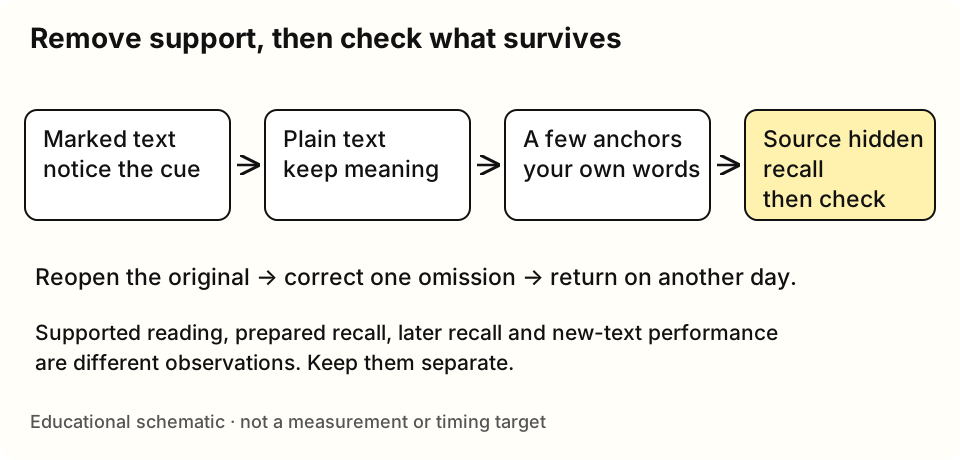
- Understand. Read silently. Name the main point, the relationship that supports it and any condition that changes it. Resolve an unfamiliar phrase before practising its delivery.
- Read naturally. Make a short ordinary reading. Keep the original facts. This is a starting attempt, not a test of how impressive your voice can sound.
- Listen for one thing. Choose one phrase where the intended distinction was lost. Identify the phrase before choosing a technique.
- Practise with support. Use the module's one cue. Add a manual boundary or focus mark only where it explains the meaning. Read the phrase, then the surrounding passage.
- Remove the markings. Read the plain text again. Keep the useful distinction without copying an exaggerated pause or pitch pattern.
- Use a small cue. Close the full passage and use only its recall anchors. Explain the same content in your own English; do not add facts to make the account sound complete.
- Recall without the source. Hide the text and its anchors. Retell what you understood. This is a prepared recall attempt, not a claim that the material was previously unseen.
- Check and repair. Open the meaning questions and original passage. Find one omission or distortion, then record a corrected short explanation. Keep delivery and factual accuracy as separate judgments.
- Return later. On a later day, attempt recall before rereading. Then use another passage with the same technique. Familiar performance, delayed recall and new-text performance are different observations.
A daily plan you can adjust
Each module contains four teaching texts. Try a new text on four practice days, revisit earlier texts on two days and use a lighter checking day when useful. Sixteen modules do not impose sixteen weeks: repeat, shorten or change a module according to the next recording and the meaning check.
One complete hour · 60 minutes in total
A planning example, not a required vocal dose. The speaking parts contain short attempts and rests; shorten the plan when needed.
- 5 minutes: Get comfortable and recall yesterday's idea before opening it.
- 10 minutes: Understand today's passage and check unfamiliar English.
- 10 minutes: Read short sections and record an ordinary attempt, resting between sections.
- 10 minutes: Listen, locate one useful distinction and choose one technique.
- 10 minutes: Repeat with a cue, then with the plain text; include breaks.
- 10 minutes: Retell with less support, reopen the source and repair one error.
- 5 minutes: Choose a later recheck and note what the recording actually showed.
A deeper two-hour session · 120 minutes in total
Add understanding and listening rather than doubling continuous speaking. The second hour can be entirely unvoiced when the voice feels tired.
- 60 minutes: Use the complete first-hour cycle.
- 20 minutes: Read another passage, clarify useful English phrases and compare its structure.
- 20 minutes: Listen to earlier takes and check meaning against the original.
- 20 minutes: Revisit older material before rereading, with short optional retellings and breaks.
Use an ordinary, comfortable voice and ordinary breath opportunities. Stop voiced practice for pain, unusual hoarseness, dizziness or breathing difficulty. Persistent voice changes need an appropriate clinician. This is speech practice, not diagnosis, a prescribed breathing treatment or a promise to remove every voice problem.
The curriculum
1. A comfortable speaking voice
Give a short thought room to finish in an ordinary voice. Change a difficult environment or an overlong phrase before adding force.
Open this module2. Thought groups
Keep words that belong to one thought together, then make the relationship to the next thought clear.
Open this module3. Words a listener can distinguish
Repair the particular word a listener could confuse, then put it back into a normal phrase.
Open this module4. Information focus
Make the new information or the correction stand out relative to what the listener already knows.
Open this module5. Intonation that carries an intention
Choose whether the thought finishes, continues or asks for confirmation, and make that intention available to the listener.
Open this module6. Pace, pauses and room for detail
Give a critical detail or change of relationship enough room; keep the rest at a useful natural pace.
Open this module7. Audible endings and conditions
Carry the last meaningful word, condition or requested action far enough to be understood, without forcing the phrase.
Open this module8. Audibility and expressive speech
Let interest, contrast and a turning point be heard while keeping the voice appropriate to one listener and the room.
Open this module9. Point, reason and condition
Give the useful point early, then keep its reason and its material condition attached.
Open this module10. A connected explanation
Make the relationship between stages, constraints and the next decision audible, not just the list of facts.
Open this module11. Evidence and reasoning
Separate what was observed from the explanation you are considering and the check that could distinguish it.
Open this module12. Trade-offs and uncertainty
Keep the recommendation, its downside and the condition that would change it in the same account.
Open this module13. Clear answers and repair
Answer the actual question, ask one consequential clarification when needed and repair the exact mistake without restarting everything.
Open this module14. Dialogue and disagreement
Represent the concern fairly, distinguish the point of disagreement and leave a concrete next step.
Open this module15. Explain a complex idea
Explain what the system does, where the uncertainty is and why that matters for a real decision.
Open this module16. Bring the whole message together
Preserve the meaning, choose a suitable delivery and reproduce both with less support on another occasion.
Open this module
Recordings, metrics and your Voice Trail
Every app exercise must keep each recording and its source-owned Voice Trail together. Compare equivalent attempts of the same exercise before interpreting a trend. In the desktop development build, open Library → Ptichi Academy. This website does not access your microphone.
What a recording can show — and what needs a listener
Supported descriptive observations
- Source duration and capture continuity
- Digital level and peak/clipping observations
- Source-time input activity, explicitly separate from validated speech/silence
- Supported relative pitch observations with gaps and experimental limits
Check manually
- Which fact or contrast a listener recovered
- Whether the retelling preserved the original meaning
- Speaking effort and suitability for this situation
Not inferred
- A microphone diagnosis of correct breathing
- A universal best pitch, pace or loudness
- A global confidence, personality, English-level or mastery score
Exercise identity and content version → lesson item → attempt → immutable recording/hash → supported observation and source-time trail. Missing or mismatched evidence stays unavailable. A web schematic is never a measured Voice Trail.
Why these methods are worth practising
Specific skills can change with practice. The useful question is which skill changed, whether a listener noticed, and whether it remained without the prompt. These studies explain the design choices; they are not results from Academy participants.
A small instruction can change what a listener hears
In a controlled study, twelve speakers read sentences and forty listeners transcribed them in background babble. All three clear-speech instructions improved average intelligibility relative to habitual speech, but the size of the benefit differed by instruction and speaker.
Our read: replace “sound better” with a recoverable distinction. In the articulation module, check whether someone heard fifteen or fifty, then repair that phrase. A change earns its place when the message becomes easier to recover.
This tested immediate English sentence reading in noise, not lasting improvement from this course or an ideal way for everyone to speak. Read the study
Familiar words can free attention for delivery
A study of twenty-four ESL students compared repeated and changing speech topics across three training sessions. Both groups improved during practice; the abstract reports maintained post-test fluency gains for the repeated-topic group.
Our read: prepared content is useful practice. You can work on phrasing without inventing a new story each time. We then remove the text and use another passage, because familiarity with one script and flexible speaking are different achievements.
The full methods were not accessed here. This small study does not validate our course, its duration, voice outcomes or a universal time-pressure drill. Read the study
A smooth rereading is not the same as remembering
In two experiments with prose passages, Roediger and Karpicke found that retrieval practice improved delayed retention relative to repeated study. The advantage depended on when memory was tested; immediate performance gave a different picture.
Our read: do both jobs. Read to understand, close the source to retrieve, then reopen it to repair an omission. Start the next session with a brief recall before rereading. The meaning questions check facts and relationships rather than verbatim imitation.
These were memory experiments. They do not show that recall alone improves voice, English pronunciation or general intelligence. Read the study
Voice is trainable, but the outcome must be named
Twenty young women with normal voices practised a taught vocal-function protocol for twenty-eight days. Both groups increased maximum phonation time and phonational frequency range; the group submitting practice recordings improved more on those measures.
Our read: this is a reason to take structured practice and a recording history seriously. It is also a reason to name the target. We practise comfortable, useful speech and inspect comparable recordings; we do not turn a maximum-duration test into a daily contest.
Only the primary abstract was available. It describes no untreated group and does not establish gains in conversation, thinking or this Academy. Its specialist protocol is not reproduced here. Read the study
More vocal effort is not proof of a better workout
In a study of twenty-six vocally healthy adults, five minutes of reading or semi-occluded exercises increased self-reported vocal effort. Ratings returned to baseline after a short period of silence. This was an immediate response, not a long-term outcome.
Our read: an hour of study need not be an hour of voicing. The daily plans alternate understanding, short spoken attempts, listening and rests. Compare comfort with your own ordinary speaking; do not chase fatigue as evidence of progress.
The study does not establish an ideal rest interval, prove harm or validate our schedule. Effort ratings and acoustic traces answer different questions. Read the study
A boundary can change what a listener groups together
In an object-placement task, Kraljic and Brennan found that speakers used prosodic boundaries that helped listeners interpret otherwise ambiguous instructions.
Our read: compare two locations for one boundary and ask what belongs together. In an important instruction, explicit wording is another way to remove doubt.
Listeners could see the objects and act on the instructions. The study does not establish a pause length for ordinary speech. Read the study
Practise the detail that answers the question
Muller Levis and Levis found that 18 advanced learners marked more intended contrasts in a controlled reading task after instruction. The listening test showed no reliable change.
Our read: vary the question while keeping the answer sentence fixed. Ask which correction someone heard before showing them the question.
The small classroom study used repeated sentences and had no untreated comparison group. It did not establish spontaneous transfer or better understanding by unfamiliar listeners. Read the study
Check whether the practice is helping you
Judge progress with the same small set of questions. Keep the original recording, the later attempt and the task conditions together. A later check without the text tells you something a supported repeat cannot.
- Meaning: which main point, reason and condition survived? Use the lesson answers; equivalent English is welcome.
- Listener recovery: can a willing listener identify the key number, contrast or next step without seeing the passage? Compare what was heard, not an impression of confidence.
- Delivery: did the chosen cue help the exact phrase while the surrounding message stayed natural?
- Comfort: did the task stay close to ordinary speaking effort? Record a plain personal note rather than interpreting microphone level as breathing efficiency.
- Retention and transfer: on a later day, recall before rereading; then try another text. Label these separately from a same-session repeat.
Continue when the intended distinction survives with less support and ordinary effort. Simplify or change the cue when meaning is lost or effort increases. These are practical review rules, not validated pass marks or a completion certificate.
Sources, scope and production
The lessons are original editorial practice, not a validated treatment or a promise that every voice or speaking problem will disappear. Independent human language review and learning-outcome evidence remain pending.
Read the evidence and its limits
NIDCD — Taking Care of Your Voice
Basic voice production, vocal-care context and avoiding overuse or force.
Does not validate this curriculum, a daily vocal dose, a breath diagnosis from audio or a universal pitch/loudness target.
ASHA — Voice Disorders
Clinical assessment and treatment are condition- and person-dependent; respiratory/phonatory coordination is not inferred from an ordinary microphone trace.
A clinical practice portal is not approval to prescribe its treatment protocols as universal self-directed lessons.
Roediger and Karpicke — Test-Enhanced Learning (2006)
Prose retrieval and delayed recall support keeping recall separate from repeated reading.
The experiments do not establish improvement in voice, English speaking, general reasoning or this exact Academy programme.
de Jong and Perfetti — Fluency Training in the ESL Classroom (2011)
A small ESL speech-repetition study is relevant to distinguishing repeated-topic performance from later speaking tests.
Abstract access only in this review. It does not establish this curriculum's dose, broad transfer or voice benefit; no shrinking time-limit protocol is prescribed from it.
Vedokrok — Separate practice performance from retention
Keep immediate supported performance and a later cue-reduced check separate.
A later failure can reflect task, context or assessment problems as well as forgetting. This released method is not efficacy evidence for the Academy.
Vedokrok — Give feedback at the smallest actionable unit
Tie one observed issue and its consequence to one controllable next change.
Not every performance problem has one local cause. Repeated failure can require a simpler task, prerequisite or environmental change.
Lam and Tjaden — Intelligibility of Clear Speech: Effect of Instruction (2013)
Twelve speakers and forty listeners: different clear-speech instructions changed sentence transcription accuracy in background babble.
A controlled English reading task, not a long-term training trial. Instruction order, individual variation and listening conditions limit transfer; no universal articulation or accent target follows.
Whitling and colleagues — Effects of warm-up exercises on self-assessed vocal effort (2022)
Twenty-six vocally healthy adults reported effort before and after short reading or semi-occluded exercises and periods of silence.
An immediate self-report experiment, not evidence for long-term harm, a prescribed rest duration, or Academy efficacy. No significant between-group difference at individual time points.
Ellis and Beltyukova — Compliance monitoring and vocal function exercises (2011)
Twenty young women with normal voices practised a taught vocal-function protocol for 28 days; monitored and unmonitored groups improved selected phonatory measures, with larger improvements in the monitored group.
Abstract access only; no untreated group is described there. Selected physiological outcomes are not everyday speech, English ability or a reason to prescribe maximum-duration exercises to every learner.
Kraljic and Brennan — Prosodic disambiguation of syntactic structure (2005)
In three English instruction experiments, speakers marked syntactic boundaries and listeners used those cues when interpreting object-placement instructions.
The picture and object task constrains what listeners can infer. It gives no general pause duration or evidence that this Academy exercise improves everyday speech.
Muller Levis and Levis — Learning to produce contrastive focus (2012)
Eighteen advanced English learners marked more intended contrasts in a controlled sentence-reading test after targeted instruction. Listening scores showed no reliable change.
A small classroom pre/post study with repeated test sentences and no untreated comparison group. This report does not show transfer to spontaneous speech or improved listener comprehension.