

Thought groups
Keep words that belong to one thought together, then make the relationship to the next thought clear.
A listener should hear which action, reason or exception belongs together instead of having to rebuild the sentence from disconnected pieces.
Speaking rule
Keep each useful detail in one thought group
Say “The last bus leaves at nine / if the road stays open.” Use the slash to let the listener hear the move from schedule to condition. Keep “at nine” together.
Listen back. Can a listener repeat both the departure time and what could change it? A small break is enough if both parts come through.
Try another text. Find one reason or condition in the next text. Mark its boundary and read the sentence once with the mark and once without it.
Short exercise
Move one pause
While the caretaker swept the steps got wet.
- Read the line once straight through. Notice what “the steps” seems to belong to as you hear it.
- Read it again with a small break after “swept.” Keep “the steps got wet” together.
- In the linked passage, put a boundary between the two proposals. Keep each proposal together.
Check. What got wet? Could someone recover that on a first listen without seeing the sentence?
Compare after trying
The steps got wet while the caretaker swept. A break after “the steps” briefly suggests that the caretaker swept the steps.
A thought group is a useful unit of meaning in this course, not a fixed number of words. A boundary may be carried by timing, pitch, emphasis or the wording itself. A slash in a teaching example shows an intended relationship; it is not a measured breath or a compulsory pause.
First identify what changes: a new reason, a contrasting option, an exception or the next event. Keep the words inside each unit connected. Listen for the relationship rather than trying to make every segment equally long.
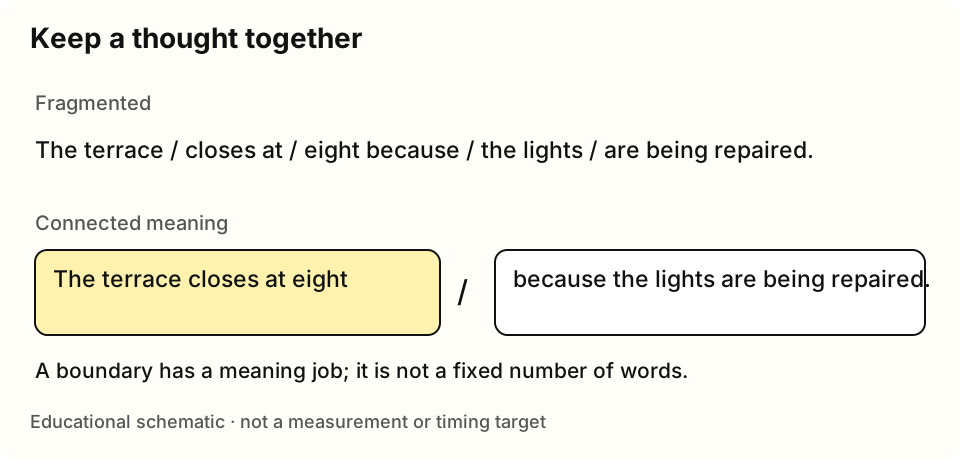
A worked contrast
The terrace / closes at / eight because / the lights / are being repaired.
The terrace closes at eight / because the lights are being repaired.
The second version keeps the closing information and its reason intact. Another natural delivery may use no audible silence and still make the relationship clear.
Practise one change
- Underline the two ideas privately.
- Read the first idea through before starting the next.
- Listen for a broken phrase inside either idea.
- Remove the marks and read again; then explain the two ideas from memory.
What to listen for
- Can the listener tell which reason belongs to which option?
- Did a boundary separate words that needed one another?
Pausing after every few words creates fragments. A larger silence is not automatically a better boundary.
Four texts to work through
Read for meaning first. Record with your usual recorder if you want audio. Use the rehearsal to try one change in a short excerpt. Close the full-text disclosure for recall. Use the anchors if you need a cue, and open the answers after your attempt.
Two ideas for the empty shop
Read the full text · close it for recall
Meaning to preserve: Can you hear the two different reasons?
A repair café would give broken things a second life. A quiet workspace would help people who have nowhere to concentrate.
Rehearse one line
A repair café would give broken things a second life. A quiet workspace would help people who have nowhere to concentrate.
Try. Finish one reason before starting the other.
Listen back. Can you hear the two different reasons?
Recall anchors · less support
- repair café
- broken things
- quiet workspace
- concentration
Check meaning after your retelling
Equivalent wording is welcome. These are checks against the fictional source, not automatic scores or proof that a listener understood.
What does each proposal offer?
The repair café gives broken things another use; the quiet workspace helps people who lack a place to concentrate.
What relationship should the reading preserve?
Each option should remain attached to its own reason, without the two becoming one confused proposal.
The problem you actually solved
Read the full text · close it for recall
Meaning to preserve: Can you distinguish your work from the team’s decision?
I turned a pile of unanswered messages into a short weekly plan. The team chose the priorities; I made the next actions visible.
Rehearse one line
I turned a pile of unanswered messages into a short weekly plan. The team chose the priorities; I made the next actions visible.
Try. Let your contribution finish before you describe the team’s role.
Listen back. Can you distinguish your work from the team’s decision?
Recall anchors · less support
- unanswered messages
- weekly plan
- team priorities
- visible actions
Check meaning after your retelling
Equivalent wording is welcome. These are checks against the fictional source, not automatic scores or proof that a listener understood.
What did the speaker contribute?
The speaker turned unanswered messages into a short weekly plan and made next actions visible.
Who chose the priorities?
The team, not the speaker alone.
The museum after dark
Read the full text · close it for recall
Meaning to preserve: Can you tell which place closes earlier and why?
The main gallery stays open until ten tonight. The roof terrace closes at eight because the lights are being repaired.
Rehearse one line
The main gallery stays open until ten tonight. The roof terrace closes at eight because the lights are being repaired.
Try. Complete the gallery update, then give the terrace exception.
Listen back. Can you tell which place closes earlier and why?
Recall anchors · less support
- gallery ten
- terrace eight
- lights repaired
Check meaning after your retelling
Equivalent wording is welcome. These are checks against the fictional source, not automatic scores or proof that a listener understood.
Which place closes earlier?
The roof terrace closes at eight; the main gallery stays open until ten.
Why does the terrace close earlier?
Its lights are being repaired.
The suitcase that took the scenic route
Read the full text · close it for recall
Meaning to preserve: Can you follow what happened first and what happened next?
My suitcase reached the city a day before I did. A station worker kept it safe while I caught the next train.
Rehearse one line
My suitcase reached the city a day before I did. A station worker kept it safe while I caught the next train.
Try. Let the unexpected event land before you explain the recovery.
Listen back. Can you follow what happened first and what happened next?
Recall anchors · less support
- suitcase arrived first
- station worker
- next train
Check meaning after your retelling
Equivalent wording is welcome. These are checks against the fictional source, not automatic scores or proof that a listener understood.
What arrived in the city first?
The suitcase arrived a day before its owner.
How was the problem handled?
A station worker kept the suitcase safe while the traveller caught the next train.
Check what carries over
- Repeat without the cue. Return to Two ideas for the empty shop. Read once in your usual voice with the rehearsal closed.
- Change the text. Try The suitcase that took the scenic route before opening its cue. Ask the listener which event came first and what the station worker did next.
- Come back later. Retell the second passage before rereading it on another day. Then check which details survived.
If you already know the second passage, treat it as a familiar repeat. Check what the listener understood and how much effort it took as two separate things.
Practising alone? Close the passage, listen to your take once, and answer the listener question from playback before opening the reference. Without a recording, retell the passage from memory and use the reference to check which ideas you kept.
Compare after listening or retelling
The suitcase reached the city a day before its owner. A station worker kept it safe while the owner caught the next train.
If the distinction disappears. Put the first event in one thought and the response in the next. Read again, keeping the details that belong to each event together.
Your recording and Voice Trail
In the desktop development build, open Library → Ptichi Academy → Thought groups. Every take belongs to its text and source version. Reopen its recording and supported Voice Trail for review. Missing observations remain unavailable; this website does not record or calculate personal voice metrics.
Exercise identity and content version → lesson item → attempt → immutable recording/hash → supported observation and source-time trail. Missing or mismatched evidence stays unavailable. A web schematic is never a measured Voice Trail.
Use an ordinary, comfortable voice and ordinary breath opportunities. Stop voiced practice for pain, unusual hoarseness, dizziness or breathing difficulty. Persistent voice changes need an appropriate clinician. This is speech practice, not diagnosis, a prescribed breathing treatment or a promise to remove every voice problem.
Sources and limitations
Kraljic and Brennan — Prosodic disambiguation of syntactic structure (2005) · In three English instruction experiments, speakers marked syntactic boundaries and listeners used those cues when interpreting object-placement instructions. The picture and object task constrains what listeners can infer. It gives no general pause duration or evidence that this Academy exercise improves everyday speech.