

Bring the whole message together
Preserve the meaning, choose a suitable delivery and reproduce both with less support on another occasion.
The purpose of the programme is an explanation a listener can use, not a polished reading that works only while the markings are visible.
Speaking rule
Keep the meaning when the wording changes
Read “The side entrance opens at nine if the safety check passes. Until then, visitors should use the main door.” Look away and retell the update in your own words. Keep the time, condition and temporary route.
Listen back. Check the retelling against all three details. If one is missing, reread just the phrase that carries it, then hide the text and try again.
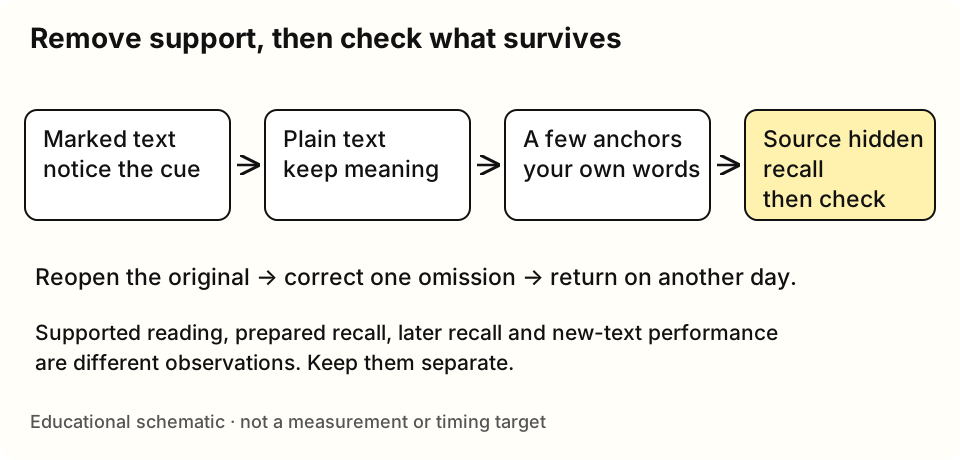
Try another text. Return later and recall before rereading. On a different text, use the same check to see whether the point and its condition still come through.
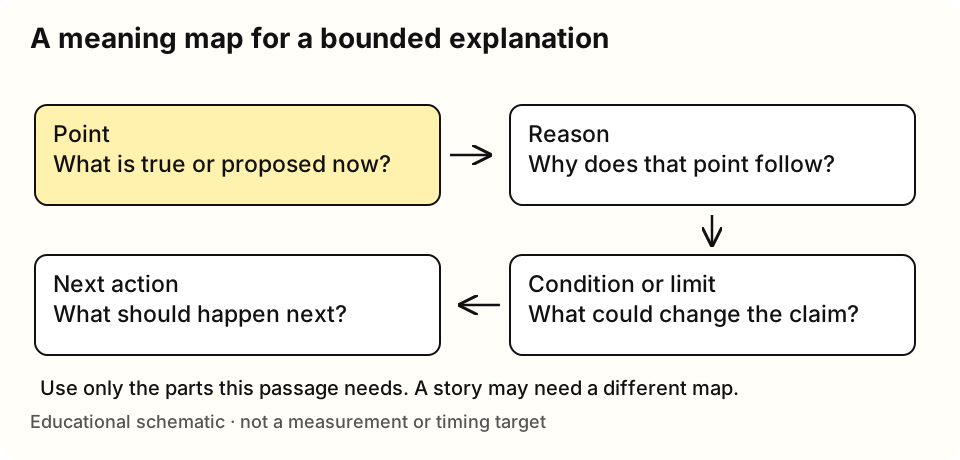
Bring the earlier controls together, but still choose only one primary repair per attempt. A main point, mechanism, material limit and next action can be checked separately without becoming four competing performance scores.
Compare an ordinary reading, a supported repeat and a retelling. Later, try recall before rereading and use another passage. These different observations show where support is still needed; they do not produce a certificate of general voice, thinking or English mastery.
A worked contrast
The reading sounds fluent, so the skill must be finished.
The reading is fluent. Now check whether the explanation stays accurate without the text and on a later attempt.
A later failure changes the next practice decision; it is not a personality verdict or a reason to repeat indefinitely.
Practise one change
- Choose one source passage and privately map its essential meaning.
- Record a natural reading, then one supported repair.
- Retell without the full text, then check and repair meaning.
- On another day, recall first and compare a different passage with the same listener question.
What to listen for
- Which improvement survived removal of the cue?
- What changed on another text or later attempt?
- Which part still needs a simpler explanation or smaller practice unit?
Do not claim a better second take proves lasting learning. Reduce the task or change the method when repeated practice is not changing the relevant outcome.
Four texts to work through
Read for meaning first. Record with your usual recorder if you want audio. Use the rehearsal to try one change in a short excerpt. Close the full-text disclosure for recall. Use the anchors if you need a cue, and open the answers after your attempt.
05 · Explain a pricing failure to business users
Read the full text · close it for recall
Meaning to preserve: Avoid premature blame; make evidence needed for diagnosis explicit.
The sales order could not determine a price for this case. That does not automatically mean the customer record is incorrect. The order may use a special combination of sales area, document type, customer classification or pricing conditions. We need one complete failing order and the expected business outcome before proposing a fix. I will compare the required determination inputs and identify which condition is missing or inconsistent. We should adjust the relevant rule or data only after that review, then retest the same scenario.
Rehearse one line
That does not automatically mean the customer record is incorrect.
Try. Give the uncertainty in “does not automatically mean” enough room. Then carry “customer record is incorrect” as the inference being questioned.
Listen back. Can the listener distinguish the pricing failure from a possible explanation for it?
Recall anchors · less support
- price missing
- customer not proven wrong
- complete failing order
- review then retest
Check meaning after your retelling
Equivalent wording is welcome. These are checks against the fictional source, not automatic scores or proof that a listener understood.
Why is changing the customer record premature?
A pricing failure may come from several determination inputs or conditions; it does not automatically prove a customer-record error.
What evidence is requested before a fix?
A complete failing order and the expected business outcome, followed by comparison of the relevant determination inputs.
06 · Standard process, extension or AI
Read the full text · close it for recall
Meaning to preserve: Present options and decision criteria without selling one platform.
There are three possible directions for this request. We could use a standard process, build a narrow extension, or introduce an AI-assisted step. The first question is not which technology is newest. It is what the business needs, which decisions must be traceable and where the current process fails. Standard capabilities are easier to operate when they fit the requirement. An extension may handle a genuine gap. An AI assistant might help draft or classify information, but it needs evaluation and a safe fallback. Let us agree on the target outcome before choosing the tool.
Rehearse one line
We could use a standard process, build a narrow extension, or introduce an AI-assisted step.
Try. Read the three options as parallel choices. Then continue with the business question before giving any option extra emphasis.
Listen back. What must be understood before the listener can choose among the three tools?
Recall anchors · less support
- standard
- extension
- AI
- outcome before tool
Check meaning after your retelling
Equivalent wording is welcome. These are checks against the fictional source, not automatic scores or proof that a listener understood.
What are the three possible directions?
A standard process, a narrow extension or an AI-assisted step.
What should be agreed before choosing among them?
The target business outcome, the process failure and traceability needs; AI additionally needs evaluation and a safe fallback.
07 · Tell an architecture story in plain English
Read the full text · close it for recall
Meaning to preserve: Explain system responsibilities using business consequences instead of acronyms alone.
Think of the solution as three responsibilities. The source system records the business event. The integration layer moves the relevant information and reports delivery failures. The receiving system checks that it can apply the change. This separation matters because a successful send is not the same as a successful business update. When something fails, we should know which responsibility owns the evidence and the recovery action. For the sponsor, the value is simple: fewer invisible handoffs, faster diagnosis and clearer accountability.
Rehearse one line
The integration layer moves the relevant information and reports delivery failures.
Try. Read the integration job as one thought. In the next line, give the receiving system a fresh start so its responsibility stays separate.
Listen back. Who moves the information, and who checks that the change can be applied?
Recall anchors · less support
- source event
- integration delivery
- receiving application
- send is not update
Check meaning after your retelling
Equivalent wording is welcome. These are checks against the fictional source, not automatic scores or proof that a listener understood.
What are the three system responsibilities?
Record the business event, move information and report delivery failures, and check whether the receiving system can apply the change.
Why is a successful send insufficient?
Delivery does not establish that the receiving system completed the business update; evidence and recovery still need an owner.
08 · Recommend a bounded AI pilot
Read the full text · close it for recall
Meaning to preserve: Make value, human control, evaluation and stopping rule audible in one recommendation.
I recommend a small AI pilot for classifying incoming support requests, not an automatic decision engine for customer records. The assistant could suggest a category and draft a short summary. A human would verify the result before any sensitive update. We should evaluate it on representative cases, including unusual requests, and measure errors, processing effort and recovery when the model is uncertain. We also need a rule for keeping private data within approved boundaries. If the pilot cannot outperform a simple manual checklist, we should stop or redesign it.
Rehearse one line
I recommend a small AI pilot for classifying incoming support requests, not an automatic decision engine for customer records.
Try. Put the proposal and its limit into two clear thought groups. Keep “classifying incoming support requests” audible before you introduce the limit.
Listen back. What would the pilot do, and what decision stays outside its scope?
Recall anchors · less support
- classify support requests
- human verifies
- representative cases
- checklist comparison
Check meaning after your retelling
Equivalent wording is welcome. These are checks against the fictional source, not automatic scores or proof that a listener understood.
What is proposed, and what is not?
A small AI-assisted support-request classification and summary pilot, not an automatic customer-record decision engine.
What could stop or change the pilot?
Failure to outperform a simple manual checklist; evaluation must include errors, effort, recovery, unusual cases and approved private-data boundaries.
Check what carries over
- Repeat without the cue. Return to 05 · Explain a pricing failure to business users. Read once in your usual voice with the rehearsal closed.
- Change the text. Try 08 · Recommend a bounded AI pilot before opening its cue. Ask what the pilot is for, who checks the output, and what evidence would change the decision.
- Come back later. Retell the second passage before rereading it on another day. Then check which details survived.
If you already know the second passage, treat it as a familiar repeat. Check what the listener understood and how much effort it took as two separate things.
Practising alone? Close the passage, listen to your take once, and answer the listener question from playback before opening the reference. Without a recording, retell the passage from memory and use the reference to check which ideas you kept.
Compare after listening or retelling
The pilot would classify incoming support requests and suggest a short summary. A human would verify the output before any sensitive update. If the pilot cannot beat a simple manual checklist, the proposal calls for stopping or redesigning it.
If the distinction disappears. Retell the proposal in three thoughts. Name its purpose, its human check and the result that would make you change course.
Your recording and Voice Trail
In the desktop development build, open Library → Ptichi Academy → Bring the whole message together. Every take belongs to its text and source version. Reopen its recording and supported Voice Trail for review. Missing observations remain unavailable; this website does not record or calculate personal voice metrics.
Exercise identity and content version → lesson item → attempt → immutable recording/hash → supported observation and source-time trail. Missing or mismatched evidence stays unavailable. A web schematic is never a measured Voice Trail.
Use an ordinary, comfortable voice and ordinary breath opportunities. Stop voiced practice for pain, unusual hoarseness, dizziness or breathing difficulty. Persistent voice changes need an appropriate clinician. This is speech practice, not diagnosis, a prescribed breathing treatment or a promise to remove every voice problem.
Sources and limitations
Vedokrok — Separate practice performance from retention · Keep immediate supported performance and a later cue-reduced check separate. A later failure can reflect task, context or assessment problems as well as forgetting. This released method is not efficacy evidence for the Academy.
Vedokrok — Give feedback at the smallest actionable unit · Tie one observed issue and its consequence to one controllable next change. Not every performance problem has one local cause. Repeated failure can require a simpler task, prerequisite or environmental change.