

Explain a complex idea
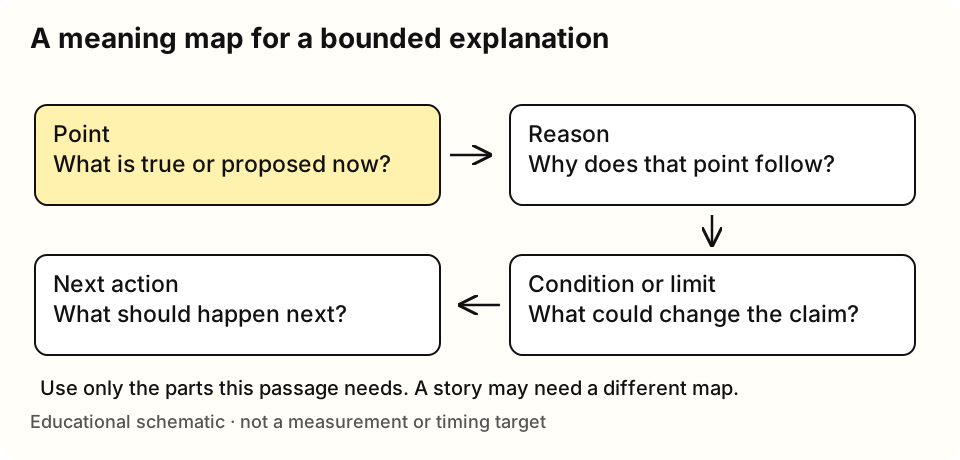
Explain what the system does, where the uncertainty is and why that matters for a real decision.
A non-specialist needs the consequence and the next action; a specialist still needs the exact boundary of the claim.
Speaking rule
Explain what was checked before saying what it means
Say “The copy contains 200 files, which matches the count we expected. We still need to check that it includes the right files before we switch systems.” Put the count and the pending check in separate phrases.
Listen back. Would someone hear permission to switch now? The listener should be able to name the result and the check still needed.
Try another text. Retell a new passage in three beats. Say what the system does, what remains uncertain and how that uncertainty affects the decision.
The enterprise-IT passages are fictional communication material, not technical configuration advice. Use them to practise separating state, mechanism, dependency and readiness.
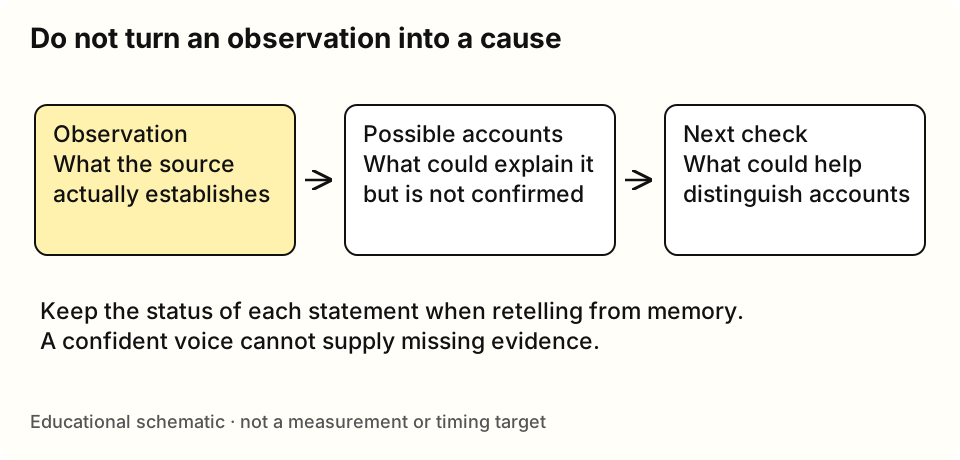
Translate a technical relationship into ordinary English without turning it into a guarantee. If the source says data mismatch is observed but the replication cause is only a hypothesis, keep both statuses in the retelling.
A worked contrast
The migration loaded the expected number, so the system is ready.
The load count matches the expected total. We still need to check scope completeness and business readiness.
A count, a completeness claim and a readiness decision are different statements.
Practise one change
- Identify the system relationship and the user consequence.
- Read the exact technical terms that are necessary; explain one that is not.
- Retell without the source, preserving the unresolved dependency.
- Check what the listener could decide from the account and what remains unknown.
What to listen for
- Did an observed symptom become a confirmed cause?
- Did a technical completion become business readiness?
Plain English must not remove the condition or substitute a reassuring story for the mechanism.
Four texts to work through
Read for meaning first. Record with your usual recorder if you want audio. Use the rehearsal to try one change in a short excerpt. Close the full-text disclosure for recall. Use the anchors if you need a cue, and open the answers after your attempt.
01 · A thirty-second project status
Read the full text · close it for recall
Meaning to preserve: Make state, unresolved dependency, owner and next action recoverable.
The master data migration is progressing, but one dependency is still open. Customer records have reached the target system, and the initial checks are complete. Some sales-area extensions are missing because their source assignments need clarification. We are not treating those records as finished. Today I need the business owner to confirm the intended assignments. Once that decision is available, we can rerun the affected load and verify the result. The project is moving, but this dependency affects the schedule.
Rehearse one line
Some sales-area extensions are missing because their source assignments need clarification.
Try. Give the missing extensions and the source assignments one short phrase each. Make “because” join them clearly.
Listen back. What remains incomplete, and what has to be clarified first?
Recall anchors · less support
- customer load
- missing sales-area extensions
- business assignments
- rerun and verify
Check meaning after your retelling
Equivalent wording is welcome. These are checks against the fictional source, not automatic scores or proof that a listener understood.
Which dependency is still open?
Some sales-area extensions are missing because intended source assignments need clarification.
What must happen before the affected records can be treated as finished?
The business owner confirms assignments, then the affected load is rerun and verified.
02 · Governance versus speed
Read the full text · close it for recall
Meaning to preserve: Explain the trade-off without claiming that one governance design fits every system.
I support simplifying the customer-change process. The current route asks people to repeat information and wait for decisions that add little value. But bypassing governance entirely would create a different problem: changes could happen without clear responsibility or an audit trail. I recommend a fast-track path for low-risk updates, with one accountable approval and the existing record of what changed. We should test it on a narrow group before changing every workflow. The decision is how to remove unnecessary steps while keeping essential controls.
Rehearse one line
I recommend a fast-track path for low-risk updates, with one accountable approval and the existing record of what changed.
Try. Keep the proposed fast track tied to low-risk updates. Let the approval and the change record come through as two separate controls.
Listen back. Which changes qualify, and which safeguards stay in the proposal?
Recall anchors · less support
- remove repetition
- keep accountability
- low-risk fast track
- narrow test
Check meaning after your retelling
Equivalent wording is welcome. These are checks against the fictional source, not automatic scores or proof that a listener understood.
What essential controls are retained in the proposal?
One accountable approval and the existing record of changes.
Why not bypass governance entirely?
Changes could lose clear responsibility and an audit trail; the goal is to remove unnecessary steps while keeping essential controls.
03 · Replication delays are not missing data
Read the full text · close it for recall
Meaning to preserve: Separate observed data mismatch from a hypothesized replication cause.
The partner functions exist in the source system now, but the target system displayed an older version during the morning check. That difference alone does not prove that the mapping is wrong. The change may have been waiting in an outbound job, in transit, or in a receiving queue. I suggest comparing the change timestamp, the message timestamp and the target update time before we correct master data again. If processing is slow, changing the data twice could create more confusion. We need to locate the delay first.
Rehearse one line
The partner functions exist in the source system now, but the target system displayed an older version during the morning check.
Try. Say the source result and the target result as two clear observations. Give “during the morning check” room to finish the second one.
Listen back. Can the listener describe the difference without guessing what caused it?
Recall anchors · less support
- source current
- target older
- processing locations
- timestamps first
Check meaning after your retelling
Equivalent wording is welcome. These are checks against the fictional source, not automatic scores or proof that a listener understood.
What is observed without proving a mapping error?
The partner functions now exist in the source, while the target displayed an older version during the morning check.
Which times should be compared before changing data again?
The source change, message and target update timestamps, to locate a possible processing delay.
04 · A migration without hidden exclusions
Read the full text · close it for recall
Meaning to preserve: Keep load count, scope completeness and business readiness as different claims.
The first migration test loaded nine hundred customer records. That is a useful start, but the number does not tell us whether each required sales area, partner function and company-code extension is present. We need to compare the result with an agreed source scope and record exceptions explicitly. I recommend a reconciliation report that separates missing customers from incomplete extensions and intentional exclusions. Only then can we make a meaningful readiness statement. Counting successful records is not the same as proving a usable business process.
Rehearse one line
I recommend a reconciliation report that separates missing customers from incomplete extensions and intentional exclusions.
Try. Keep the three categories separate as you read the list. Give “intentional exclusions” the same room as the two types of missing data.
Listen back. Can the listener name all three categories the report must distinguish?
Recall anchors · less support
- nine hundred loaded
- agreed scope
- extensions and exclusions
- business readiness
Check meaning after your retelling
Equivalent wording is welcome. These are checks against the fictional source, not automatic scores or proof that a listener understood.
What does loading nine hundred customers not establish?
Whether all required sales areas, partner functions and company-code extensions are present or the business process is usable.
What distinctions should the reconciliation report preserve?
Missing customers, incomplete extensions and intentional exclusions, compared with the agreed source scope.
Check what carries over
- Repeat without the cue. Return to 01 · A thirty-second project status. Read once in your usual voice with the rehearsal closed.
- Change the text. Try 04 · A migration without hidden exclusions before opening its cue. Ask what the count shows, what still needs reconciling, and whether it establishes readiness.
- Come back later. Retell the second passage before rereading it on another day. Then check which details survived.
If you already know the second passage, treat it as a familiar repeat. Check what the listener understood and how much effort it took as two separate things.
Practising alone? Close the passage, listen to your take once, and answer the listener question from playback before opening the reference. Without a recording, retell the passage from memory and use the reference to check which ideas you kept.
Compare after listening or retelling
The count confirms that nine hundred customer records loaded. The team still needs to reconcile missing customers, incomplete extensions, and deliberate exclusions against the agreed scope before making a readiness claim.
If the distinction disappears. State the measured result first. Give completeness and readiness their own sentences so the count cannot stand in for either one.
Your recording and Voice Trail
In the desktop development build, open Library → Ptichi Academy → Explain a complex idea. Every take belongs to its text and source version. Reopen its recording and supported Voice Trail for review. Missing observations remain unavailable; this website does not record or calculate personal voice metrics.
Exercise identity and content version → lesson item → attempt → immutable recording/hash → supported observation and source-time trail. Missing or mismatched evidence stays unavailable. A web schematic is never a measured Voice Trail.
Use an ordinary, comfortable voice and ordinary breath opportunities. Stop voiced practice for pain, unusual hoarseness, dizziness or breathing difficulty. Persistent voice changes need an appropriate clinician. This is speech practice, not diagnosis, a prescribed breathing treatment or a promise to remove every voice problem.