

Clear answers and repair
Answer the actual question, ask one consequential clarification when needed and repair the exact mistake without restarting everything.
The other person needs a useful next contribution, not a perfectly rehearsed answer to a different question.
Speaking rule
Answer the question and repair the exact detail
Answer “Which entrance opens first?” with “The west entrance opens first.” Then correct your answer in place with “One correction. The east entrance opens first.” Stop when the replacement is clear.
Listen back. Which entrance would the listener use now? If both remain plausible, repeat the corrected answer as a complete phrase.
Try another text. Use a factual detail from another text. Answer a question about it, then practise a concise correction using a different specific detail.
The prepared texts let you study a response before trying to reproduce its function from memory. Reading a response is not evidence of live conversational skill, but it can make the structure available for later use.
Notice whether the source is answering, clarifying, admitting an unknown or correcting a fact. Preserve that function in your retelling. A local repair can be brief: name the correction, keep the unchanged facts and continue.
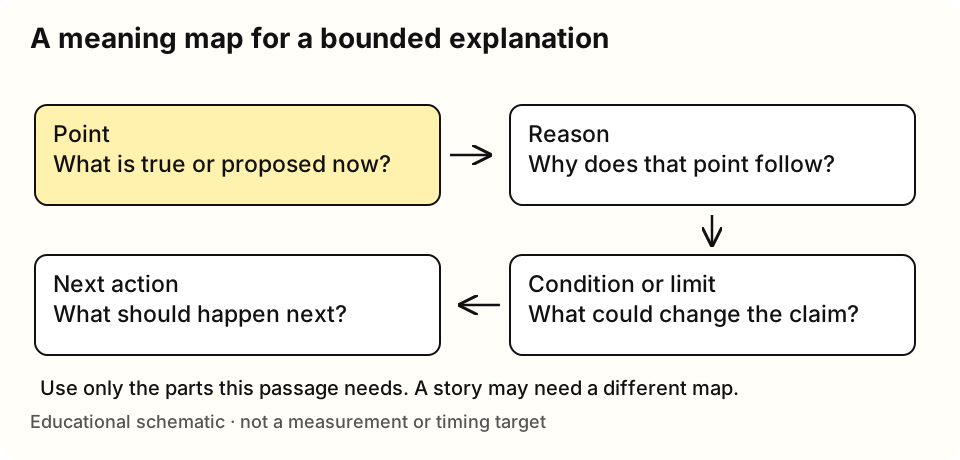
A worked contrast
I should start again from the beginning because I used the wrong date.
One correction: Friday, not Thursday. The rest of the plan is unchanged.
The repair identifies exactly what changed and prevents a second long answer from obscuring it.
Practise one change
- Name the response's job before reading.
- Read it with the answer or clarification available early.
- Retell while preserving the same communicative job.
- Check whether the corrected fact, unknown or limit remained explicit.
What to listen for
- What question did the source actually answer?
- What stayed unchanged after the repair?
Do not turn every answer into a long clarification ritual or every mistake into a new speech.
Four texts to work through
Read for meaning first. Record with your usual recorder if you want audio. Use the rehearsal to try one change in a short excerpt. Close the full-text disclosure for recall. Use the anchors if you need a cue, and open the answers after your attempt.
01 · Answer an unexpected question
Read the full text · close it for recall
Meaning to preserve: Give a usable answer in the opening thought, then name its limit.
Yes, we can try the shorter format, but I would not change the whole event at once. The opening discussion is already working well. The part people find tiring is the long final presentation. We could shorten that section, keep the questions, and ask participants what they understood afterwards. That would give us a useful experiment without disrupting what works. My answer is yes to a small trial, not yes to an untested permanent change.
Rehearse one line
Yes, we can try the shorter format, but I would not change the whole event at once.
Try. Give the initial “Yes” room, then carry the limit all the way through “at once.”
Listen back. Did the listener hear permission for a trial or permission to change the whole event?
Recall anchors · less support
- shorter final presentation
- opening works
- keep questions
- small trial
Check meaning after your retelling
Equivalent wording is welcome. These are checks against the fictional source, not automatic scores or proof that a listener understood.
Which part is proposed for shortening?
The long final presentation, while retaining the opening discussion and questions.
What is the answer explicitly not approving?
An untested permanent change to the whole event.
02 · Clarify the ambiguous request
Read the full text · close it for recall
Meaning to preserve: Make the single clarification consequential; avoid a string of vague questions.
When you say that the report should be automatic, do you mean that the draft should be prepared automatically or that it should be sent without review? Those are different decisions. We can generate a draft while keeping a person responsible for checking unusual figures. Sending it automatically would need stronger validation and clear ownership of mistakes. Once we know which outcome you want, we can estimate effort and choose a sensible first step. The question is not a delay; it prevents us from solving the wrong problem.
Rehearse one line
When you say that the report should be automatic, do you mean that the draft should be prepared automatically or that it should be sent without review?
Try. Make the two meanings of “automatic” distinct. Say the first option, give a small beat after “or,” then complete the second.
Listen back. Can the listener state the two choices they need to clarify?
Recall anchors · less support
- automatic draft
- automatic sending
- human review
- different validation
Check meaning after your retelling
Equivalent wording is welcome. These are checks against the fictional source, not automatic scores or proof that a listener understood.
Which ambiguity must be resolved?
Whether automatic means preparing a draft or sending a report without review.
Why do those options require different decisions?
Automatic sending needs stronger validation and ownership; a draft can retain a person who checks unusual figures.
03 · Say what you do not know
Read the full text · close it for recall
Meaning to preserve: Separate confirmed observations from an unverified diagnosis and next check.
I cannot confirm the cause of the delay yet. We know the message entered the queue at ten thirty, and we know the receiving system processed it almost an hour later. We have not established which stage used most of that time. I will compare the timestamps from both sides and check whether the same pattern affected other messages. I can give you an evidence-based update this afternoon. I would rather be precise about what we know than invent a technical explanation.
Rehearse one line
I cannot confirm the cause of the delay yet.
Try. Deliver this as a complete answer to a question about the cause. In the next sentence, move to the known timing as a separate piece of information.
Listen back. Did you answer the question before offering the timeline?
Recall anchors · less support
- queue ten thirty
- almost hour later
- stage unknown
- timestamp comparison
Check meaning after your retelling
Equivalent wording is welcome. These are checks against the fictional source, not automatic scores or proof that a listener understood.
Which timestamps are known?
The message entered the queue at ten thirty and was processed by the receiver almost an hour later.
What can the speaker promise to do rather than promise a cause?
Compare timestamps and affected messages and provide an evidence-based update; the responsible stage is not established.
04 · Repair a mistake without restarting
Read the full text · close it for recall
Meaning to preserve: Correct the exact mistake and carry on without hiding it or restarting everything.
Let me correct one detail from my previous answer. I said that the pilot involved eight locations; it involved six. The conclusion does not change: we saw the same problem in more than one setting, but the sample is too small to justify a full rollout. I should have checked the count before quoting it. I will send the corrected summary after this meeting. The correction matters, but it does not require me to repeat the whole presentation or pretend the error did not happen.
Rehearse one line
I said that the pilot involved eight locations; it involved six.
Try. Give “six” the focus. Let the correction finish there before you continue with what it means for the conclusion.
Listen back. Which number should the listener now use?
Recall anchors · less support
- six, not eight
- multiple settings
- small sample
- corrected summary
Check meaning after your retelling
Equivalent wording is welcome. These are checks against the fictional source, not automatic scores or proof that a listener understood.
What exact fact is corrected?
The pilot involved six locations, not eight.
What limit remains after the correction?
The sample is still too small to justify a full rollout, even though the problem appeared in more than one setting.
Check what carries over
- Repeat without the cue. Return to 01 · Answer an unexpected question. Read once in your usual voice with the rehearsal closed.
- Change the text. Try 04 · Repair a mistake without restarting before opening its cue. Ask which figure the listener would use now and whether the correction changed the conclusion.
- Come back later. Retell the second passage before rereading it on another day. Then check which details survived.
If you already know the second passage, treat it as a familiar repeat. Check what the listener understood and how much effort it took as two separate things.
Practising alone? Close the passage, listen to your take once, and answer the listener question from playback before opening the reference. Without a recording, retell the passage from memory and use the reference to check which ideas you kept.
Compare after listening or retelling
The pilot covered six locations. The same issue appeared in more than one setting, and the sample is still too small to support a full rollout.
If the distinction disappears. Replace the incorrect detail in one complete phrase. Then add one sentence about whether the conclusion changed.
Your recording and Voice Trail
In the desktop development build, open Library → Ptichi Academy → Clear answers and repair. Every take belongs to its text and source version. Reopen its recording and supported Voice Trail for review. Missing observations remain unavailable; this website does not record or calculate personal voice metrics.
Exercise identity and content version → lesson item → attempt → immutable recording/hash → supported observation and source-time trail. Missing or mismatched evidence stays unavailable. A web schematic is never a measured Voice Trail.
Use an ordinary, comfortable voice and ordinary breath opportunities. Stop voiced practice for pain, unusual hoarseness, dizziness or breathing difficulty. Persistent voice changes need an appropriate clinician. This is speech practice, not diagnosis, a prescribed breathing treatment or a promise to remove every voice problem.