

Trade-offs and uncertainty
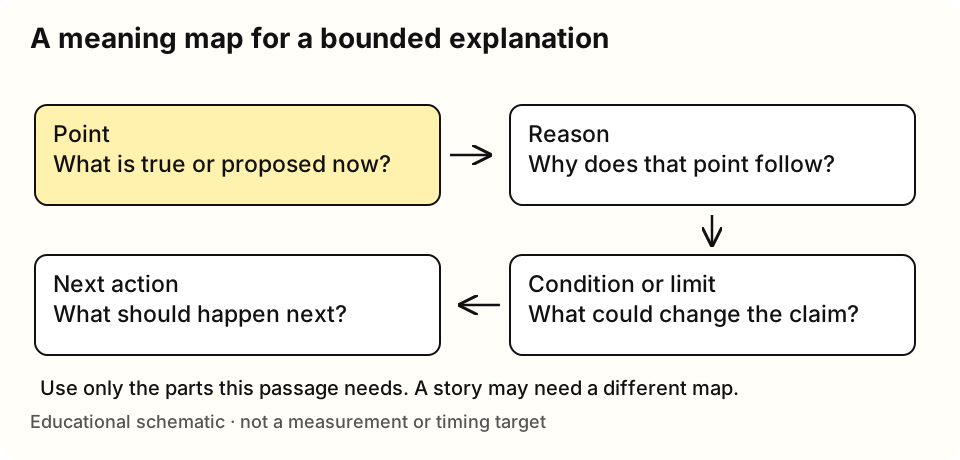
Keep the recommendation, its downside and the condition that would change it in the same account.
A listener needs a decision they can examine, not certainty performed through tone.
Speaking rule
Name the cost and what would change your advice
Say “I’d start with one room. It is easier to staff, but fewer people can attend. If the waiting list fills, I’d add a second session.” Keep the downside and the trigger as distinct thoughts.
Listen back. Can a listener say what they give up and when you would change the plan? If they only heard the recommendation, give the trade-off its own sentence.
Try another text. Take another choice from the next text and say its benefit, cost and change condition in three short sentences.
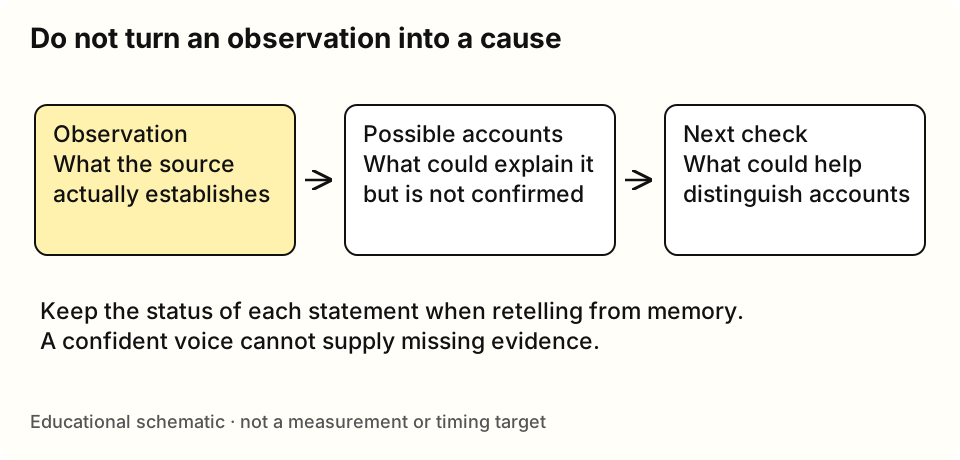
An uncertainty statement is useful when it says what is known, what remains open and what can be checked next. Vague hedging around every sentence can hide even the facts that are established.
In a recommendation, find the source's material trade-off or reversal condition. Keep it during recall. The task is not to defend the first answer at all costs; changed evidence may require a changed recommendation.
A worked contrast
This is probably the best option, although nothing is certain.
I recommend the smaller reversible trial. It answers the immediate question; it does not establish long-term reliability.
The second version names both value and limit instead of using a confidence tone as a substitute.
Practise one change
- Find the recommendation and its decision-changing condition.
- Read the known and unknown parts with accurate wording.
- Retell with the strongest limitation still present.
- Compare whether a listener can explain what would change the recommendation.
What to listen for
- Did uncertainty erase a usable next action?
- Did confidence erase a material limitation?
More hedging is not automatically more honest. Be precise about the boundary of what is known.
Four texts to work through
Read for meaning first. Record with your usual recorder if you want audio. Use the rehearsal to try one change in a short excerpt. Close the full-text disclosure for recall. Use the anchors if you need a cue, and open the answers after your attempt.
05 · Prefer a reversible test
Read the full text · close it for recall
Meaning to preserve: Explain what makes the trial reversible and which decision the evidence can inform.
The park committee has two proposals for an unused square. A permanent stage might attract events, but the neighbours worry about noise. A weekend pop-up would be less ambitious and much easier to reverse. I recommend testing two small events with clear finishing times before building anything permanent. We should measure attendance and ask nearby residents about disruption. If the trial fails, we can stop at low cost. If it succeeds, it gives evidence for a larger decision, not automatic permission to build.
Rehearse one line
I recommend testing two small events with clear finishing times before building anything permanent.
Try. Give “testing two small events” the focus. Then keep “before building anything permanent” attached to that recommendation.
Listen back. What is being approved now, and what decision remains open?
Recall anchors · less support
- permanent stage
- two pop-up events
- noise and attendance
- reversible
Check meaning after your retelling
Equivalent wording is welcome. These are checks against the fictional source, not automatic scores or proof that a listener understood.
Why is the pop-up preferred before a permanent stage?
It is easier to reverse and can test attendance and neighbour disruption at lower cost.
Would a successful trial automatically authorise construction?
No. It informs the larger decision rather than granting permission to build.
06 · Ask what would change your mind
Read the full text · close it for recall
Meaning to preserve: State the position and a credible falsifier, not an invented certainty.
I favour keeping the repair service open on Wednesdays because it serves people who cannot visit at weekends. But I would change my recommendation if we found that almost all visits could be moved without inconvenience. We need a short survey and actual attendance data, not a single loud complaint. A strong position includes the evidence that would weaken it. Naming that evidence does not make the recommendation timid. It makes the reasoning inspectable and helps the team choose a useful next test.
Rehearse one line
But I would change my recommendation if we found that almost all visits could be moved without inconvenience.
Try. Give the words after “if” their own short thought. Finish “without inconvenience” clearly because it limits when you would change your mind.
Listen back. What finding would change the recommendation?
Recall anchors · less support
- Wednesday access
- weekend difficulty
- attendance and survey
- reversal condition
Check meaning after your retelling
Equivalent wording is welcome. These are checks against the fictional source, not automatic scores or proof that a listener understood.
What supports staying open on Wednesday?
It serves people who cannot visit at weekends.
What evidence could change that recommendation?
Finding that almost all visits could be moved without inconvenience, supported by attendance data and a short survey rather than one complaint.
07 · Separate uncertainty from indecision
Read the full text · close it for recall
Meaning to preserve: Name known, unknown, mitigation and decision owner without overpromising.
We know that the new registration process works for ordinary requests. We do not yet know how it behaves when two people submit the same information at once. I would not block all progress because of that unknown, and I would not ignore it either. We can release the change to a limited group while we test concurrent submissions and prepare a rollback. The decision depends on whether that remaining risk is acceptable to the owner. Uncertainty should appear in the plan, not disappear behind confident language.
Rehearse one line
We do not yet know how it behaves when two people submit the same information at once.
Try. Keep “do not yet know” audible. Give the simultaneous submission example enough space so the uncertainty has a specific subject.
Listen back. Which behaviour needs further testing?
Recall anchors · less support
- ordinary requests tested
- simultaneous submissions unknown
- limited group
- owner risk decision
Check meaning after your retelling
Equivalent wording is welcome. These are checks against the fictional source, not automatic scores or proof that a listener understood.
Which behaviour remains unknown?
What happens when two people submit the same information at once.
What bounded action is proposed?
A limited-group release while testing concurrent submissions and preparing rollback, conditional on the owner's acceptance of the remaining risk.
08 · Revise when the evidence changes
Read the full text · close it for recall
Meaning to preserve: Make the new fact, revised recommendation and evaluation point explicit.
I originally recommended moving the weekly workshop online because fewer people were attending in person. After talking to the participants, we learned that many relied on the room's equipment and could not join from home. Attendance alone had hidden that constraint. I am changing my recommendation: keep one in-person workshop, offer an optional online discussion, and review participation after a month. Revising the plan is not a failure of consistency. It is the proper response when evidence changes the decision.
Rehearse one line
After talking to the participants, we learned that many relied on the room's equipment and could not join from home.
Try. Give “relied on the room’s equipment” the focus in your delivery. In the full passage, let that finding explain why the recommendation changed.
Listen back. What did the conversation reveal that the attendance count missed?
Recall anchors · less support
- falling attendance
- equipment at venue
- keep in person
- optional online discussion
Check meaning after your retelling
Equivalent wording is welcome. These are checks against the fictional source, not automatic scores or proof that a listener understood.
What new evidence changed the original online recommendation?
Many participants relied on equipment in the physical room and could not participate from home.
What is the revised plan?
Keep one in-person workshop, add an optional online discussion and review participation after a month.
Check what carries over
- Repeat without the cue. Return to 05 · Prefer a reversible test. Read once in your usual voice with the rehearsal closed.
- Change the text. Try 08 · Revise when the evidence changes before opening its cue. Ask which new fact changed the recommendation, what the revised plan is, and when it will be reviewed.
- Come back later. Retell the second passage before rereading it on another day. Then check which details survived.
If you already know the second passage, treat it as a familiar repeat. Check what the listener understood and how much effort it took as two separate things.
Practising alone? Close the passage, listen to your take once, and answer the listener question from playback before opening the reference. Without a recording, retell the passage from memory and use the reference to check which ideas you kept.
Compare after listening or retelling
Participants depended on the room’s equipment. The revised plan keeps one in-person workshop, adds an optional online discussion, and reviews participation after a month.
If the distinction disappears. Name the new fact before giving the revised plan. Put the review point in its own short phrase if it was lost.
Your recording and Voice Trail
In the desktop development build, open Library → Ptichi Academy → Trade-offs and uncertainty. Every take belongs to its text and source version. Reopen its recording and supported Voice Trail for review. Missing observations remain unavailable; this website does not record or calculate personal voice metrics.
Exercise identity and content version → lesson item → attempt → immutable recording/hash → supported observation and source-time trail. Missing or mismatched evidence stays unavailable. A web schematic is never a measured Voice Trail.
Use an ordinary, comfortable voice and ordinary breath opportunities. Stop voiced practice for pain, unusual hoarseness, dizziness or breathing difficulty. Persistent voice changes need an appropriate clinician. This is speech practice, not diagnosis, a prescribed breathing treatment or a promise to remove every voice problem.