

Speech training can fail in a surprisingly competent way.
Research
The overcorrection problem: when speech training makes you sound worse
Why more pause, more pitch, more articulation or more volume can improve a metric while making speech less natural or less useful.
You follow the instruction. You pause more. You slow down. You make the important word louder. You articulate every consonant. Your second recording is objectively different.
And somehow it sounds worse.
Not necessarily less “professional.” Worse in a more useful sense: the message becomes heavy, theatrical, fragmented, effortful or harder to listen to.
This is the overcorrection problem.
A useful speaking control is turned into a one-direction target:
some pause helps → more pause must help more
some prominence helps → more pitch movement must help more
a critical word needs clarity → every word should be maximally articulated
a quiet phrase needs audibility → more loudness must be better
That logic is convenient for software because larger changes are easy to see. It is weak communication coaching.
Ptichi's working rule is the opposite:
Use the smallest change that creates the listener effect you wanted. Then check whether the result still sounds natural, feels sustainable and survives new wording.
There is no public Ptichi desktop installer today. The exercises below work with any recorder.
Why speaking advice tends to become exaggerated
A coach faces a practical problem: subtle changes are difficult to teach.
If someone cannot hear a thought boundary, saying “make the transition microscopically clearer” is not useful. A larger contrast can help the person perceive the control.
So coaches exaggerate.
Pause longer.
Stress the word.
Open the vowels.
Finish the statement.
Project more.
That is often useful during acquisition. The learner needs to feel what the control does.
The mistake is treating the exaggerated version as the destination.
Think of learning to steer a car. Early corrections can be obvious because you are discovering the relationship between the wheel and the road. The goal is not to keep making larger steering movements.
Speech is similar. A strong contrast can reveal a control. Skilled delivery usually needs the control to become smaller, context-sensitive and less visible.
The training sequence should therefore contain two different questions:
- Can I produce the contrast at all?
- How little of the contrast do I need for the message to work?
Many speech products are built almost entirely around question one.
Clearer speech can become less natural
A 2026 study gives a useful warning.
Shuminsky and Davidow compared habitual speech with untrained and briefly trained clear-speech conditions. Twelve adult female talkers read sentences. Twenty-eight normal-hearing adults rated naturalness. The trained clear condition was rated least natural; it was also the slowest and contained the most and longest pauses. Perceived Naturalness and Acoustic Characteristics of Habitual Versus Clear Speech.
The study does not show that clear-speech training is bad. It did not measure intelligibility in that experiment, and the task was sentence reading.
An earlier controlled study gives the necessary counterweight. Different clear-speech instructions produced different intelligibility effects for listeners transcribing speech in multitalker babble, with substantial variation between speakers. Intelligibility of Clear Speech: Effect of Instruction.
Together, these studies resist an easy slogan.
Deliberate clear speech can help in some listening conditions.
Deliberate clear speech can also sound less natural.
Those are not contradictions. They describe a trade-off that coaching needs to manage instead of hiding.
The metric-maximization trap
Suppose an app measures five things:
- speaking rate;
- average pause duration;
- pitch range;
- relative energy;
- articulation-related acoustic features.
The interface needs a direction.
Up or down?
Green or red?
Better or worse?
That is where a descriptive measure can quietly become a training ideology.
If a user is speaking too quickly for a dense explanation, reducing local rate may help. That does not imply that the lowest WPM is best.
If a thought boundary is hard to hear, a pause may help. That does not imply that the longest pause is best.
If one word needs contrast, more prominence may help. That does not imply maximum pitch or loudness movement is best.
If a final key word fades, preserving energy may help. That does not imply punching every phrase ending.
A number can have a direction without the human outcome having the same direction.
That distinction is the centre of the problem.
Pace: slower is not a one-way improvement
Consider the usual coaching instruction:
Slow down.
Sometimes that is exactly right.
But current research makes a universal rule difficult to defend. In one 2026 degraded-listening study, slower manipulated sentences helped comprehension and recognition memory relative to faster speech. In another experiment with young listeners, both fast and slow speech could increase errors under cognitive load in the tested conditions. Rate under cognitive load.
Different populations, different tasks, different manipulations.
The useful lesson is not that one paper is right and the other is wrong.
It is that pace has a contextual optimum for a task, not a universal moral direction.
This is why local pace control is more useful than chasing a global band. Give the listener time where the information becomes dense or consequential. Do not make every sentence slow merely because one section was rushed.
Pauses: placement beats quantity
Pause advice has the same failure mode.
A speaker with no audible boundaries may benefit from a pause.
Then the learner discovers the control and starts inserting one everywhere.
The result is speech that sounds like it was edited with scissors.
Research on prosodic boundaries supports a more flexible model. Speakers can mark boundaries with different combinations of pause, pitch movement and final lengthening, and a 2026 German laboratory study found meaningful variation between speakers in how those cues were combined. Stability of prosodic boundary cue production.
That does not prove a personalized coaching algorithm. It does weaken the idea that one pause recipe should fit everyone.
The target is not more silence.
The target is an audible relationship between ideas.
Prominence: if everything stands out, nothing does
Prominence is relational.
Say:
We need the NEW version.
The word works because it stands out relative to its neighbours and because the context needs that contrast.
Now emphasize every content word:
We NEED the NEW VERSION TODAY.
The acoustic variation increased.
The information hierarchy got worse.
Research on prosody and information structure shows that prosodic form and meaning have many-to-many relationships. Speakers and listeners use pitch, duration, intensity and other cues in context; there is no single acoustic recipe for focus. Prosody and Information Structure.
So “more expressive” is a dangerous target.
A better question is:
Which item does the listener need to notice here?
Once the listener can recover that item, additional emphasis may be pure decoration.
Phrase endings: stable is not the same as louder
Consider:
The next step is a security review.
If “review” disappears, the listener loses information.
One possible repair is to preserve more energy at the end.
But “more energy” easily becomes “punch the final word.”
Now the sentence lands like an advertisement.
Phrase-end stability separates several possible problems: pitch fall, energy collapse, rushing and articulation loss.
That separation matters because the corrective direction differs.
A pitch fall can be perfectly natural.
An energy collapse may need repair.
A rushed ending may need local timing.
A long phrase may need restructuring upstream.
The symptom “the ending feels weak” is not one metric.
Finality: a useful contrast can turn into a costume
English statement-finality coaching is another classic overcorrection.
A learner notices that definite statements often sound more finished with a falling contour.
The coach says:
Go down at the end.
The learner starts forcing every statement lower.
Soon, every sentence sounds as if it is announcing the final line of a documentary.
The original distinction was useful: asking and stating can carry different intonational patterns.
The overcorrection is turning a pragmatic contrast into a prestige style.
Ptichi's statement-finality practice therefore asks whether the intended speech act is recoverable, not whether the final pitch moved down by a prescribed amount.
A simple experiment: natural repair before prescribed repair
Use a short work message:
The release is technically ready, but security still needs to approve the production window. I will confirm the date after that review.
Record Take A naturally.
Now listen once.
Choose one listener problem. For example:
The condition after “but” is easy to miss.
Do not immediately apply a technical cue.
Take B — natural repair
Say the message again with one instruction only:
Make the condition easier to hear, but keep the delivery natural.
You might move the boundary, change the wording, make the condition slightly more prominent or do something else you would naturally do.
Take C — prescribed repair
Now apply one explicit cue:
Add a deliberate boundary before “but security still needs…”
Compare the three takes.
Ask separately:
- Which makes the condition easiest to recover?
- Which sounds most natural?
- Which feels easiest to repeat?
- Did the explicit cue add anything over the natural repair?
There is no requirement that Take C wins.
That is the point.
Why “natural” cannot become the new magic score
Naturalness is also dangerous when turned into a universal goal.
Some necessary communication changes feel less natural at first.
A second-language speaker learning a new contrast may need an exaggerated practice stage.
A person speaking in noise may need clearer articulation.
A presentation to a large room may require more projection than a desk conversation.
An unfamiliar technique can feel artificial simply because it is unfamiliar.
So Ptichi should not replace:
maximize the metric
with:
maximize naturalness
The useful model has several guardrails:
listener outcome
naturalness
effort
capture validity
transfer
A good intervention improves the target without creating an unacceptable cost elsewhere.
That is a harder product model than one score.
It is also closer to the actual job.
The minimum-effective-change rule
Our preferred coaching rule is:
Once the listener target works, reduce the intervention until any further reduction would make the target fail again.
This is not a validated universal algorithm. It is a practical design principle.
Suppose the listener misses the word Thursday.
You exaggerate prominence until the listener reliably catches it.
Then reduce the prominence.
If the listener still catches it, reduce again.
You are looking for a minimum effective contrast, not a maximal acoustic event.
This approach has three advantages.
First, it protects naturalness.
Second, it reduces the temptation to game metrics.
Third, it gives transfer a better chance. A huge scripted intervention may work on one rehearsed sentence but collapse when the wording changes.
Overcorrection is evidence, not failure
Training systems tend to hide negative results.
The graph moved in the wrong direction.
The user sounds less natural.
The listener prefers Take A.
The intervention added effort.
Those are not embarrassing exceptions.
They are some of the most useful observations in the session.
If a cue improves the target metric but hurts the message, the cue needs adjustment.
If a cue works only with the original sentence, transfer failed.
If a cue creates strain, stop.
If a simpler natural repair works just as well, the stronger intervention did not earn its complexity.
Ptichi's Evidence Lab direction treats negative results as first-class evidence for exactly this reason.
A coach should learn not only what works.
It should learn when to stop making a useful thing bigger.
Our read
Many speech tools are good at detecting movement and weak at deciding whether the movement deserves praise.
That is partly a measurement problem and partly a product-design problem.
A dashboard naturally rewards visible change.
Human communication often rewards sufficient change.
That distinction affects how Ptichi should coach:
- define the listener problem;
- try a natural repair;
- add one bounded cue if needed;
- check the listener target;
- check effort and naturalness separately;
- reduce exaggeration;
- use new wording.
The product should sometimes conclude:
The simpler version was enough.
Or:
The metric changed, but the message did not improve.
Or:
Take A was better.
Those are not weak AI answers.
They are signs that the system is optimizing the task instead of the dashboard.
Transfer is where exaggerated technique gets exposed
A memorized sentence can tolerate a lot of choreography.
You know where the pause goes.
You know which word to stress.
You know how the final contour should move.
Change the wording and the scaffold disappears.
Try this transfer prompt:
Explain a project risk, one condition that changes the outcome, and the next action.
Do not mark the script.
Record once.
If the important relationship is unclear, make one small repair.
Then change the scenario completely:
Explain why you recommend option B even though option A is cheaper.
Can you recreate the communicative effect without reproducing the original acoustic recipe?
That is the direction Ptichi cares about.
Not bigger movement.
More control.
What this does not prove
The research cited here does not validate a Ptichi overcorrection detector or prove that natural-first repair is better for every speaker.
The clear-speech studies use specific reading and listening tasks.
The rate studies use specific listening populations and experimental conditions.
The prosody studies do not prove that one speaker has a permanent personal acoustic signature.
The exercises on this page are Ptichi editorial protocols, not clinical treatment.
Persistent pain, strain, worsening hoarseness or other health-type symptoms are outside ordinary communication coaching.
Continue from the control that actually failed
If the problem is information density, use local pace control.
If the relationship between ideas disappears, use thought groups.
If one word fails to land, use prominence.
If the final key word disappears, use phrase-end stability.
If pronunciation is the problem, use clear articulation without accent removal.
The individual pages teach the controls. This longread is the guardrail around all of them:
do not turn a useful control into a monotonic target.
What you can verify on this page
This page includes a Ptichi-authored example built for explanation or rehearsal.
What it does not support: It is an editorial example, not an observed-user result, experiment or proof that Ptichi improves speech.
This page includes a bounded listen-and-compare exercise that you can run with your own recorder.
What it does not support: The exercise does not prove that Ptichi improves speech or that a second take will generalize to other listeners or situations.
Sources and boundaries
Perceived Naturalness and Acoustic Characteristics of Habitual Versus Clear Speech for Individuals With Hearing Loss primary-research · 2026-09-27
What it supports: Twelve adult female talkers read sentences in habitual, untrained clear, and trained clear conditions; 28 normal-hearing adults rated naturalness. Trained clear speech was rated least natural, was slowest, and had the most and longest pauses, with substantial variation between talkers and listeners.
What it does not support: The study rated naturalness and measured acoustics, not listener intelligibility, real-world transfer, an ideal rate or pause length, or Ptichi training outcomes. The reading task and samples limit generalization.
Intelligibility of clear speech: effect of instruction primary-research · 2026-09-05
What it supports: Different clear-speech instructions changed intelligibility in a controlled listener-transcription experiment; multiple listener judgments were important for lower-intelligibility speakers.
What it does not support: Small controlled sample and noisy-listening task; does not justify a universal articulation target or accent-removal claim.
Both fast and slow speech can increase listening effort and impair speech comprehension in young listeners primary-research · 2026-09-17
What it supports: Shows rate-dependent comprehension/listening-effort costs in young listeners and reports that under dual-task load both fast and slow speech could increase errors in the tested conditions.
What it does not support: A controlled young-listener experiment, not a workplace-speaking trial or evidence for one universal local/global pace prescription.
Stability of prosodic boundary cue production in interactive settings primary-research · 2026-09-27
What it supports: In a laboratory task, 30 adult native German speakers differed in how they combined pause duration, f0 range and final lengthening to mark boundaries in coordinate name sequences; each speaker's cue use was relatively consistent across speaking styles despite occasional requests to repeat.
What it does not support: The task used German name sequences and pre-programmed misunderstanding from a confederate listener. It did not test workplace explanations, English or Russian transfer, training benefit, listener outcomes from a personalized cue, or a fixed personal prosody trait.
Prosody and Information Structure review · 2026-09-17
What it supports: Reviews qualified evidence that speakers use prosody in relation to focus/givenness and listeners attend to prosodic cues when processing information structure; production shows many-to-many form-meaning mappings.
What it does not support: Does not define one acoustic recipe for prominence, validate Ptichi scoring, or justify treating larger pitch/loudness changes as better communication.
Reviewed:
Related
Product
How Ptichi works: the speech-practice technology we are building
Inside Ptichi: programmes, prepared practice text, two-take comparison, local recording, bounded feedback, retests and a history of the skill.
Techniques
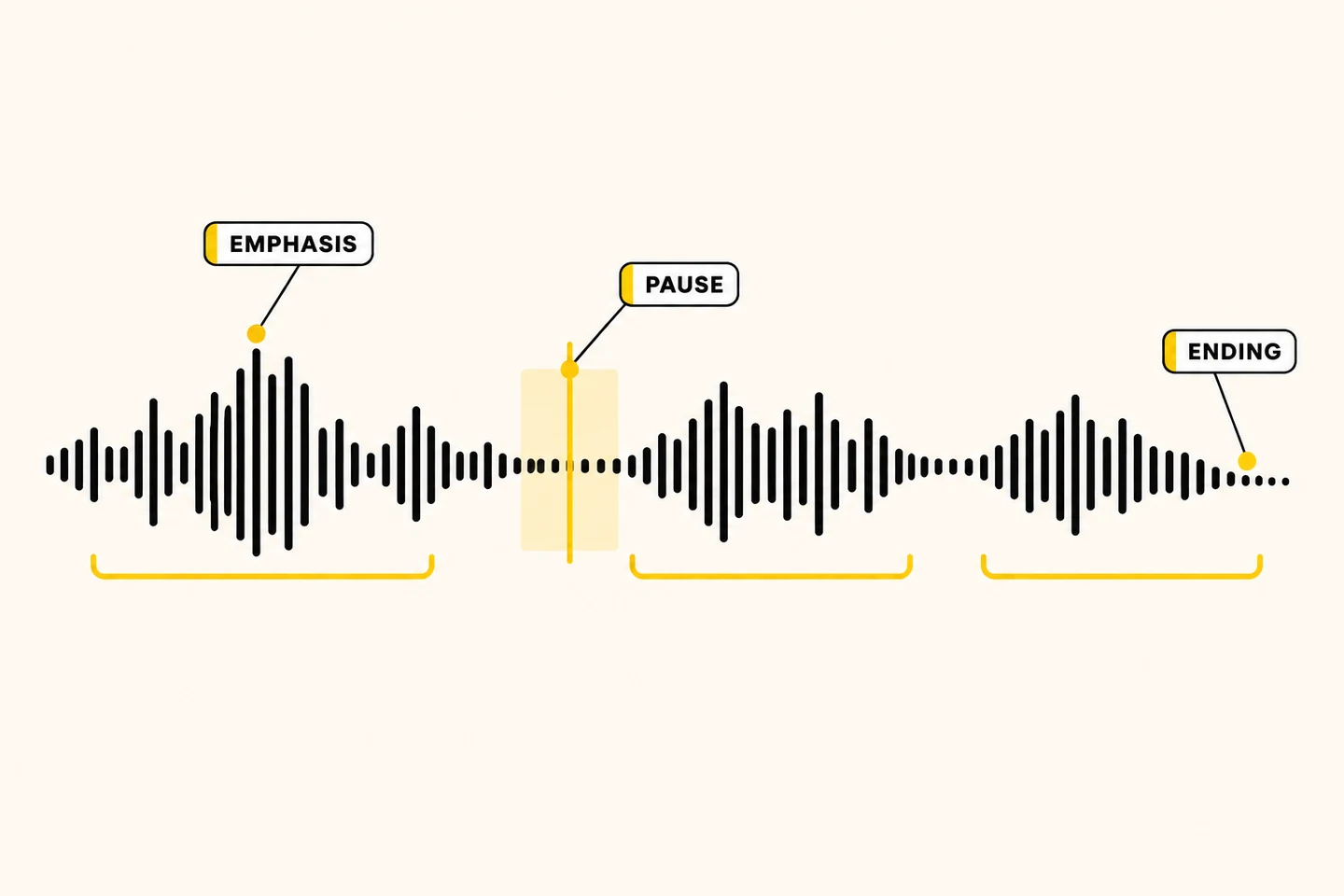
Clear articulation without accent removal: make the critical word survive
Train listener recovery of names, numbers and key words without turning accent similarity or exaggerated mouth movement into the goal.
Techniques
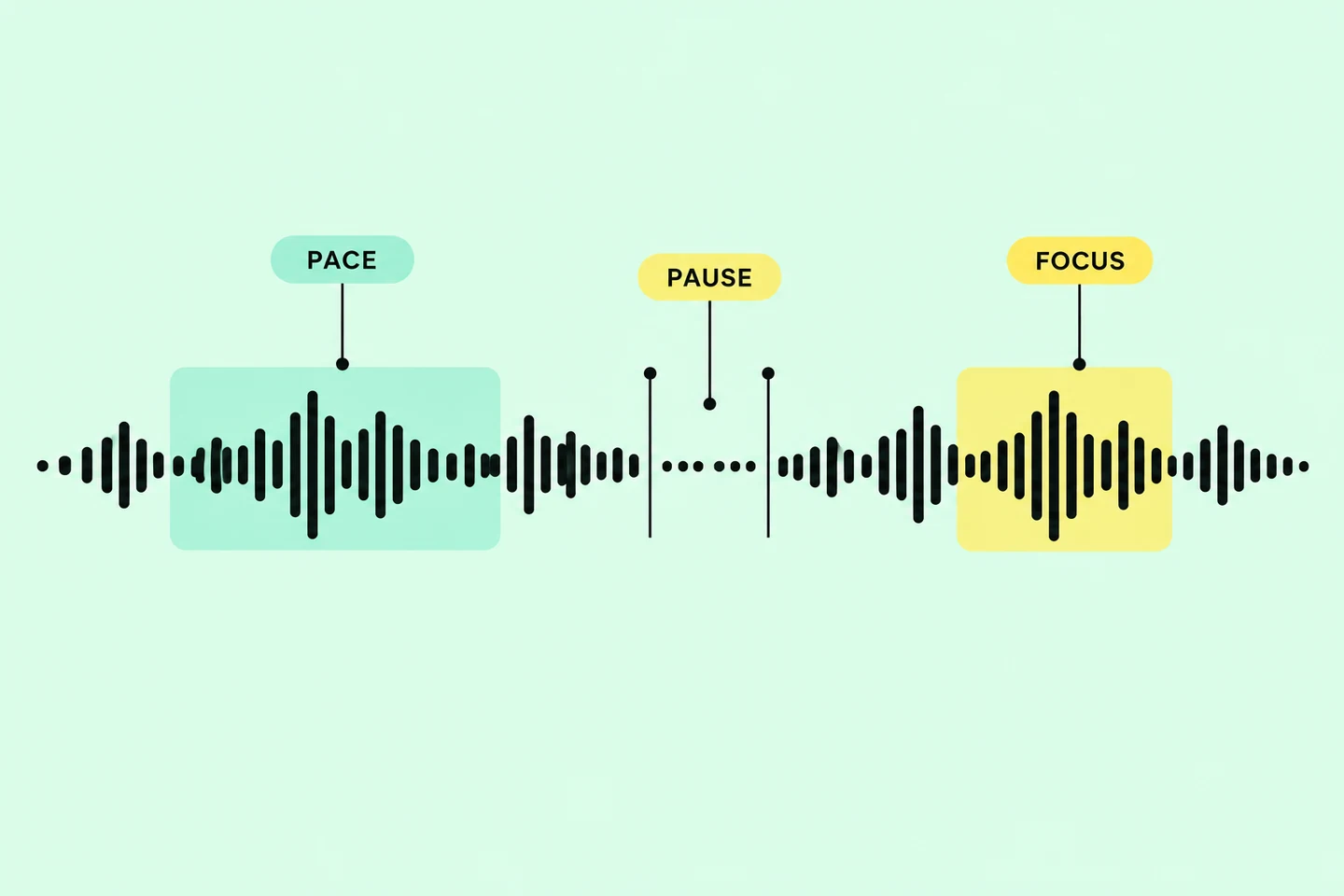
How to adjust your speaking pace without an ideal WPM target
Try one timing change around a key fact, then compare listener understanding, effort and naturalness. A WPM count alone cannot choose the best pace.
Techniques
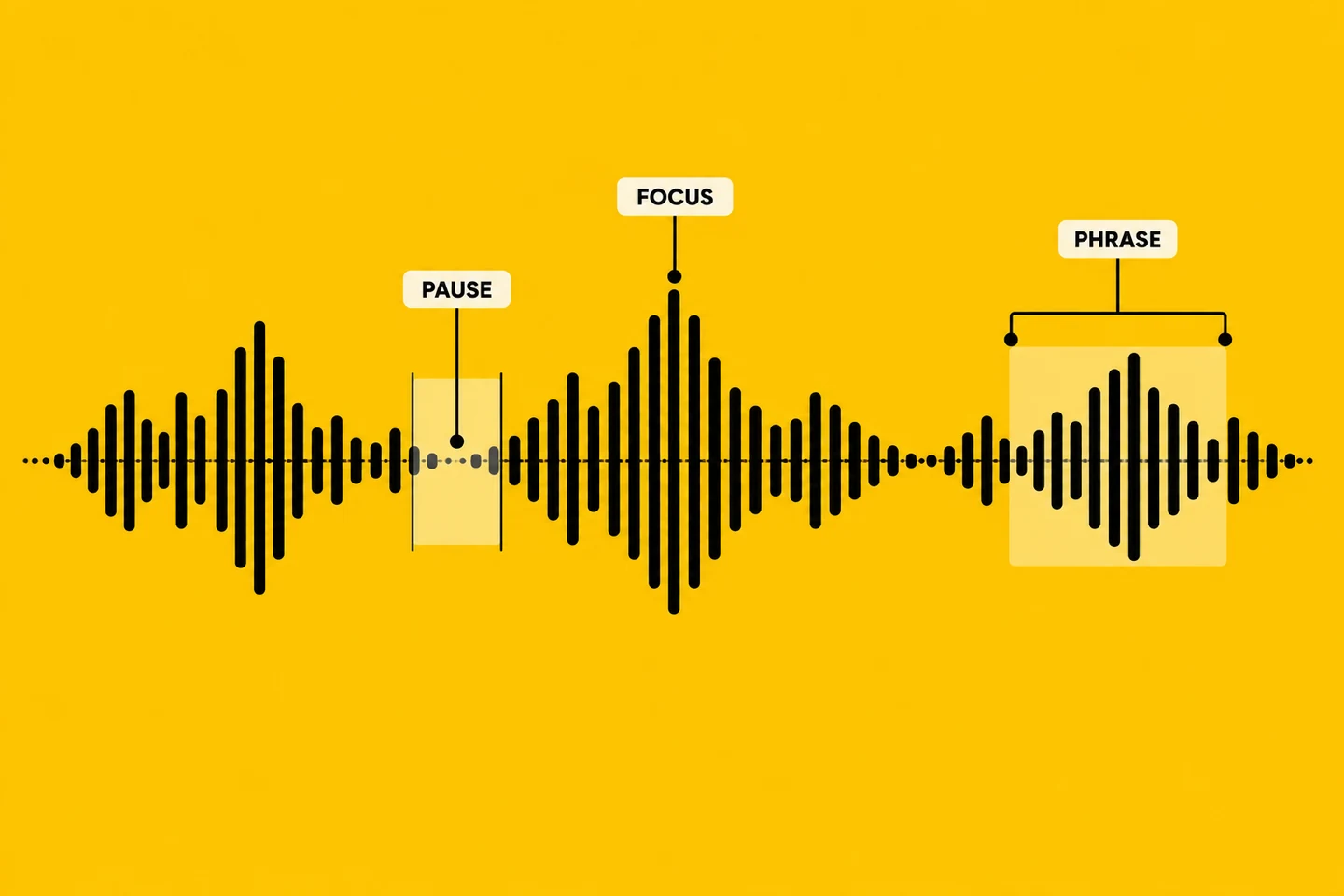
Thought groups: why a useful pause is about meaning, not milliseconds
Make boundaries between ideas audible without slowing every word or turning pause duration into a score.
Techniques
Sentence endings fade or rush: what to check first
Check whether the final useful words are clear, try one comfortable change, and keep listener recovery separate from your own playback impression.
Techniques
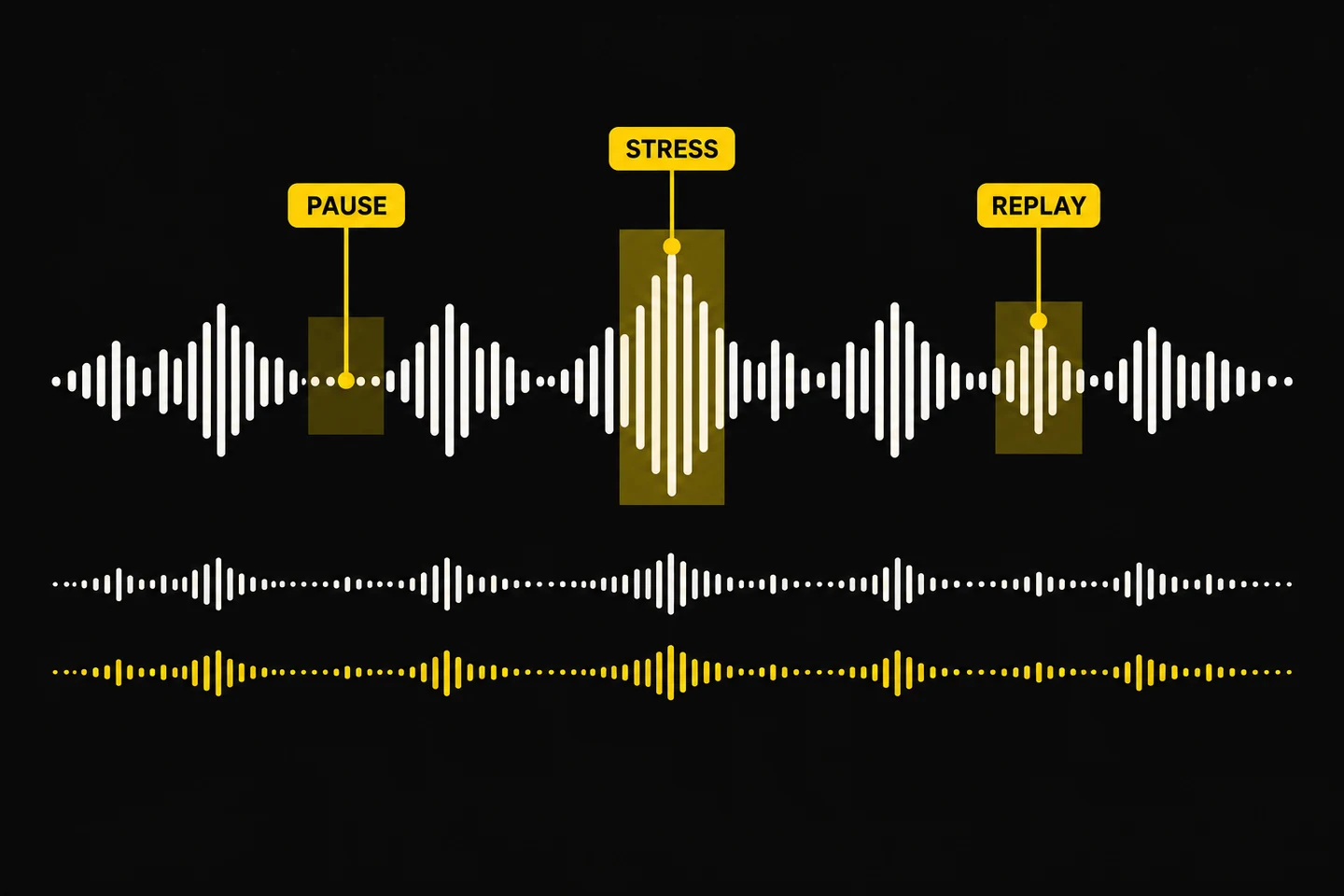
Prominence: how to make the important word land without sounding theatrical
Use contrastive prominence to make new or corrected information stand out—without stressing every ‘important’ word.