

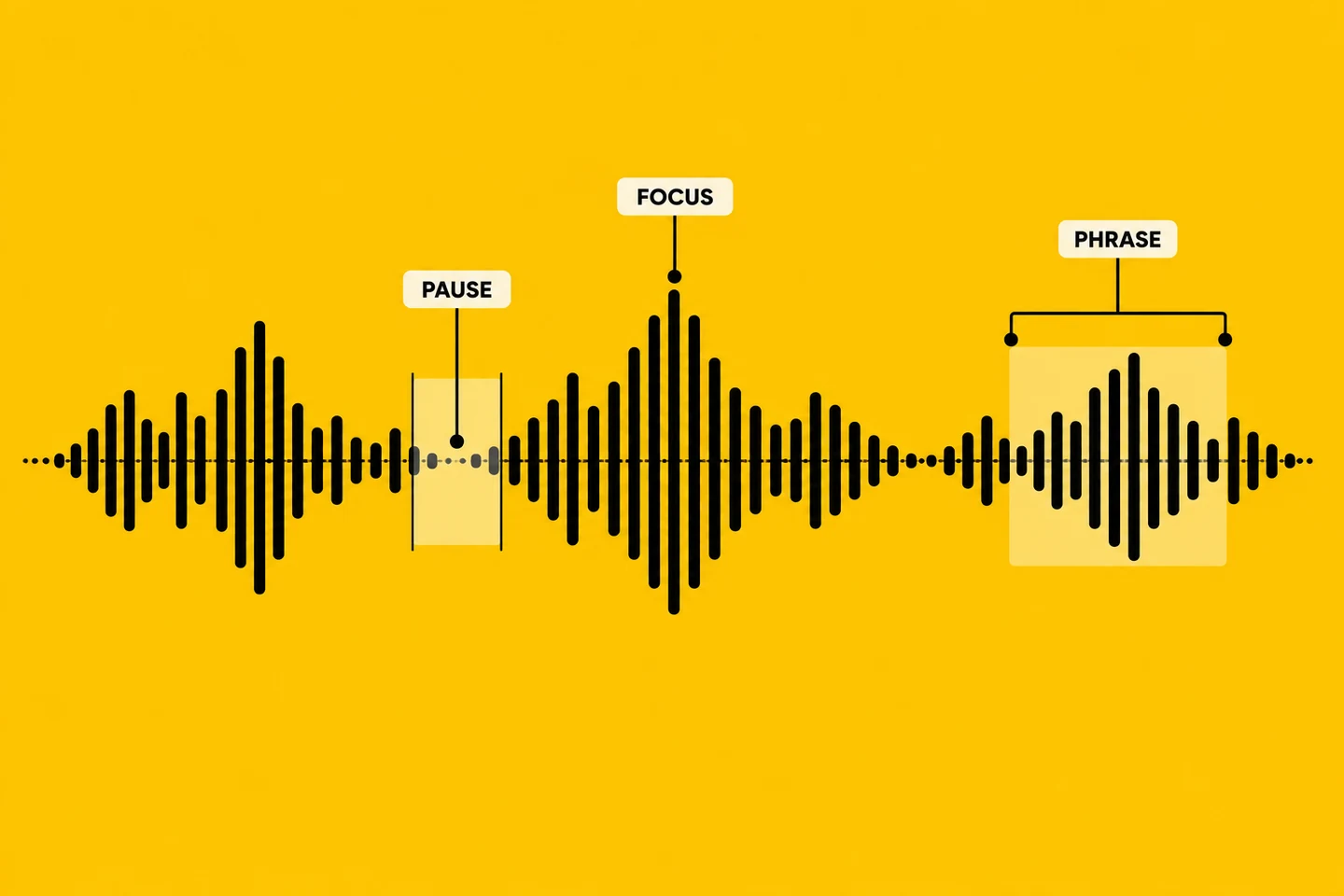
Make the boundary between ideas audible so the listener can follow your message. This is thought grouping. A pause is one possible cue; the aim is to mark where one idea ends and the next begins, not to hit a target duration.
Thought groups: why a useful pause is about meaning, not milliseconds
Make boundaries between ideas audible without slowing every word or turning pause duration into a score.
Before you practise: what to check
The end of a thought is also different from the end of your conversational turn. If you have another idea to add, check whether the listener expects you to continue, as well as whether they can follow the structure.
Before adding silence, decide what it should help the listener hear.
Put a long silence after every sentence and you have not necessarily become clearer. You may simply have become slower in installments.
Start with the listener’s problem
Take this short update:
We keep the old report for reconciliation. New decisions use the updated report.
The important distinction is not that there should be 420 milliseconds of silence in the middle. The distinction is that the listener must hear two different purposes.
If those purposes run together, a boundary is worth testing.
If “reconciliation” is the confusing part, a pause will not rescue the sentence. A carefully timed mystery is still a mystery.
This is the first rule of thought groups:
Fix meaning before optimizing timing.
A boundary is not just silence
Listeners can use several acoustic cues to hear phrase structure. In one controlled study of acoustically manipulated Chinese sentences, listeners used pause, final lengthening and pitch information when detecting and rating intonational phrase boundaries. How listeners weight acoustic cues to intonational phrase boundaries.
That study does not give us a workplace pause prescription. It is a perception experiment in a specific language and task. What it does give us is a useful correction to the simplistic model:
boundary = silence
A better model is:
boundary = a bundle of cues that makes the transition recoverable
The exact bundle can vary. That is why a single “ideal pause length” is a weak coaching target.
In the report example above, one speaker might close “for reconciliation,” leave a modest gap, then start “New decisions” at a fresh pitch. Another might make the same turn clear mostly through timing. These are possible ways to say it, not two voice types that a recording can diagnose.
The three versions worth hearing
Use this sentence:
The API is stable, but the monitoring is not.
Record three versions.
Version 1: the stream. Say it with almost no separation between the two ideas.
Version 2: the boundary. Let “The API is stable” land. Then continue with the contrast.
Version 3: the theatre pause. Insert a deliberately long dramatic silence before “but”.
Now listen without looking at the script.
Compare Version 2 and Version 3: which makes the contrast easier to hear without sounding staged? A longer pause may draw attention to itself rather than help you follow the sentence.
That is the anti-gaming lesson: a larger pause is not a better boundary.
Why thought groups help dense speech
Spoken language disappears. The listener cannot scan back up the page when a relationship is unclear.
A thought group gives the listener a small unit to hold: one state, one contrast, one reason, one consequence, one action.
Compare the jobs in these examples:
We can ship today / but the documentation will follow tomorrow.
The defect is fixed / so the next step is regression testing.
I recommend option B / because it keeps the migration reversible.
The slash is not a command to stop breathing for a prescribed duration. It marks a relationship that should survive in the audio.
Sometimes the boundary will include a pause. Sometimes the speaker will lengthen the end of the first phrase slightly, reset pitch, change rhythm, or use a combination. The listener only cares about the result: can I hear the structure?
Try a blind-ish self-test
A script can make a weak recording seem clearer because your eyes supply the structure.
So remove the script from the test.
- Record Take A in your ordinary style.
- Listen once without reading.
- Write down where you hear the first complete idea end.
- Record Take B with one deliberate boundary at the intended transition.
- Wait a few minutes and listen in shuffled order if possible.
- Choose which version makes the relationship easier to recover.
Then use a new sentence.
The design is approved, but the rollout plan is still open.
Notice whether you are copying a pause duration or marking the relationship in the new sentence. One successful attempt is not proof of learning, and one difficult attempt does not explain what went wrong. Try another sentence later; if possible, ask someone who has not seen the script what relationship they heard.
For a smaller experiment, say the same short update three times in your natural voice. Listen without the script. Note which combination of timing, ending and new start makes the change of idea easiest to hear. Strengthen just one part slightly, then try the idea with new wording. Keep the version that sounds clear and like you. You do not need a pitch graph to do this.
A complete thought need not finish your turn
A thought boundary separates ideas. A turn end is the point where you finish speaking and another person can respond. These can coincide, but you may need several thought groups to answer one question.
Consider an authored example:
The walk is still on. We’re meeting at the library instead of the station.
The first sentence is complete. The plan is not fully explained until the second. You need room between the ideas without making the second one sound like an afterthought added after you had finished.
That is a different job from making every sentence sound emphatically final. It is also different from preventing another person from interrupting.
Check what one listener expects
Take A. Tell a partner a short plan with one thing that stays the same and one thing that changes. Give them the situation, but no script or explanation of the cue you intend to use. Answer naturally in your own words. You can use a recorder you already have; this website does not record.
Listen. After one hearing, ask: “At the end of the first idea, did you expect more, or did it sound as though I was finished? What gave you that impression?” Also ask what changed in the plan. Expected continuation and recovered meaning are separate observations.
Change one thing. Use their answer to choose one local change. If the gap drew attention, shorten only that gap. If an unusually drawn-out ending sounded final, try a less drawn-out ending instead. Keep the words, overall pace and ordinary voice. Do not change both at once. If Take A already works, keep it.
Take B. Give the same answer with only that change. Keep both ideas audible; joining everything into one fast stream defeats the purpose.
Compare. Did the first idea still make sense on its own? Did the continuation feel expected? Did the change make the answer harder to follow or less natural? A smaller gap is worth keeping only if it helps this message.
Transfer. Explain a different plan with the same two-part job, such as what stays and changes in tomorrow’s dinner arrangements. Start without a marked script. Check the new message rather than copying the timing of the old one.
The partner is describing what they remember after listening, not showing how they would respond in a live conversation. After hearing both versions, they also know the rest of your answer. That is useful rehearsal but cannot show that your change caused a different expectation. If another listener is available, let them hear one version without a script or an announced continuation.
This exercise cannot settle why someone interrupts. A request for clarification, deliberate interruption or a call delay needs its own response. A voice adjustment may not help. Do not turn this into “always raise your pitch” or “never pause after a sentence.”
Research suggests
Prosodic boundaries are perceptual events supported by multiple cues, not pure silence. That fits a broader view of prosody as part of how speech carries structure and information, rather than decorative “voice variation.”
A 2026 production study asked 30 adult native German speakers to say name sequences that could be grouped in different ways. Speakers differed in how they combined pauses, pitch range and lengthening before a boundary. Within a speaker, cue use stayed relatively consistent across speaking styles, even after occasional requests to repeat. Pause was the most common cue; lengthening appeared with other cues rather than alone.
That is a result from a narrow German lab task with a confederate listener following a planned feedback pattern. It did not test a work explanation, an English or Russian learner, whether a listener understood the revised message better, or whether coaching someone to use their usual cue improves anything. It also does not establish a permanent personal “prosody type.”
The evidence is much weaker for claims such as:
- every important sentence needs a pause;
- longer pauses are clearer;
- one duration works across speakers and languages;
- an acoustic pause detector can decide whether an explanation is clear.
Those are different questions and need different evidence.
Two turn-taking studies sharpen the distinction. In a 2015 Dutch question study, reusing a short question’s recorded ending inside a longer question changed listeners’ button-press timing. A possible sentence ending was not enough to explain their responses. The manipulated task did not test coaching or interruption prevention.
A 2021 Dutch telephone-turn study found that early button presses near plausible turn endings occurred mainly at intonational phrase boundaries. This prosody result was correlational. Context did not help consistently, and the study cannot identify one acoustic cue to teach. These are turn-end estimation tasks, not evidence that Ptichi improves conversation.
Our read
Many speaking tools can measure silence because silence is convenient to measure. A coach can also say “pause more” in one breath, while a listener’s understanding takes more work to check. Once a number exists, it is tempting to make the number the lesson.
Ptichi should resist that.
The sequence should be:
listener relationship → boundary behavior → optional acoustic evidence
not:
pause duration → quality score → invented story about clarity
This matters because a speaker can “improve” a pause metric while making the message worse. A stop in the wrong place can obscure the relationship between ideas.
There is a fair counterargument: perhaps the speakers kept their cue patterns because the name-sequence task was familiar or the listener’s requests were not strong enough to change how they spoke. The study cannot settle how people adapt in a real meeting. That is why Ptichi should test, not announce, the idea of strengthening a speaker’s already-natural boundary cue. The related product research task compares cue combinations on new wording and asks whether listeners recover the intended relationship while the delivery stays natural. A target waveform is not the outcome. No personalized boundary-coaching feature is released or proven to work.
For conversation, our proposed practice adds a second question: does the listener expect the answer to continue? We would keep this beside the meaning check, not turn it into a floor-control score. The strongest counterargument is that the wording or situation may explain the listener’s expectation better than delivery. The repeated-listener exercise cannot decide that. A comparable-message test with fresh listeners, changed wording and no loss of meaning or naturalness could support or overturn the proposal. Until then it remains an editorial experiment; no automatic turn-holding coach is released.
Breathing and boundaries interact, but they are not the same skill
A well-placed breath often happens near a useful linguistic boundary. That does not mean every thought group requires an inhale, or that every inhale creates a good thought group.
If you repeatedly run out of air before the boundary, work on breath for speech.
If the boundary is fine but the whole message feels globally rushed, work on local pace control.
Breathing and thought grouping need separate checks.
Where this advice breaks
A boundary cannot repair:
- unfamiliar terminology;
- missing context;
- an answer that has no main point;
- a sentence with five competing ideas;
- incorrect information.
If Take B still feels confusing, do not keep extending the silence. Rewrite the thought structure.
And if a speaker’s pause pattern changes suddenly alongside speech, breathing or neurological symptoms, that is outside ordinary communication coaching.
Transfer test: explain, do not recite
Use a new 20-second prompt:
Explain one project risk and what you want the listener to do about it.
Do not mark slashes first. Record once cold.
Then ask:
- Can I hear the risk as one unit?
- Can I hear the requested action as another?
- Is the transition clear without sounding staged?
That is closer to the real job than hitting a pause target.
Continue with prominence when the structure is clear but the important word still does not stand out, or read the overview of all ten voice controls. In Ptichi, automatic boundary timing remains experimental/research-gated; the self-listening exercise works without it.
Sources and boundaries
What you can verify on this page
This page includes a Ptichi-authored example built for explanation or rehearsal.
What it does not support: It is an editorial example, not an observed-user result, experiment or proof that Ptichi improves speech.
This page includes a bounded listen-and-compare exercise that you can run with your own recorder.
What it does not support: The exercise does not prove that Ptichi improves speech or that a second take will generalize to other listeners or situations.
Sources and boundaries
Where shown, check notes record what Ptichi's editorial agent read for this article. They are separate from the source's registered review date and do not establish expert approval or show that an exercise works.
How listeners weight acoustic cues to intonational phrase boundaries primary-research · 2026-09-12
What it supports: Listeners used pause, final lengthening and pitch cues to detect and rate boundaries in acoustically manipulated Chinese sentences.
What it does not support: A perception experiment, not a training trial. No universal optimal pause duration, workplace intervention validation or automatic cross-language generalization.
Stability of prosodic boundary cue production in interactive settings primary-research · 2026-09-27
What it supports: In a laboratory task, 30 adult native German speakers differed in how they combined pause duration, f0 range and final lengthening to mark boundaries in coordinate name sequences; each speaker's cue use was relatively consistent across speaking styles despite occasional requests to repeat.
What it does not support: The task used German name sequences and pre-programmed misunderstanding from a confederate listener. It did not test workplace explanations, English or Russian transfer, training benefit, listener outcomes from a personalized cue, or a fixed personal prosody trait.
Listeners use intonational phrase boundaries to project turn ends in spoken interaction primary-research · 2026-10-03
Editorial check for this article: Full text ·
What it supports: Dutch question tasks show that altered intonational phrasing affects turn-end estimation. Institutional full text reviewed.
What it does not support: Controlled question material, not English coaching or interruption prevention; no universal acoustic cue or Ptichi efficacy follows.
Turn-end Estimation in Conversational Turn-taking: The Roles of Context and Prosody primary-research · 2026-10-03
Editorial check for this article: Full text ·
What it supports: Phrase boundaries were associated with early turn-end button presses in selected Dutch telephone turns. Institutional full text reviewed.
What it does not support: Correlational prosody result; context benefits varied by task and turn length. No individual cue isolation, coaching or Ptichi efficacy test.
Related

Goals
Explain a change without narrating the whole meeting
Rehearse what changes, why it changes and what happens next, with an honest boundary between a decision and a proposal.

Practice
Two thoughts. One useful pause.
A short listening exercise: record a contrast, make the boundary audible, then try it with new words.
Product
What Ptichi is
Free exercises for speech, voice and reading aloud. Find what gets in the way, try one useful change and listen for the difference. Desktop app in development.