

Before comparing two speaking takes, keep the microphone position consistent. If you lean in for one take and sit back for the other, the sound difference cannot confidently be attributed to the exercise. Check the setup first, then the speech.
Compare the speech, not the microphone distance
A practical placement check before A/B voice practice, plus a bounded way to use the microphone as feedback without turning it into a judge.
Before you practise: what to check
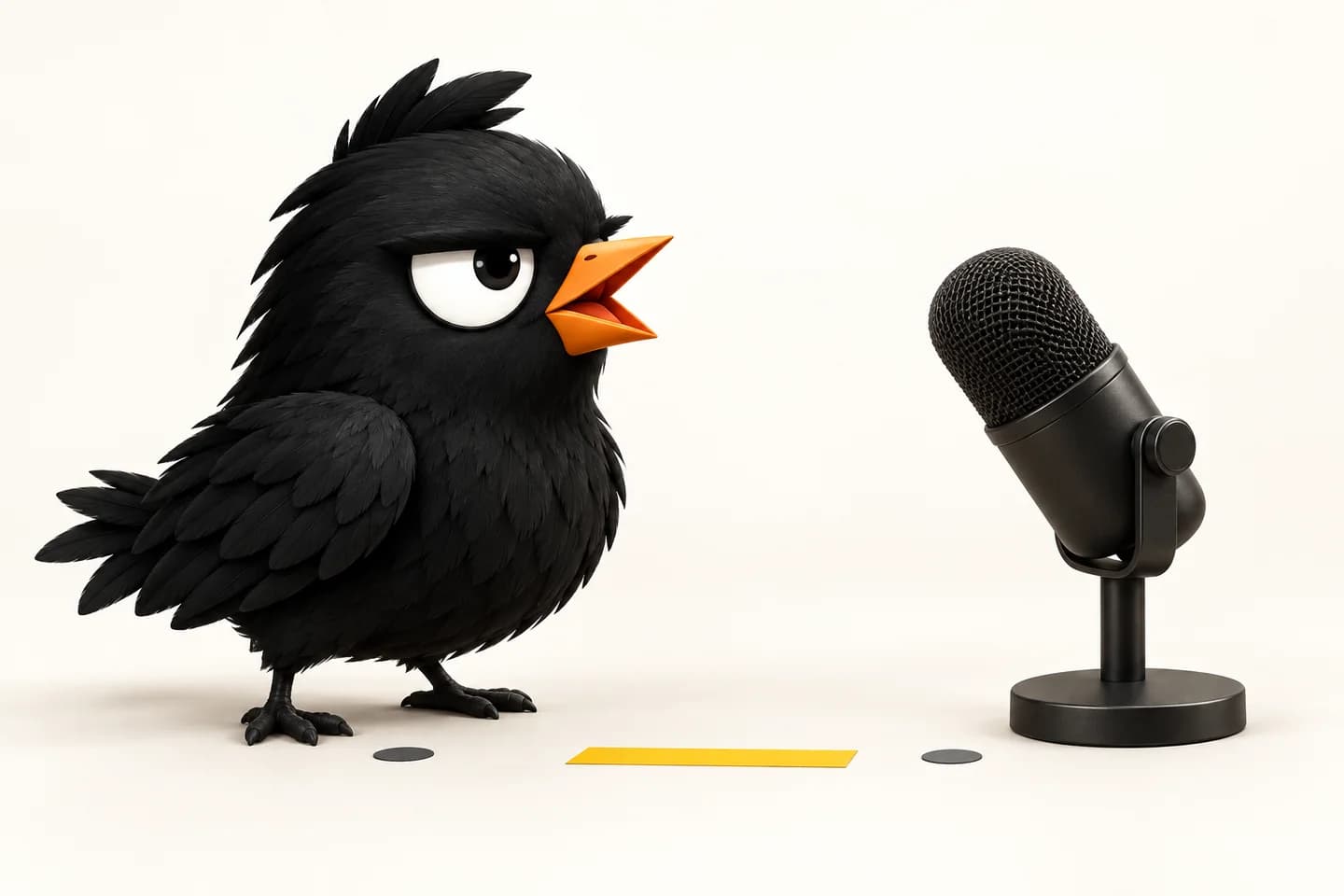
The microphone can also change the psychology of practice. Not because the hardware makes you confident, and not because a recording knows whether you are a good speaker. It helps when it turns a vague internal impression into a small piece of evidence you can replay, compare and stop thinking about.
That distinction matters. A microphone can be a mirror. It should not become a judge.
The microphone is part of the result
Shure notes that small changes in distance and placement can noticeably affect a recording. With a cardioid microphone, moving closer can also increase low-frequency content through the proximity effect. Shure’s vocal recording guide.
Do not assume every laptop or headset behaves that way. Directionality, processing and automatic level control vary. There is no universal ideal distance on this page.
When Take B seems more substantial
Imagine rehearsing:
The budget stays the same. Only the approval process changes.
For A, you sit back. Before B, you lean towards the laptop. The second recording sounds fuller. That is worth noticing, but it does not establish that you communicated the contrast better. Too many things may have changed together.
This is an invented example, not a Ptichi measurement. A fuller sound is not evidence of clearer meaning.
A short placement check
- Use one microphone and one recording application. You need not disable processing; keep the setting consistent.
- Record a brief sentence from a comfortable position. Note where your chair and device are so you can reproduce the arrangement without holding a rigid posture.
- Record the same sentence slightly closer or farther away. Do not deliberately improve the delivery. This is a setup trial.
- Listen for missing words, unwanted boom or air bursts on consonants. Is the position comfortable to maintain?
- Choose a repeatable arrangement. Record fresh A and B takes there, changing only the speaking intention.
Do not judge level differences when an application automatically matches playback loudness. Equal perceived loudness does not make the recording conditions identical.
| Note before recording | Purpose |
|---|---|
| Microphone and application | Keep the recording path consistent |
| Device and body position | Repeat the arrangement comfortably |
| Processing, if known | Preserve settings; label unknowns honestly |
| Noise or interruption | Avoid treating interference as a speech change |
If a take is interrupted, label it and repeat it. Do not quietly use a failed recording as the baseline for an attractive comparison.
Why a microphone can make voice practice psychologically easier
This is the useful version of the claim, not the magical one.
A microphone can help because it lets you move from identity language to task language.
Without a recording, the thought may be:
I sound weak.
With a recording and a declared target, the question can become:
Does the final word disappear?
Or:
Can I hear the contrast between the two options?
Or:
Is the condition still clear after one listening pass?
The second set of questions is psychologically easier to work with because each one has an end. You can listen, answer it and stop. “Do I have a good voice?” has no natural stopping point.
That is our read, not a clinical claim. The microphone is useful here as an external reference. It turns memory into an object you can inspect, which makes it easier to separate “I disliked hearing myself” from “the listener-relevant target actually failed.”
The microphone gives practice a boundary
Private voice practice easily becomes vague. You say a sentence several times, remember the version you meant to produce, and gradually lose track of what changed.
A recording creates a boundary:
before recording → one attempt → playback → one decision.
That boundary matters more than the sophistication of the microphone. The file lets you return to the same attempt instead of reconstructing it from memory.
This is one reason Ptichi prefers a short A/B loop over continuous self-monitoring. If you watch a graph while speaking, listen while speaking and judge yourself while speaking, the practice task can become “manage the dashboard.” Record first. Review second.
A microphone is good at remembering. Let it do that job.
A stable setup can reduce attribution anxiety
There is another practical benefit to keeping the setup boring.
Suppose every take sounds different. One is louder, one is warmer, one has more room, and one sounds strangely compressed. It becomes difficult to know whether you changed or the capture changed.
That ambiguity can feed unhelpful interpretation:
I was better yesterday.
My voice suddenly sounds worse.
The exercise stopped working.
A repeatable setup does not remove normal variation in human speech. It removes some avoidable uncertainty about the recording chain.
Our product interpretation is simple: the more stable the capture conditions are, the less psychological work you need to spend explaining technical noise to yourself.
This is not a claim that microphone placement treats anxiety. It is a claim about experiment design: fewer uncontrolled variables make the result easier to interpret.
The red light can be useful — and misleading
For some people, pressing Record changes the attempt immediately. The sentence becomes more formal. Breathing changes. The first words feel less automatic. You may start monitoring yourself.
Do not automatically remove that effect. First decide what you are practising.
If you want a neutral baseline, record several ordinary attempts until the act of recording is no longer the most interesting event in the room.
If you want to rehearse performance pressure, the slight formality of a recording can become part of the task. Later you can add a timer, a standing posture, a camera or a real listener one variable at a time.
Do not confuse those two uses. A microphone can be either measurement equipment or part of the challenge. It should not silently be both.
What research on recorded feedback suggests — carefully
Research on socially anxious speakers gives one useful warning: recorded self-observation can change self-perception, but the result depends on how the feedback is structured.
In a study of socially anxious participants, video feedback combined with cognitive preparation and a post-feedback review improved self-perception more than exposure alone, while video feedback without the added review did not show the same pattern. Read the study.
A later study of 140 socially anxious students found that the most structured condition — video feedback plus preparation, audience feedback and cognitive review — produced larger improvements in state anxiety and self-perception than the comparison conditions. Chen et al., 2018.
Another study found that repeated public-speaking exposure reduced the gap between anxious participants' self-ratings and observer ratings while observer-rated performance also improved. Cheng et al., 2017.
These are not microphone-training studies. They concern public-speaking anxiety, video feedback and exposure procedures. They do not prove that buying a microphone, listening to yourself repeatedly or using Ptichi will reduce anxiety.
The transferable lesson is narrower: replay is more useful when it is attached to a clear review task. “Watch yourself until you feel better” is not a protocol.
A microphone can help you practise without an audience
A real listener is valuable, but a real listener changes the task. You may edit the message for them, react to their face, rush because they are waiting, or avoid practising because arranging a listener is inconvenient.
A microphone gives you a private intermediate step.
That makes it useful for:
- trying an unfamiliar phrasing before using it with someone;
- hearing whether a thought boundary exists outside your head;
- comparing a normal attempt with one bounded change;
- rehearsing a formal opening without asking another person to sit through five versions;
- practising in a second language when live conversation is not available at that moment.
Research in language learning supports the broader value of recorded self-review, though not a special psychological effect of microphones. Studies of learners reviewing their own recorded speaking found that guided self-feedback can help learners identify discrepancies and formulate next actions. Huang, 2016. Digital voice-recording plus systematic feedback has also been used in large language-learning courses with improvements across repeated assessments, although the recording technology was only one part of the intervention. Swanson & Schlig, 2010.
The microphone gives access to the attempt. The useful learning work still happens in the comparison and reflection.
Do not let self-listening become rumination
More replay is not automatically more practice.
A useful session should have a stopping rule. For example:
- declare one question;
- record Take A;
- listen once;
- change one thing;
- record Take B;
- answer the same question;
- make one changed-wording attempt;
- stop.
If you catch yourself replaying the same recording mainly to decide whether you like your voice as a person, the task has drifted.
You can reset it by asking one observable question or by ending the session. A microphone has a record button. It does not require a twenty-seventh replay.
If recording causes significant distress or reinforces severe anxiety or avoidance, generic self-practice is not a substitute for appropriate professional support.
Use the microphone as a mirror, not a score machine
The microphone can answer:
- what was captured;
- whether two attempts differ;
- whether a word disappeared;
- whether a pause exists;
- whether the ending faded;
- whether a setup change altered the signal.
It cannot directly answer:
- whether you are confident;
- whether you are competent;
- whether people will like you;
- whether your personality is persuasive;
- whether one better take means you have learned the skill.
Those are different questions, many of them not acoustic questions at all.
This is why Ptichi's microphone-native direction matters. The microphone should make evidence more concrete, not make judgment more global.
Microphone Passport is not a microphone score
Ptichi's desktop design includes a concept called Microphone Passport. The name can sound like a certification badge. That is not the intention.
The job is much narrower: keep track of enough capture truth to know what the current take can support.
A future session may need to know things such as:
- which input was selected;
- whether a short microphone check produced a usable signal;
- whether the device or relevant processing state changed between takes;
- whether capture was interrupted;
- which automatic measurements, if any, have enough support to be shown for this recording.
That is capability-specific trust.
It should not collapse into:
Your microphone: 86/100.
A microphone does not have one useful global score for Ptichi's purposes. A device can be perfectly adequate for replay and manual comparison while a particular automatic metric remains unsupported. Another setup may sound polished but change processing between attempts, which makes attribution harder.
The important product question is therefore not “How premium is your microphone?” It is:
Can we trust this capture enough for the next decision?
Sometimes the answer should be “yes for replay, no for this measurement.” That is not a broken experience. It is a more honest one.
Why an unavailable metric can be a feature
Software dislikes empty states. Product teams are tempted to replace “we cannot establish this” with an estimate, a warning-coloured number or a model guess.
For speech practice, that can be worse than showing nothing.
If timing evidence is trustworthy but energy evidence is not, Ptichi should not upgrade both because the overall recording “looks good.” If the microphone changed, an A/B comparison can remain replayable while some causal interpretation becomes weaker.
“Unavailable” is a boring UI state. It is also better than inventing evidence.
This is one of the reasons Ptichi separates microphone readiness from speaking feedback and keeps trust capability-specific rather than awarding one green badge to the entire session.
A five-minute microphone ritual
Use this when you want the psychological benefit of a repeatable routine without turning the session into studio engineering.
Minute 1 — setup. Put the microphone in your normal repeatable position. Check that the expected input is selected.
Minute 2 — baseline. Say one short, real, non-confidential message once. Do not fix it while recording.
Minute 3 — review. Listen once. Answer one question only.
Minute 4 — one change. Make Take B with one deliberate change.
Minute 5 — release the script. Say the same idea in different words and finish.
The ritual is deliberately finite. Its job is to make starting easy and interpretation narrow.
When AI is listening, the microphone becomes part of the instruction
Speech recognition does not receive your intention. It receives an audio signal.
That makes microphone consistency useful for spoken AI work as well as rehearsal. If a name disappears, a number changes or the final condition is lost, check three different causes before deciding that you need to “speak better”:
- Message: did you actually state the name, number or condition clearly enough to verify?
- Delivery: did it survive the end of the phrase, or was it compressed into the next thought?
- Capture: did noise, echo, clipping or distance damage the signal?
Google's Speech-to-Text guidance recommends a well-positioned microphone, avoiding clipping and listening to a sample for distortion or unexpected noise. It also notes that excessive background noise and echo may reduce recognition accuracy.
This still does not make expensive equipment the first answer. A better microphone can improve a damaged signal. It cannot add the missing deadline to a vague brief.
For the larger work question, read Why voice matters more for work in the age of AI. Then try a structured spoken AI brief without changing the recording setup between takes.
What this does not establish
This is not calibration or microphone certification. It does not measure a noise floor, diagnose a room or establish that an external microphone is necessary. If a built-in microphone captures understandable speech under repeatable conditions, start there. Buying equipment is not an exercise step.
The Microphone Passport description above reflects the current desktop product design. There is no public desktop release today, and it should not be read as a claim that every target-device behavior has already been physically verified.
The psychology research above does not validate Ptichi as an anxiety intervention. Recorded feedback can be helpful in specific structured contexts, but self-observation can also become unproductive if the task is global, repetitive or distressing.
Continue with Why your recorded voice sounds unfamiliar if hearing yourself is the problem. Continue with one thought-boundary contrast if you already have a stable setup and want one concrete speech target.
Ptichi treats recording readiness separately from speaking feedback. The goal is not to make you dependent on the microphone. The useful end state is that you can notice, change and reproduce the skill when the microphone is no longer there.
Sources and boundaries
What you can verify on this page
This page includes a Ptichi-authored example built for explanation or rehearsal.
What it does not support: It is an editorial example, not an observed-user result, experiment or proof that Ptichi improves speech.
This page includes a bounded listen-and-compare exercise that you can run with your own recorder.
What it does not support: The exercise does not prove that Ptichi improves speech or that a second take will generalize to other listeners or situations.
Sources and boundaries
How to Record and Mix Vocals manufacturer-technical-guidance · 2026-09-05
What it supports: Microphone distance and position affect recording sound; cardioid proximity effect can emphasize lower frequencies.
What it does not support: Manufacturer vocal-recording guidance is not evidence of speech training efficacy or a universal prescription for laptops and headsets.
Google Cloud Speech-to-Text best practices official-technical-documentation · 2026-09-28
What it supports: Google recommends a well-positioned microphone, avoiding clipping and checking sample audio for distortion; it notes that excessive background noise and echo may reduce recognition accuracy.
What it does not support: Service-specific engineering guidance, not a universal microphone-buying rule, a measure of human communication quality or evidence that Ptichi exercises improve recognition.
Related

Goals
How to give AI a useful spoken brief
Turn a spoken request into a usable AI brief: state the outcome, essential context, constraints, deliverable and check in two short takes.
Practice
Two thoughts. One useful pause.
A short listening exercise: record a contrast, make the boundary audible, then try it with new words.
Problems
Why your voice sounds different on a recording
Why your recorded voice sounds unfamiliar, how playback differs from self-hearing, and one short listening exercise to separate sound from clarity.