

A connected explanation
Make the relationship between stages, constraints and the next decision audible, not just the list of facts.
A listener needs to know why one detail leads to another and which part changes what they should do.
Speaking rule
Say what connects the steps
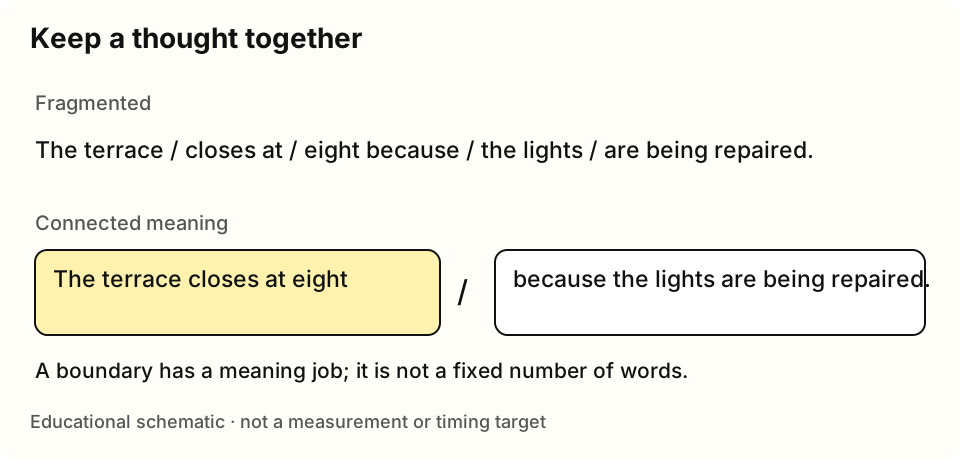
Say “We check the address. We print the label.” Then join the steps so the dependency is clear. “We print the label after the address is checked, so a missing address holds up shipping.”
Listen back. Can a listener explain what happens if an address is missing? If they can repeat the steps but cannot explain the delay, say the relationship more directly.
Try another text. Find two stages in the next text. Retell them using “after,” “because” or “only if,” whichever matches the source.
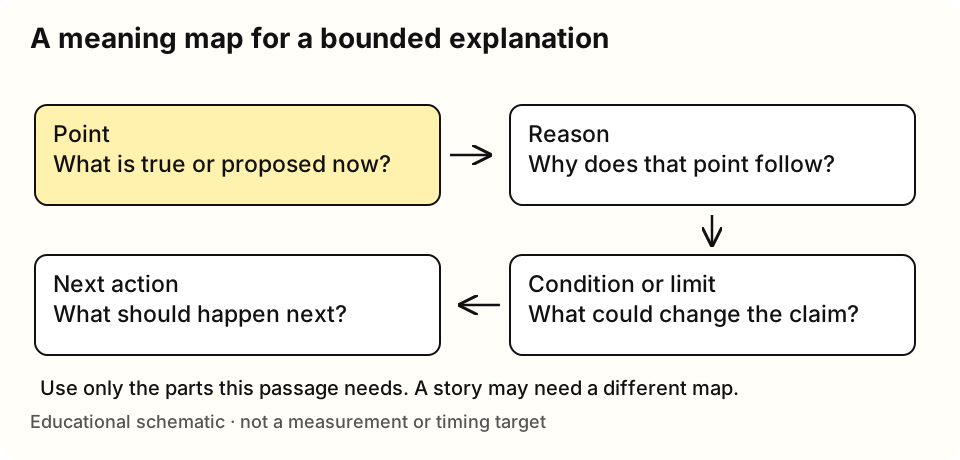
An explanation often has a mechanism: a request enters, a decision waits, a result is sent. Naming the steps is only the beginning. The useful relationship may be a bottleneck, dependency or exception.
When you retell, keep the structure before adding detail. Select the detail that helps this listener understand the mechanism or take the next action. An analogy earns its place only while it preserves the important relationship.
A worked contrast
There are three doors in the process, and the first one receives many requests.
The decision stage is the bottleneck. More incoming requests would enlarge the queue, not make the decision stage faster.
The second version explains a consequence. It does not merely replace technical words with a memorable image.
Practise one change
- Draw or name the source's stages privately.
- Read the relationship between them as one connected account.
- Retell to an imagined newcomer using the same facts.
- Check that simplification did not remove the constraint or next action.
What to listen for
- Can the listener explain why the constraint matters?
- Did the retelling preserve the difference between a tested sample and a completed job?
Do not turn a useful analogy into an explanation of facts it cannot represent.
Four texts to work through
Read for meaning first. Record with your usual recorder if you want audio. Use the rehearsal to try one change in a short excerpt. Close the full-text disclosure for recall. Use the anchors if you need a cue, and open the answers after your attempt.
05 · Make a complex process easy to follow
Read the full text · close it for recall
Meaning to preserve: Preserve the three stages and the bottleneck; avoid an analogy that changes the facts.
Imagine the service as three doors. A request enters through the first door, where we check that the details are complete. Behind the second door, a specialist makes the decision. Behind the third, the result is sent to the person who asked. If the second door is slow, pushing more requests through the first does not make the whole service faster. It creates a queue. Our first improvement should be to understand why decisions wait, not to celebrate how many forms we receive.
Rehearse one line
Behind the second door, a specialist makes the decision.
Try. In the full passage, let this stage stand apart from intake and delivery. Give “makes the decision” time to register before you move to the result.
Listen back. Which stage decides the request, and which stage only sends the outcome?
Recall anchors · less support
- request
- decision
- result
- decision queue
Check meaning after your retelling
Equivalent wording is welcome. These are checks against the fictional source, not automatic scores or proof that a listener understood.
What are the three stages in the door analogy?
Checking request details, making the specialist decision and sending the result.
Why would increasing intake not fix a slow second stage?
It would create a queue while the decision bottleneck remained.
06 · Choose detail for the listener
Read the full text · close it for recall
Meaning to preserve: Keep the shared conclusion and choose one audience-relevant reason.
For the finance team, the important news is that the project remains within its approved budget. The team used fewer external services than expected, and that offset a higher testing cost. For the engineers, a different detail matters: the extra testing found a failure that would have delayed the next release. Both stories are true. Neither audience needs every invoice or every test log in the opening minute. Start with the shared conclusion, then select the detail that helps this listener act.
Rehearse one line
The team used fewer external services than expected, and that offset a higher testing cost.
Try. Put a small emphasis on “offset.” Then retell the relationship in one sentence using your own words.
Listen back. Can the listener explain how testing cost more while the project stayed within budget?
Recall anchors · less support
- within budget
- fewer external services
- more testing
- failure found
Check meaning after your retelling
Equivalent wording is welcome. These are checks against the fictional source, not automatic scores or proof that a listener understood.
How did the project remain within budget?
Lower external-service use offset higher testing costs.
Which testing detail matters to engineers?
The extra testing found a failure that would have delayed the next release.
07 · Finish with an actionable next step
Read the full text · close it for recall
Meaning to preserve: Keep the tested scope distinct from completion; end with a specific owner decision.
We have found the cause of the repeated booking errors: the same address was entered in two different formats, and the matching rule treated them as separate records. The correction has been tested on a small sample, but the full list has not been reviewed. I propose a controlled clean-up tomorrow morning. Please confirm who can approve the final list by four today. Once we have that owner, we can agree the full schedule. Without that decision, we should not announce that the issue is closed.
Rehearse one line
The correction has been tested on a small sample, but the full list has not been reviewed.
Try. Say the sample result first. Let “but” introduce the larger list as a separate unresolved check.
Listen back. What has been tested, and what work remains?
Recall anchors · less support
- two address formats
- small sample tested
- full list open
- approval owner
Check meaning after your retelling
Equivalent wording is welcome. These are checks against the fictional source, not automatic scores or proof that a listener understood.
What caused the booking errors in this fictional account?
Two address formats were treated as separate records by the matching rule.
What still prevents calling the issue closed?
Only a small sample has been tested; the full list remains unreviewed and an owner must approve the final list and schedule.
08 · Clarity challenge: a new decision
Read the full text · close it for recall
Meaning to preserve: Keep recommendation, decisive reason, constraint and next evaluation step distinct.
The neighbourhood library wants to add an evening session. There is demand for it, but there are only two trained volunteers after six. A full evening opening would need three people. We have another option: run one quiet study session on Tuesdays, with advance registration and a smaller room. That would serve some visitors without pretending we can operate the entire building. My recommendation is to trial the smaller session for four weeks, record attendance and workload, then decide whether to expand.
Rehearse one line
A full evening opening would need three people.
Try. Read this as the reason a full opening cannot proceed. When you continue, give the smaller alternative a clear fresh start.
Listen back. Why is the full opening short of staff, and how does the next option respond to that limit?
Recall anchors · less support
- two volunteers
- three for full opening
- Tuesday smaller session
- four-week review
Check meaning after your retelling
Equivalent wording is welcome. These are checks against the fictional source, not automatic scores or proof that a listener understood.
Why is a full evening opening not yet supported?
Only two trained volunteers are available after six, while a full opening needs three.
What smaller trial is proposed?
One registered quiet-study session in a smaller room on Tuesdays for four weeks, followed by a review of attendance and workload.
Check what carries over
- Repeat without the cue. Return to 05 · Make a complex process easy to follow. Read once in your usual voice with the rehearsal closed.
- Change the text. Try 08 · Clarity challenge: a new decision before opening its cue. Ask why the full evening opening is difficult and how the smaller proposal responds to that limit.
- Come back later. Retell the second passage before rereading it on another day. Then check which details survived.
If you already know the second passage, treat it as a familiar repeat. Check what the listener understood and how much effort it took as two separate things.
Practising alone? Close the passage, listen to your take once, and answer the listener question from playback before opening the reference. Without a recording, retell the passage from memory and use the reference to check which ideas you kept.
Compare after listening or retelling
There are two trained volunteers after six and a full evening opening needs three. The proposal is a registered Tuesday quiet-study session in a smaller room.
If the distinction disappears. Say the constraint before the alternative. Connect them in one plain sentence with “so” or “because” if the relationship was lost.
Your recording and Voice Trail
In the desktop development build, open Library → Ptichi Academy → A connected explanation. Every take belongs to its text and source version. Reopen its recording and supported Voice Trail for review. Missing observations remain unavailable; this website does not record or calculate personal voice metrics.
Exercise identity and content version → lesson item → attempt → immutable recording/hash → supported observation and source-time trail. Missing or mismatched evidence stays unavailable. A web schematic is never a measured Voice Trail.
Use an ordinary, comfortable voice and ordinary breath opportunities. Stop voiced practice for pain, unusual hoarseness, dizziness or breathing difficulty. Persistent voice changes need an appropriate clinician. This is speech practice, not diagnosis, a prescribed breathing treatment or a promise to remove every voice problem.