

Point, reason and condition
Give the useful point early, then keep its reason and its material condition attached.
The listener should know what is being proposed and what could prevent it before following the background detail.
Speaking rule
Say the point early and keep its condition attached
Answer “Can we open on Saturday?” with “The main room can open Saturday if the permit comes through. The staff are ready.” Say it again with the staffing detail first and compare when the answer becomes clear.
Listen back. After the opening sentence, can the listener give the day, the room and the condition? Keep the condition close if someone repeats the plan as definite.
Try another text. Retell a different passage in two sentences. Put the usable point and its condition in the first, then add one reason.
A clear opening does not need to squeeze every nuance into one sentence. It gives the listener a usable orientation: what is true, proposed or requested now.
The reason explains why that point follows. The condition limits it. In the retelling, check these parts separately; it is easy to remember an attractive conclusion and lose the condition that made it honest.
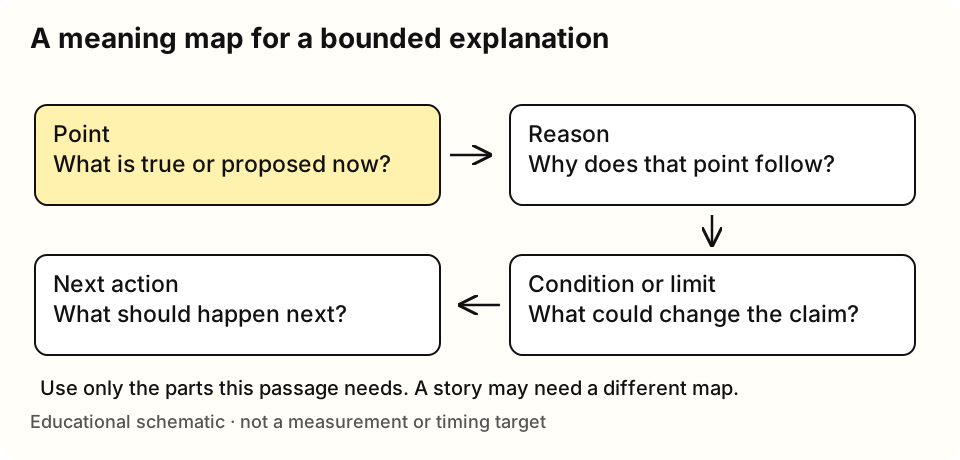
A worked contrast
There were shifts to arrange and some work on the rooms, and we have been discussing Saturday.
The main room can open on Saturday if the required approval is in place. The smaller room stays closed.
The second version names the action and its boundary. It does not claim that readiness or approval has already been established.
Practise one change
- Find the point, reason and condition in the passage.
- Read without making every part equally heavy.
- Retell using only those three relationships.
- Reopen the text and repair any missing condition before judging delivery.
What to listen for
- Could the listener state the main proposal?
- Was a fact turned into an unsupported conclusion?
Point-first is a useful default, not an excuse to hide context, uncertainty or another person's question.
Four texts to work through
Read for meaning first. Record with your usual recorder if you want audio. Use the rehearsal to try one change in a short excerpt. Close the full-text disclosure for recall. Use the anchors if you need a cue, and open the answers after your attempt.
01 · Lead with the answer
Read the full text · close it for recall
Meaning to preserve: Read the recommendation first; make the Saturday limit and approval request easy to recover.
The community workshop can open on Saturday, but only for the morning session. The main room is ready, and the volunteers have confirmed their shifts. The smaller room still needs an electrical inspection, so we should keep it closed. My recommendation is to open the main room from nine until noon and announce that limit clearly. If the smaller room passes inspection and we receive approval, we can consider extending the schedule next week. Today we need approval for the smaller opening, not a promise about the whole building.
Rehearse one line
The community workshop can open on Saturday, but only for the morning session.
Try. Say the opening plan and its morning limit in one breath-sized thought. If you need a break, let “but only” begin a short second thought.
Listen back. Can the listener say when the workshop can open and how long that opening lasts?
Recall anchors · less support
- Saturday morning
- main room
- approval
- small room inspection
Check meaning after your retelling
Equivalent wording is welcome. These are checks against the fictional source, not automatic scores or proof that a listener understood.
What is the proposed opening scope?
The main room on Saturday from nine until noon, subject to approval for that limited opening.
Why is the smaller room excluded?
It still needs an electrical inspection. The source does not promise the whole building can open.
02 · Give one reason at a time
Read the full text · close it for recall
Meaning to preserve: Make the two options distinct. Keep each consequence attached to its cause.
We considered two ways to improve the waiting area. More seats would make busy afternoons more comfortable, but they would narrow the path to the entrance. Moving the check-in desk would keep that path clear and give visitors a better first view of the room. The desk move takes longer to organise, yet it solves the access problem rather than only hiding it. I suggest moving the desk first and adding seats only after we measure the free space.
Rehearse one line
More seats would make busy afternoons more comfortable, but they would narrow the path to the entrance.
Try. Keep the benefit and the blocked entrance together when you explain the seats. Give the cost the same attention you gave the benefit.
Listen back. Why would adding seats create a problem?
Recall anchors · less support
- more seats
- blocked entrance
- move desk
- measure space
Check meaning after your retelling
Equivalent wording is welcome. These are checks against the fictional source, not automatic scores or proof that a listener understood.
What is the downside of adding seats first?
They would narrow the path to the entrance.
Why is moving the desk recommended first?
It addresses access, after which available space can be measured before adding seats.
03 · Separate a fact from a conclusion
Read the full text · close it for recall
Meaning to preserve: Sound certain about the observation and appropriately cautious about the explanation.
Last week, twelve people left the online form before submitting it. We can see the number, but the record does not tell us why they stopped. The form may be confusing, too long, or simply unnecessary for some visitors. I would not call the design broken yet. I suggest watching a few voluntary test sessions, checking where people hesitate, and changing one problem at a time. The observed drop-off is a reason to investigate, not proof of a particular cause.
Rehearse one line
We can see the number, but the record does not tell us why they stopped.
Try. Let “we can see the number” finish as an observation, then give the unknown cause its own space.
Listen back. Can the listener repeat what the record showed and what it left unexplained?
Recall anchors · less support
- twelve abandoned forms
- cause unknown
- voluntary observation
- one change
Check meaning after your retelling
Equivalent wording is welcome. These are checks against the fictional source, not automatic scores or proof that a listener understood.
What is observed?
Twelve people left the online form without submitting it.
What does that observation not establish?
Why they left or that one particular design problem caused it. The proposed next step is voluntary observation of where people hesitate.
04 · Protect the important condition
Read the full text · close it for recall
Meaning to preserve: Make the dependency audible without turning a conditional date into a promise.
We can publish the new timetable on Thursday if the safety review is signed off by Wednesday afternoon. The timetable itself is finished. What remains is approval of the emergency route, and we cannot substitute a verbal assurance for that step. I will check with the reviewer at noon tomorrow and update the team immediately afterwards. If approval slips, the public announcement should move as well. I want everyone to hear the condition before they hear the date.
Rehearse one line
We can publish the new timetable on Thursday if the safety review is signed off by Wednesday afternoon.
Try. Read the publish date and the approval deadline as a claim and its condition. Give “Wednesday afternoon” room to finish.
Listen back. Which deadline has to be met for Thursday publication?
Recall anchors · less support
- Thursday timetable
- Wednesday approval
- emergency route
- announcement conditional
Check meaning after your retelling
Equivalent wording is welcome. These are checks against the fictional source, not automatic scores or proof that a listener understood.
What must happen for Thursday publication?
The safety review, including approval of the emergency route, must be signed off by Wednesday afternoon.
What should happen if approval slips?
The public announcement should move too; a verbal assurance does not replace approval.
Check what carries over
- Repeat without the cue. Return to 01 · Lead with the answer. Read once in your usual voice with the rehearsal closed.
- Change the text. Try 04 · Protect the important condition before opening its cue. After the opening thought, can the listener name the proposed day and the approval deadline?
- Come back later. Retell the second passage before rereading it on another day. Then check which details survived.
If you already know the second passage, treat it as a familiar repeat. Check what the listener understood and how much effort it took as two separate things.
Practising alone? Close the passage, listen to your take once, and answer the listener question from playback before opening the reference. Without a recording, retell the passage from memory and use the reference to check which ideas you kept.
Compare after listening or retelling
Thursday is the proposed publication day. The safety review needs to be signed off by Wednesday afternoon for that date to hold.
If the distinction disappears. Say the proposed date with its condition attached. Give the reason or background in the next thought.
Your recording and Voice Trail
In the desktop development build, open Library → Ptichi Academy → Point, reason and condition. Every take belongs to its text and source version. Reopen its recording and supported Voice Trail for review. Missing observations remain unavailable; this website does not record or calculate personal voice metrics.
Exercise identity and content version → lesson item → attempt → immutable recording/hash → supported observation and source-time trail. Missing or mismatched evidence stays unavailable. A web schematic is never a measured Voice Trail.
Use an ordinary, comfortable voice and ordinary breath opportunities. Stop voiced practice for pain, unusual hoarseness, dizziness or breathing difficulty. Persistent voice changes need an appropriate clinician. This is speech practice, not diagnosis, a prescribed breathing treatment or a promise to remove every voice problem.
Sources and limitations
Vedokrok — Give feedback at the smallest actionable unit · Tie one observed issue and its consequence to one controllable next change. Not every performance problem has one local cause. Repeated failure can require a simpler task, prerequisite or environmental change.