
Evidence and reasoning
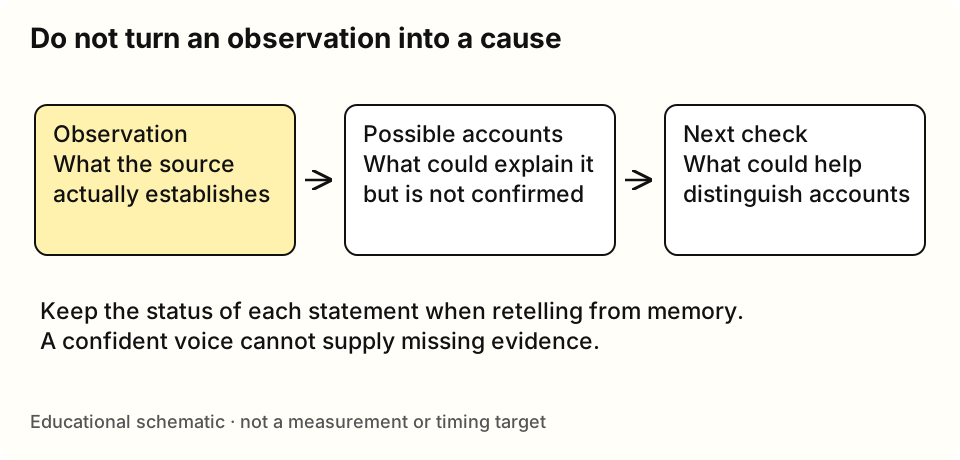
Separate what was observed from the explanation you are considering and the check that could distinguish it.
A polished account can sound convincing while quietly promoting a guess into a fact.
Speaking rule
Separate what happened from your explanation
Say “Three people left when the form asked for an address. The wording may have confused them. We could watch someone fill it in and ask where they got stuck.” Pause briefly after the observation before offering the possible cause.
Listen back. Can a listener separate the count, the possible cause and the proposed check? If the cause comes back as a fact, make your uncertainty audible in the words.
Try another text. Use a different passage. Retell one observation and one inference, then check each against the source before saying what evidence would help.
Short exercise
Retell the evidence in two sentences
Three parcels arrived late this week. The courier changed routes on Monday. Two of the parcels also left the depot late.
- Read the three facts once. Look away and say what happened in one sentence.
- Use the next sentence to name one check that could distinguish a depot delay from a route delay.
- Repeat the task with the linked passage. Preserve the observed fact and one useful check.
Check. Did your retelling turn a possible explanation into a fact? Reopen the example and check the count before trying again.
Compare after trying
Three parcels arrived late. A useful check is to compare when each parcel left the depot with when it reached the customer. The route change alone leaves the cause uncertain.
In these texts, an observation is something the fictional case says is known. A hypothesis is a possible account of it. A discriminating check would help choose between competing accounts rather than merely add more activity.
Use the passage as the authority for its facts. When retelling from memory, say what is uncertain instead of filling the gap with a plausible story. The voice can clarify the distinction; it cannot make the inference valid by sounding confident.
A worked contrast
The form is confusing because twelve people left it.
Twelve people left the form. That does not tell us why. We need to observe where users hesitate before choosing a change.
The second account keeps the observation while withholding an unsupported cause.
Practise one change
- Mark an observation, a possible explanation and the next check.
- Read so that each has its own status.
- Retell without adding an unobserved cause.
- Use the answer key to check the relationship, then improve one delivery detail.
What to listen for
- Which statement is actually supported by the source?
- Would the next check distinguish explanations or merely produce more data?
Do not invent extra hypotheses to sound analytical. 'We cannot distinguish these yet' can be the accurate conclusion.
Four texts to work through
Read for meaning first. Record with your usual recorder if you want audio. Use the rehearsal to try one change in a short excerpt. Close the full-text disclosure for recall. Use the anchors if you need a cue, and open the answers after your attempt.
01 · Observation is not explanation
Read the full text · close it for recall
Meaning to preserve: Distinguish observed facts, hypotheses and a discriminating next check.
Three meetings ended late this month. That is an observation. It does not tell us whether the agenda was too long, the decisions were unclear, or urgent questions appeared at the end. Before changing the meeting length, I would compare the agendas and ask where time was actually spent. If most delays came from one unresolved decision, shortening every meeting could make the problem worse. The useful question is not simply what happened, but which explanation fits the evidence and can be tested.
Rehearse one line
Three meetings ended late this month. That is an observation.
Try. Finish the observation before you offer any explanation. In the full reading, keep the possible causes together as questions to investigate.
Listen back. How many meetings ended late, and which cause was established?
Recall anchors · less support
- three late meetings
- possible explanations
- where time went
- unresolved decision
Check meaning after your retelling
Equivalent wording is welcome. These are checks against the fictional source, not automatic scores or proof that a listener understood.
What is known, and what remains unexplained?
Three meetings ended late; the source has not established whether agenda length, unclear decisions or late urgent questions caused that.
Why could shortening every meeting make things worse?
If one unresolved decision caused most delays, less meeting time might leave that problem unresolved rather than address it.
02 · Trace the causal chain
Read the full text · close it for recall
Meaning to preserve: Keep the chain intact and distinguish the visible delay from its upstream cause.
The exhibition missed its opening date because the final labels arrived late. The labels arrived late because the descriptions were changed after the print order. Those changes happened when the team discovered that two objects had been wrongly identified. Moving the printer deadline would not have prevented the original error. The deeper improvement is to confirm each object's identity before approval for print. A clear explanation follows the chain of events rather than blaming whichever step happened last.
Rehearse one line
The labels arrived late because the descriptions were changed after the print order.
Try. Give the cause after “because” its own space. In the next sentence, make clear that the changed descriptions also had a cause.
Listen back. Can the listener work back from late labels to the earlier mistake?
Recall anchors · less support
- opening missed
- late labels
- changed descriptions
- wrong object identities
Check meaning after your retelling
Equivalent wording is welcome. These are checks against the fictional source, not automatic scores or proof that a listener understood.
What is the chain behind the missed exhibition opening?
Labels were late after descriptions changed following discovery that two objects had been wrongly identified.
Which earlier check is proposed?
Confirm each object's identity before approving print; moving the printer deadline alone would not prevent the identification error.
03 · Find the constraint
Read the full text · close it for recall
Meaning to preserve: Explain the system limit without assuming a particular technical fix.
A small repair shop receives twenty requests each day. Its front desk can register thirty, but the technicians can complete only fifteen. Adding a faster booking form may improve the visitor experience, yet it will not by itself increase completed repairs. The queue will grow unless repair capacity, task complexity or demand changes. We should first inspect the technicians' work and identify what consumes their time. A system improves when its limiting step improves, not when its easiest step looks faster.
Rehearse one line
Its front desk can register thirty, but the technicians can complete only fifteen.
Try. Keep “thirty” with the front desk and “fifteen” with the technicians. Give “but” enough space to signal which capacity changes the answer.
Listen back. Which stage limits how many repairs can be completed?
Recall anchors · less support
- twenty requests
- thirty intake
- fifteen repairs
- technician constraint
Check meaning after your retelling
Equivalent wording is welcome. These are checks against the fictional source, not automatic scores or proof that a listener understood.
Which stage is the stated capacity constraint?
Technicians can finish fifteen repairs a day, fewer than the twenty incoming requests and the front desk's capacity of thirty.
Why is a faster booking form insufficient by itself?
It does not increase repair capacity; the queue can still grow unless capacity, complexity or demand changes.
04 · Resolve competing requirements
Read the full text · close it for recall
Meaning to preserve: Show how separating cases changes the trade-off; retain the classification risk.
Our customers want quicker answers, while the support team needs time to verify unusual cases. Those needs are not necessarily enemies. We can separate routine questions from exceptions: publish a checked answer for common requests and give the unusual ones an explicit review path. The goal is not maximum speed for every answer or maximum checking for every question. It is fast handling where the risk is low and careful handling where a mistake would matter. We still need to test whether the classification is reliable.
Rehearse one line
We can separate routine questions from exceptions: publish a checked answer for common requests and give the unusual ones an explicit review path.
Try. Keep the checked answer with common requests. Use a small boundary before the review path for unusual ones.
Listen back. How should the team handle each kind of request?
Recall anchors · less support
- routine questions
- unusual cases
- checked answers
- reliable classification
Check meaning after your retelling
Equivalent wording is welcome. These are checks against the fictional source, not automatic scores or proof that a listener understood.
How are speed and checking separated?
Routine questions receive checked published answers, while unusual cases follow an explicit review path.
What must still be tested?
Whether the classification between routine and unusual cases is reliable.
Check what carries over
- Repeat without the cue. Return to 01 · Observation is not explanation. Read once in your usual voice with the rehearsal closed.
- Change the text. Try 04 · Resolve competing requirements before opening its cue. Can the listener separate the proposed split from the question that still needs testing?
- Come back later. Retell the second passage before rereading it on another day. Then check which details survived.
If you already know the second passage, treat it as a familiar repeat. Check what the listener understood and how much effort it took as two separate things.
Practising alone? Close the passage, listen to your take once, and answer the listener question from playback before opening the reference. Without a recording, retell the passage from memory and use the reference to check which ideas you kept.
Compare after listening or retelling
Common questions would get a checked published answer. Unusual cases would go through a separate review. The team still needs to test whether it can tell the two kinds of requests apart reliably.
If the distinction disappears. Give the proposal one sentence and the unresolved check another. Say which part is already supported and which still needs evidence.
Your recording and Voice Trail
In the desktop development build, open Library → Ptichi Academy → Evidence and reasoning. Every take belongs to its text and source version. Reopen its recording and supported Voice Trail for review. Missing observations remain unavailable; this website does not record or calculate personal voice metrics.
Exercise identity and content version → lesson item → attempt → immutable recording/hash → supported observation and source-time trail. Missing or mismatched evidence stays unavailable. A web schematic is never a measured Voice Trail.
Use an ordinary, comfortable voice and ordinary breath opportunities. Stop voiced practice for pain, unusual hoarseness, dizziness or breathing difficulty. Persistent voice changes need an appropriate clinician. This is speech practice, not diagnosis, a prescribed breathing treatment or a promise to remove every voice problem.