

Audibility and expressive speech
Let interest, contrast and a turning point be heard while keeping the voice appropriate to one listener and the room.
Expression should help a listener follow the message. It should not demand extra vocal force or turn every paragraph into an advertisement.
Speaking rule
Let the turning point change the delivery
Say “We found the key. It opens the side door.” Treat the first line as routine. On the second, give “side” a little more space, as if that discovery changes where someone should go. Keep speaking to one person at a comfortable volume.
Listen back. Ask which door matters now. If the change draws attention to your performance and the answer is still unclear, make the emphasis smaller and keep the contrast specific.
Try another text. In a new passage, find the sentence that changes what happens next. Give that sentence a small change of pace or emphasis and check what stood out.
Choose what the passage is doing: welcoming, explaining, qualifying or telling how something changed. Give the relevant moment its place instead of applying a dramatic style to every line.
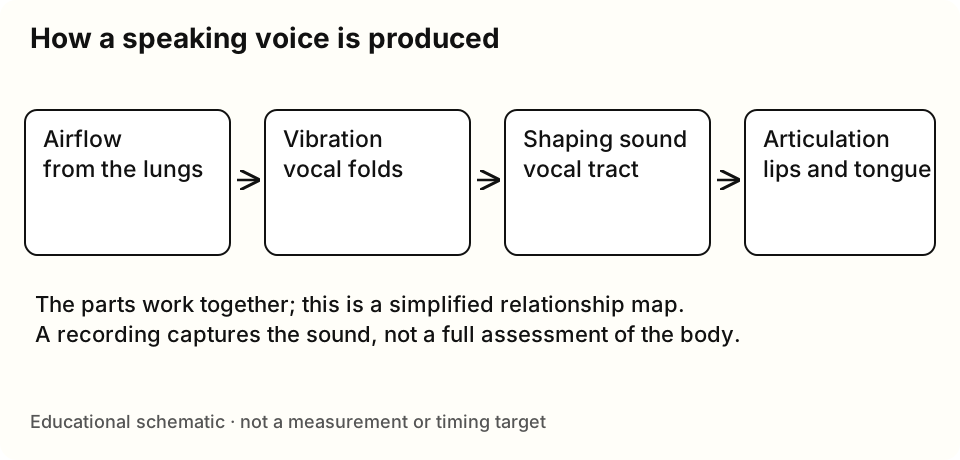
Check the environment as well as the voice. Competing with noise is not the same task as addressing one person in a quiet room. A microphone's digital level is affected by distance and gain; it is not a universal projection score.
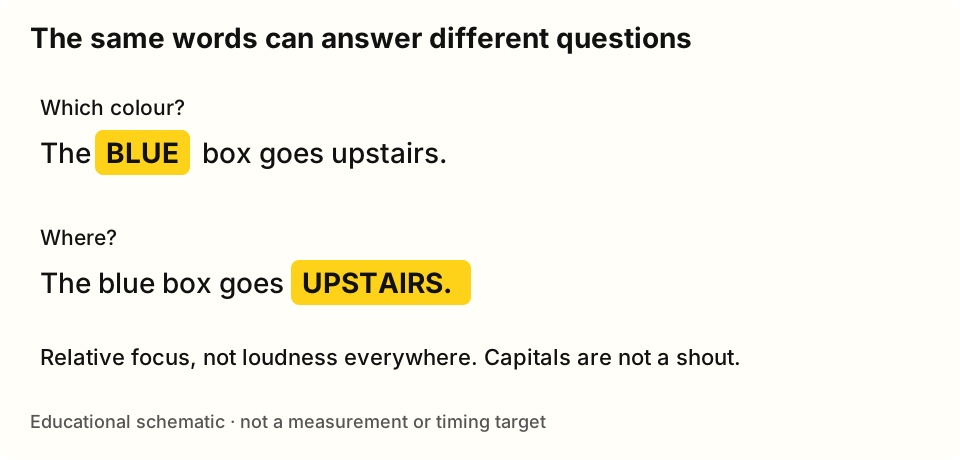
A worked contrast
Every sentence receives the same large pause and heavy emphasis.
The opening stays conversational. / The turning point receives one clear change of emphasis.
Judge whether the change serves the passage and remains comfortable. A listener checks the point; the speaker reports effort.
Practise one change
- Name the intention and listener.
- Read once in a comfortable conversational voice.
- Choose one turning point or useful contrast and change only that part.
- Compare the result without rewarding extra volume for its own sake.
What to listen for
- Did expression make the point easier to follow?
- Did the reading still fit the speaker and situation?
A bigger voice, wider pitch range or lower pitch is not a general improvement. Keep effort and appropriateness visible.
Four texts to work through
Read for meaning first. Record with your usual recorder if you want audio. Use the rehearsal to try one change in a short excerpt. Close the full-text disclosure for recall. Use the anchors if you need a cue, and open the answers after your attempt.
01 · A welcome with useful information
Read the full text · close it for recall
Meaning to preserve: Keep the welcome conversational and preserve both spaces and the break-time movement rule.
Welcome to the evening reading. The programme begins in the main room, and there is a quieter listening area beside it. Visitors can move between the two spaces during the breaks. The host wants the welcome to feel warm, but warmth does not replace those practical details. In a quiet room, one listener should be able to hear the invitation, the two spaces and the rule about moving between them. There is no need to make the voice artificially low or large. The useful question is whether the information reaches the person without extra effort from the speaker.
Rehearse one line
The programme begins in the main room, and there is a quieter listening area beside it.
Try. Read the first part as a warm welcome. Give “quieter listening area” one small change of emphasis so it sounds like a useful option.
Listen back. Can the visitor name both places, and did the welcome still sound conversational?
Recall anchors · less support
- main room
- quiet listening area
- move at breaks
Check meaning after your retelling
Equivalent wording is welcome. These are checks against the fictional source, not automatic scores or proof that a listener understood.
Which two spaces can visitors use?
The main room and a quieter listening area beside it.
When can visitors move between the spaces?
During the breaks.
02 · Interest without advertising
Read the full text · close it for recall
Meaning to preserve: Make the repair marks, rather than a like-new appearance, carry the point of the exhibition.
The small exhibition begins with an ordinary object: a repaired wooden chair. Beside it are photographs showing the chair in different homes over forty years. The curator is interested in the marks that repair has left, rather than in making the object look new. The guide can let that interest be heard without selling the visitor a life-changing experience. Choose the detail that carries the point and give it appropriate weight. A steady, thoughtful reading may be more suitable than constant excitement. Expression should help the listener see the object differently, while leaving the modest scale of the claim intact.
Rehearse one line
The small exhibition begins with an ordinary object: a repaired wooden chair.
Try. Let the lead-in stay easy. Give “repaired wooden chair” a little more space, as if pointing it out to one visitor.
Listen back. Which object did the visitor picture first?
Recall anchors · less support
- repaired chair
- forty years of homes
- repair marks
Check meaning after your retelling
Equivalent wording is welcome. These are checks against the fictional source, not automatic scores or proof that a listener understood.
What interests the curator?
The marks left by repair, rather than making the chair look new.
What role do the photographs play?
They show the chair in different homes over forty years and give context to the ordinary object.
03 · A quiet turning point
Read the full text · close it for recall
Meaning to preserve: Keep storm damage separate from the social turning point: neighbours beginning to decide and work together.
For years, the neighbours passed one another on the stairs without much conversation. When a storm damaged the shared garden, they met to decide what could be saved. One person brought tools, another brought a list of plants, and a third offered to organise the work. The change in the story is not the damage itself. It is the move from separate routines to a shared decision. A reader can make that turn audible with a boundary and a different emphasis. It does not require an emotional imitation. The listener needs to understand what changed between the people.
Rehearse one line
When a storm damaged the shared garden, they met to decide what could be saved.
Try. Let “they met to decide” carry the change. Keep the storm in the same ordinary voice you used for the opening.
Listen back. Did the listener notice what the neighbours did together after the storm?
Recall anchors · less support
- separate routines
- storm damage
- shared decision
- different contributions
Check meaning after your retelling
Equivalent wording is welcome. These are checks against the fictional source, not automatic scores or proof that a listener understood.
What is the social turning point?
The neighbours move from passing separately to making a shared decision and organising work together.
What do the three neighbours contribute?
Tools, a list of plants and an offer to organise the work.
04 · Sounding like yourself on purpose
Read the full text · close it for recall
Meaning to preserve: Explain why the speaker keeps one useful change while removing exaggerated delivery; separate naturalness from listener recovery.
After several attempts, the final reading is clearer, but one version sounds strangely formal. The speaker has made every boundary large and every important word heavy. The information is recoverable, yet the delivery no longer resembles an ordinary explanation. The next attempt keeps the useful distinction and reduces the extra performance around it. This is not a return to the first version. It is a choice about which change earned its place. A natural voice is not one fixed acoustic pattern; in this exercise, the speaker judges effort and suitability while a listener checks what the words communicate.
Rehearse one line
The information is recoverable, yet the delivery no longer resembles an ordinary explanation.
Try. Read the contrast with a small shift on “ordinary explanation.” Make the rest of the sentence sound like you are telling one person what you noticed.
Listen back. Did the difference between being understood and sounding conversational come through?
Recall anchors · less support
- clear but formal
- exaggerated delivery
- keep useful change
- check effort and meaning
Check meaning after your retelling
Equivalent wording is welcome. These are checks against the fictional source, not automatic scores or proof that a listener understood.
Why does the speaker make another attempt after the clearer reading?
One clearer version sounds unnecessarily formal because every boundary and focus has become heavy.
What should be kept in the next attempt?
The useful communicative distinction, while reducing extra performance; accuracy and speaker effort remain separate checks.
Check what carries over
- Repeat without the cue. Return to 01 · A welcome with useful information. Read once in your usual voice with the rehearsal closed.
- Change the text. Try 03 · A quiet turning point before opening its cue. Ask which change in the story stood out. After listening, judge separately whether the delivery still sounded like an ordinary account.
- Come back later. Retell the second passage before rereading it on another day. Then check which details survived.
If you already know the second passage, treat it as a familiar repeat. Check what the listener understood and how much effort it took as two separate things.
Practising alone? Close the passage, listen to your take once, and answer the listener question from playback before opening the reference. Without a recording, retell the passage from memory and use the reference to check which ideas you kept.
Compare after listening or retelling
The neighbours went from passing each other on the stairs to deciding together how to save the garden. Listen for that change, then judge separately whether the delivery sounded conversational.
If the distinction disappears. Give the neighbours' decision one small change in emphasis. Keep the lead-in conversational and try the passage again.
Your recording and Voice Trail
In the desktop development build, open Library → Ptichi Academy → Audibility and expressive speech. Every take belongs to its text and source version. Reopen its recording and supported Voice Trail for review. Missing observations remain unavailable; this website does not record or calculate personal voice metrics.
Exercise identity and content version → lesson item → attempt → immutable recording/hash → supported observation and source-time trail. Missing or mismatched evidence stays unavailable. A web schematic is never a measured Voice Trail.
Use an ordinary, comfortable voice and ordinary breath opportunities. Stop voiced practice for pain, unusual hoarseness, dizziness or breathing difficulty. Persistent voice changes need an appropriate clinician. This is speech practice, not diagnosis, a prescribed breathing treatment or a promise to remove every voice problem.
Sources and limitations
NIDCD — Taking Care of Your Voice · Basic voice production, vocal-care context and avoiding overuse or force. Does not validate this curriculum, a daily vocal dose, a breath diagnosis from audio or a universal pitch/loudness target.
Lam and Tjaden — Intelligibility of Clear Speech: Effect of Instruction (2013) · Twelve speakers and forty listeners: different clear-speech instructions changed sentence transcription accuracy in background babble. A controlled English reading task, not a long-term training trial. Instruction order, individual variation and listening conditions limit transfer; no universal articulation or accent target follows.