

Audible endings and conditions
Carry the last meaningful word, condition or requested action far enough to be understood, without forcing the phrase.
The end may contain the limit that prevents a listener from treating a possibility as a promise.
Speaking rule
Carry the condition all the way to its last word
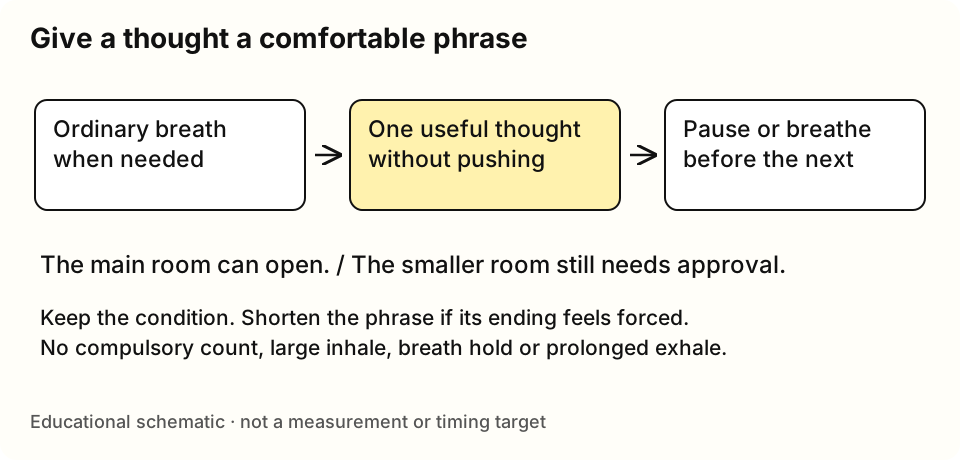
Say “We can leave at eight / if the road is clear.” Give the condition its own easy phrase. If the end feels crowded, start a fresh sentence with “That depends on the road being clear.”
Listen back. Could the listener say what would stop the departure? Compare that answer with how much effort the ending took.
Try another text. Find another sentence with “if” or “unless.” Read the whole claim and check whether the last words still carry the exception.
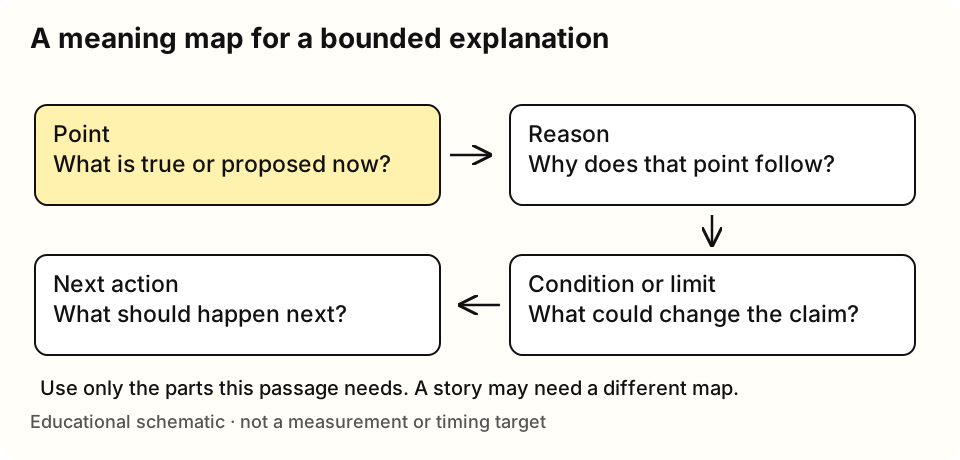
An audible ending is about the message that remains available, not simply a louder final syllable. A condition such as 'if approval arrives' changes the meaning of the earlier date.
First check whether the ending is too long, buried in the wording or physically effortful. Shorten the sentence or take an ordinary breath before the next thought. Keep the relevant condition in the message.
A worked contrast
We can publish on Thursday [the approval condition disappears].
We can publish on Thursday / IF the review is approved first.
The condition is part of the claim. The emphasis and slash are optional rehearsal aids, not measured evidence.
Practise one change
- Privately identify the final material condition or action.
- Read the whole message, then listen for that ending.
- Shorten or regroup the phrase if it becomes forced.
- Retell without the text and check that the condition is still present.
What to listen for
- Was the ending audible and faithful to the original?
- Could the listener distinguish a conditional plan from a confirmed result?
Do not push the throat, manufacture vocal fry or drive pitch down to make an ending sound finished.
Four texts to work through
Read for meaning first. Record with your usual recorder if you want audio. Use the rehearsal to try one change in a short excerpt. Close the full-text disclosure for recall. Use the anchors if you need a cue, and open the answers after your attempt.
A garden with one condition
Read the full text · close it for recall
Meaning to preserve: Under what condition can the garden open?
We can open the roof garden on Saturday if the safety check is complete.
Rehearse one line
We can open the roof garden on Saturday if the safety check is complete.
Try. Keep the condition as audible as the invitation.
Listen back. Under what condition can the garden open?
Recall anchors · less support
- roof garden
- Saturday
- safety check complete
Check meaning after your retelling
Equivalent wording is welcome. These are checks against the fictional source, not automatic scores or proof that a listener understood.
What condition must be met before opening?
The safety check must be complete.
Is Saturday an unconditional promise in this text?
No. The opening depends on the stated safety check.
What the free ticket leaves out
Read the full text · close it for recall
Meaning to preserve: What would still require a separate ticket?
The free ticket covers the talk, but not the workshop.
Rehearse one line
The free ticket covers the talk, but not the workshop.
Try. Let not the workshop finish clearly.
Listen back. What would still require a separate ticket?
Recall anchors · less support
- free talk
- workshop excluded
Check meaning after your retelling
Equivalent wording is welcome. These are checks against the fictional source, not automatic scores or proof that a listener understood.
What does the free ticket cover?
The talk.
What needs a separate ticket?
The workshop.
Three chairs, one clear path
Read the full text · close it for recall
Meaning to preserve: Can the helper recover both the number and the clear route?
Put three chairs beside the door and leave the middle aisle clear.
Rehearse one line
Put three chairs beside the door and leave the middle aisle clear.
Try. Finish the clear-route instruction without letting it trail away.
Listen back. Can the helper recover both the number and the clear route?
Recall anchors · less support
- three chairs
- beside door
- middle aisle clear
Check meaning after your retelling
Equivalent wording is welcome. These are checks against the fictional source, not automatic scores or proof that a listener understood.
How many chairs go where?
Three chairs beside the door.
Which route must remain clear?
The middle aisle.
A result with an honest limit
Read the full text · close it for recall
Meaning to preserve: What does the result still leave unknown?
The pilot shortened the queue for booked visits, but we have not tested walk-in demand yet.
Rehearse one line
The pilot shortened the queue for booked visits, but we have not tested walk-in demand yet.
Try. Keep the untested part in the answer.
Listen back. What does the result still leave unknown?
Recall anchors · less support
- booked visits
- shorter queue
- walk-ins not tested
Check meaning after your retelling
Equivalent wording is welcome. These are checks against the fictional source, not automatic scores or proof that a listener understood.
Where was the queue shortened?
For booked visits in the pilot.
What remains unknown?
The effect on walk-in demand, which has not been tested.
Check what carries over
- Repeat without the cue. Return to A garden with one condition. Read once in your usual voice with the rehearsal closed.
- Change the text. Try A result with an honest limit before opening its cue. Ask what the pilot actually showed and what it still leaves unknown.
- Come back later. Retell the second passage before rereading it on another day. Then check which details survived.
If you already know the second passage, treat it as a familiar repeat. Check what the listener understood and how much effort it took as two separate things.
Practising alone? Close the passage, listen to your take once, and answer the listener question from playback before opening the reference. Without a recording, retell the passage from memory and use the reference to check which ideas you kept.
Compare after listening or retelling
The pilot shortened the queue for booked visits. Its effect on walk-in demand is still unknown.
If the distinction disappears. Give the qualification a short phrase of its own. Check that its final words stay clear without extra force.
Your recording and Voice Trail
In the desktop development build, open Library → Ptichi Academy → Audible endings and conditions. Every take belongs to its text and source version. Reopen its recording and supported Voice Trail for review. Missing observations remain unavailable; this website does not record or calculate personal voice metrics.
Exercise identity and content version → lesson item → attempt → immutable recording/hash → supported observation and source-time trail. Missing or mismatched evidence stays unavailable. A web schematic is never a measured Voice Trail.
Use an ordinary, comfortable voice and ordinary breath opportunities. Stop voiced practice for pain, unusual hoarseness, dizziness or breathing difficulty. Persistent voice changes need an appropriate clinician. This is speech practice, not diagnosis, a prescribed breathing treatment or a promise to remove every voice problem.
Sources and limitations
NIDCD — Taking Care of Your Voice · Basic voice production, vocal-care context and avoiding overuse or force. Does not validate this curriculum, a daily vocal dose, a breath diagnosis from audio or a universal pitch/loudness target.