

Pace, pauses and room for detail
Give a critical detail or change of relationship enough room; keep the rest at a useful natural pace.
A listener may miss a date, negation or condition even when the overall reading is not especially fast.
Speaking rule
Slow down around one detail that matters
Say “Bring the signed form on Friday by two.” Try it again with a short beat after “signed form,” then say “on Friday by two” as one connected detail. Keep the rest at your usual pace.
Listen back. After one hearing, can the listener repeat both Friday and two? If one drops out, change where you give that detail room.
Try another text. In another passage, choose one date, quantity or instruction that matters. Read once at your usual pace and once with room around just that detail.
An average words-per-minute value describes a whole interval. It does not show which phrase carried the important information, whether the listener understood it or where the speaker was planning.
Choose a local target: the correction, the exception, the cause-to-conclusion boundary. Try a small timing change and compare what remained recoverable. If global slowing adds effort or fragments the message, use the smaller change instead.
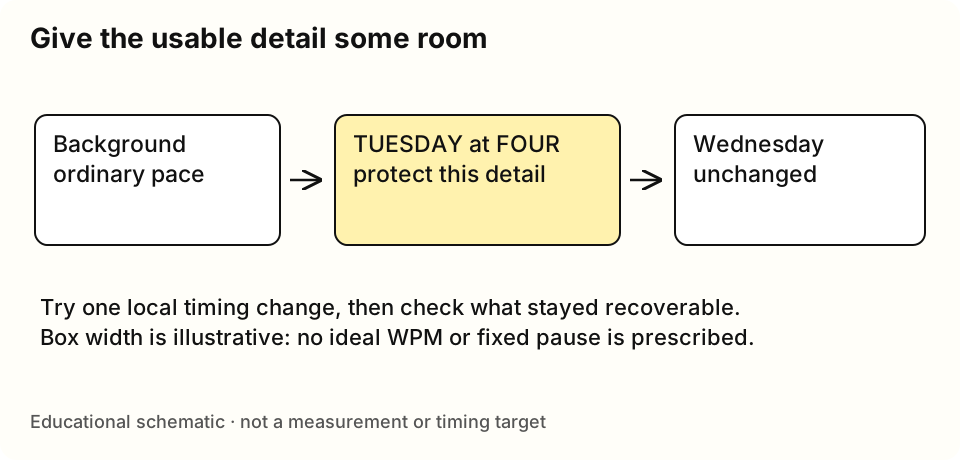
A worked contrast
The room closes early on Tuesday at four and Wednesday is unchanged.
On TUESDAY, the room closes at FOUR. / Wednesday is unchanged.
The second version protects the usable details. It does not impose a target speed or an exact pause duration.
Practise one change
- Identify one date, contrast or relationship to protect.
- Record an ordinary reading.
- Give just that phrase a little more time or a clearer boundary.
- Compare recovery and effort, then read a different passage with the same principle.
What to listen for
- Which detail survived on first listening?
- Did the local change help without slowing every word?
Neither faster nor slower is automatically better. Do not turn a descriptive pace number into a verdict about fluency.
Four texts to work through
Read for meaning first. Record with your usual recorder if you want audio. Use the rehearsal to try one change in a short excerpt. Close the full-text disclosure for recall. Use the anchors if you need a cue, and open the answers after your attempt.
01 · The date inside the explanation
Read the full text · close it for recall
Meaning to preserve: Protect Tuesday, four in the afternoon and the unchanged Wednesday schedule through local timing rather than global slowing.
The reading room will close early on Tuesday, at four in the afternoon. The change is needed because the building team must inspect the lighting before the evening session. Wednesday's opening time stays the same. There is a small notice on the door, but the librarian also explains the change aloud. The background can move at an ordinary conversational pace. The day, the earlier closing time and the unchanged Wednesday schedule need enough room to register. Slowing every word equally would make the announcement longer without necessarily protecting the information that a visitor will use.
Rehearse one line
The reading room will close early on Tuesday, at four in the afternoon.
Try. Give the time a small beat before you say it. Keep “four in the afternoon” together and leave the rest at your usual pace.
Listen back. Can the listener repeat both the day and the time after one hearing?
Recall anchors · less support
- Tuesday
- four in the afternoon
- Wednesday unchanged
Check meaning after your retelling
Equivalent wording is welcome. These are checks against the fictional source, not automatic scores or proof that a listener understood.
When will the reading room close early?
On Tuesday at four in the afternoon.
What remains unchanged, and why is the change needed?
Wednesday's opening time is unchanged. The building team needs to inspect lighting before the evening session.
02 · A pause at the relationship
Read the full text · close it for recall
Meaning to preserve: Separate the observed increase from uncertainty about its cause; retain both the shorter invitation and the reminder.
The survey attracted more replies after the invitation was shortened. That happened at the same time as a reminder was sent to people who had already expressed interest. We cannot tell from the totals which change produced the extra responses. A pause can help distinguish the observed increase from the proposed explanation. Put it where that relationship changes, rather than after a fixed number of words. In the second reading, keep both possible influences. An explanation that sounds beautifully measured but loses one of them is smoother and less accurate at the same time.
Rehearse one line
We cannot tell from the totals which change produced the extra responses.
Try. Give “cannot tell” room before you move through the rest of the sentence. Keep the explanation of the unknown cause in one thought.
Listen back. Does the cause sound unresolved even though the replies increased?
Recall anchors · less support
- more replies
- shorter invitation
- reminder
- cause unknown
Check meaning after your retelling
Equivalent wording is welcome. These are checks against the fictional source, not automatic scores or proof that a listener understood.
Which two changes happened around the increase in replies?
The invitation was shortened and a reminder was sent to people who had expressed interest.
What can the totals not establish?
Which change caused the extra responses; the source does not distinguish their effects.
03 · Give the contrast some space
Read the full text · close it for recall
Meaning to preserve: Keep fewer events distinct from fewer hours, and preserve the volunteer-availability condition.
We are reducing the number of events, not the hours available for each event. Last month, three small sessions competed for the same volunteers. Next month, one longer session should give visitors more time with the same team. That is the proposal, and it still depends on volunteer availability. The contrast belongs near the beginning because it prevents a predictable misunderstanding. Give number of events and hours per event enough separation to be distinguished. Then return to the explanation. The goal is not a slower personality; it is a listener who understands what is being reduced.
Rehearse one line
We are reducing the number of events, not the hours available for each event.
Try. Give “number of events” enough time to register, then make a short space before the contrast.
Listen back. What is changing, and what is staying the same for each event?
Recall anchors · less support
- fewer events
- not fewer hours
- one longer session
- volunteer condition
Check meaning after your retelling
Equivalent wording is welcome. These are checks against the fictional source, not automatic scores or proof that a listener understood.
What is being reduced?
The number of events, not the time available for each event.
What still conditions the proposal?
Volunteer availability.
04 · A rhythm that can change
Read the full text · close it for recall
Meaning to preserve: Let the cancelled train mark the turning point, while keeping the earlier events and the need for accommodation in order.
At first, the account of the journey moves quickly: the late bus, the crowded station and the search for the right platform. Then one event changes the plan. The last train has been cancelled, and the traveller must find a place to stay. The story does not need the same pace in every sentence. A little room around the turning point can help the listener understand why the next decision matters. Keep the words conversational and the facts intact. A timing change has a job here; it is not an instruction to make every story sound suspenseful.
Rehearse one line
The last train has been cancelled, and the traveller must find a place to stay.
Try. Take a small beat before this sentence when you read the full passage. Say the cancellation and the response as two parts of one turning point.
Listen back. Which event made the traveller look for a place to stay?
Recall anchors · less support
- late bus
- station and platform
- cancelled train
- place to stay
Check meaning after your retelling
Equivalent wording is welcome. These are checks against the fictional source, not automatic scores or proof that a listener understood.
What changes the traveller's plan?
The last train is cancelled.
What decision follows that event?
The traveller needs to find accommodation; it is different from the earlier bus and platform difficulties.
Check what carries over
- Repeat without the cue. Return to 01 · The date inside the explanation. Read once in your usual voice with the rehearsal closed.
- Change the text. Try 04 · A rhythm that can change before opening its cue. Ask what changed the traveller's plan and what they needed to do next.
- Come back later. Retell the second passage before rereading it on another day. Then check which details survived.
If you already know the second passage, treat it as a familiar repeat. Check what the listener understood and how much effort it took as two separate things.
Practising alone? Close the passage, listen to your take once, and answer the listener question from playback before opening the reference. Without a recording, retell the passage from memory and use the reference to check which ideas you kept.
Compare after listening or retelling
The last train was cancelled. That was the turning point that made the traveller look for a place to stay.
If the distinction disappears. Take a small beat before the turning point. Keep the earlier account at its usual pace, then listen for the one event that changes the action.
Your recording and Voice Trail
In the desktop development build, open Library → Ptichi Academy → Pace, pauses and room for detail. Every take belongs to its text and source version. Reopen its recording and supported Voice Trail for review. Missing observations remain unavailable; this website does not record or calculate personal voice metrics.
Exercise identity and content version → lesson item → attempt → immutable recording/hash → supported observation and source-time trail. Missing or mismatched evidence stays unavailable. A web schematic is never a measured Voice Trail.
Use an ordinary, comfortable voice and ordinary breath opportunities. Stop voiced practice for pain, unusual hoarseness, dizziness or breathing difficulty. Persistent voice changes need an appropriate clinician. This is speech practice, not diagnosis, a prescribed breathing treatment or a promise to remove every voice problem.
Sources and limitations
Lam and Tjaden — Intelligibility of Clear Speech: Effect of Instruction (2013) · Twelve speakers and forty listeners: different clear-speech instructions changed sentence transcription accuracy in background babble. A controlled English reading task, not a long-term training trial. Instruction order, individual variation and listening conditions limit transfer; no universal articulation or accent target follows.