

Information focus
Make the new information or the correction stand out relative to what the listener already knows.
A listener should recover what changed, rather than hearing twelve equally important words.
Speaking rule
Put the emphasis on the word that answers the question
Answer “Which room?” with “We need the SMALL room on Friday.” Answer “Which day?” with “We need the small room on FRIDAY.” Say the capitalized word a little more distinctly while keeping the rest conversational.
Listen back. Play each take without the question. Would a listener know whether you were correcting the room or the day?
Try another text. Pick a sentence from the next text. Ask two different questions it could answer, then shift the focus to match each one.
Short exercise
Answer two questions with the same words
Ava moved the blue crate on Monday.
- Say the line as an answer to “Did Ava move the red crate?” Give the colour a little more room.
- Say the same line as an answer to “Did Ava move it on Tuesday?” Let the day stand out. Keep the other words easy.
- Read the linked passage as a correction to someone who named the wrong colour.
Check. Which detail sounds corrected in each take? A listener can answer before you show either question.
Compare after trying
The first take corrects the colour to blue. The second corrects the day to Monday. There is more than one way to make a detail stand out.
Focus is a relationship between foreground and background. A word can stand out through timing, pitch, relative loudness or clear wording. The course does not prescribe one acoustic recipe.
Decide what mistaken interpretation you are preventing. If the box is correct but its colour is wrong, the useful contrast is colour. If every word receives the same strong emphasis, the contrast disappears into the performance.
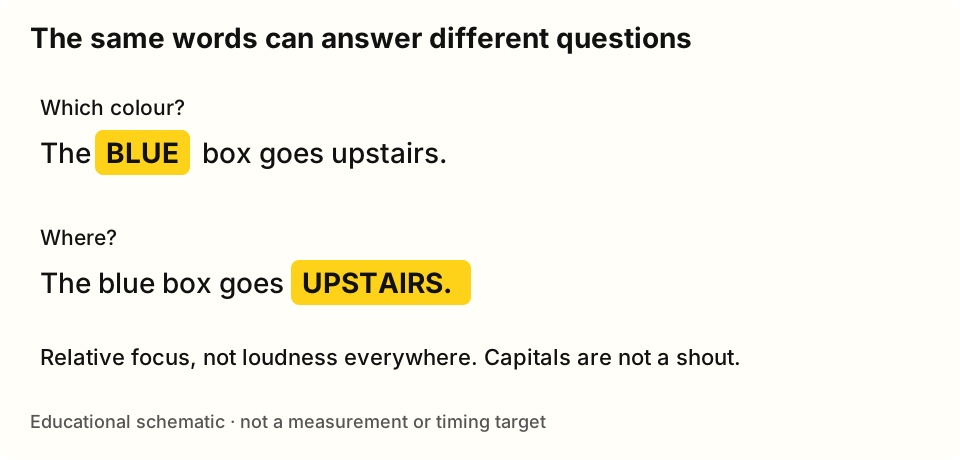
A worked contrast
We need the BLUE BOX from the SMALL ROOM TODAY.
The box is right. We need the BLUE one, not the green one.
The second version gives the correction one job. Capitals show editorial focus, not an instruction to shout.
Practise one change
- Name the intended correction before reading.
- Choose one focus word or short phrase.
- Read once, then ask what changed.
- Remove the marking and keep the distinction in your own-word retelling.
What to listen for
- Can the listener say what was new or corrected?
- Did the other words stay conversational?
Constant emphasis makes a passage tiring and may hide the very distinction it was meant to reveal.
Four texts to work through
Read for meaning first. Record with your usual recorder if you want audio. Use the rehearsal to try one change in a short excerpt. Close the full-text disclosure for recall. Use the anchors if you need a cue, and open the answers after your attempt.
The right box, the wrong colour
Read the full text · close it for recall
Meaning to preserve: Which colour would the caller now choose?
The blue box goes upstairs.
Rehearse one line
The blue box goes upstairs.
Try. Make blue carry the correction, then finish normally.
Listen back. Which colour would the caller now choose?
Recall anchors · less support
- blue box
- colour correction
- upstairs
Check meaning after your retelling
Equivalent wording is welcome. These are checks against the fictional source, not automatic scores or proof that a listener understood.
Which box should be chosen?
The blue box.
What is the practice focus in this version?
The colour distinction. The same words are used in another lesson with the destination as the focus.
The same box, a different correction
Read the full text · close it for recall
Meaning to preserve: Where would the caller now take the box?
The blue box goes upstairs.
Rehearse one line
The blue box goes upstairs.
Try. Make upstairs carry this correction.
Listen back. Where would the caller now take the box?
Recall anchors · less support
- blue box
- upstairs
- destination correction
Check meaning after your retelling
Equivalent wording is welcome. These are checks against the fictional source, not automatic scores or proof that a listener understood.
Where should the box go?
Upstairs.
Why is this not the same practice target as the colour version?
The wording is identical, but this version asks the listener to recover the destination rather than the colour correction.
The oat milk mystery
Read the full text · close it for recall
Meaning to preserve: Can you hear what should be changed?
I asked for oat milk, not regular milk.
Rehearse one line
I asked for oat milk, not regular milk.
Try. Give oat milk enough contrast to identify the correction.
Listen back. Can you hear what should be changed?
Recall anchors · less support
- oat milk
- not regular milk
- specific repair
Check meaning after your retelling
Equivalent wording is welcome. These are checks against the fictional source, not automatic scores or proof that a listener understood.
What milk was requested?
Oat milk, rather than regular milk.
What should the listener know to change?
The milk type, not every part of the order.
A test is not a launch
Read the full text · close it for recall
Meaning to preserve: Can you tell what was recommended and what was not?
I recommend a small trial on Friday, not a permanent change.
Rehearse one line
I recommend a small trial on Friday, not a permanent change.
Try. Let small trial stand out against permanent change.
Listen back. Can you tell what was recommended and what was not?
Recall anchors · less support
- small trial
- Friday
- not permanent
Check meaning after your retelling
Equivalent wording is welcome. These are checks against the fictional source, not automatic scores or proof that a listener understood.
What was recommended for Friday?
A small trial.
What was explicitly not recommended?
A permanent change.
Check what carries over
- Repeat without the cue. Return to The right box, the wrong colour. Read once in your usual voice with the rehearsal closed.
- Change the text. Try A test is not a launch before opening its cue. Ask the listener what was proposed and what was ruled out. Did the emphasis help them hear the contrast?
- Come back later. Retell the second passage before rereading it on another day. Then check which details survived.
If you already know the second passage, treat it as a familiar repeat. Check what the listener understood and how much effort it took as two separate things.
Practising alone? Close the passage, listen to your take once, and answer the listener question from playback before opening the reference. Without a recording, retell the passage from memory and use the reference to check which ideas you kept.
Compare after listening or retelling
The speaker recommends a small trial on Friday and rules out a permanent change. On playback, notice whether that contrast was easy to hear.
If the distinction disappears. Give the kind of change one clear emphasis. Say the date and the surrounding words conversationally.
Your recording and Voice Trail
In the desktop development build, open Library → Ptichi Academy → Information focus. Every take belongs to its text and source version. Reopen its recording and supported Voice Trail for review. Missing observations remain unavailable; this website does not record or calculate personal voice metrics.
Exercise identity and content version → lesson item → attempt → immutable recording/hash → supported observation and source-time trail. Missing or mismatched evidence stays unavailable. A web schematic is never a measured Voice Trail.
Use an ordinary, comfortable voice and ordinary breath opportunities. Stop voiced practice for pain, unusual hoarseness, dizziness or breathing difficulty. Persistent voice changes need an appropriate clinician. This is speech practice, not diagnosis, a prescribed breathing treatment or a promise to remove every voice problem.
Sources and limitations
Lam and Tjaden — Intelligibility of Clear Speech: Effect of Instruction (2013) · Twelve speakers and forty listeners: different clear-speech instructions changed sentence transcription accuracy in background babble. A controlled English reading task, not a long-term training trial. Instruction order, individual variation and listening conditions limit transfer; no universal articulation or accent target follows.
Muller Levis and Levis — Learning to produce contrastive focus (2012) · Eighteen advanced English learners marked more intended contrasts in a controlled sentence-reading test after targeted instruction. Listening scores showed no reliable change. A small classroom pre/post study with repeated test sentences and no untreated comparison group. This report does not show transfer to spontaneous speech or improved listener comprehension.