

Intonation that carries an intention
Choose whether the thought finishes, continues or asks for confirmation, and make that intention available to the listener.
The same short words can deliver checked information or ask someone to confirm it. The listener needs to know which response is being invited.
Speaking rule
Choose whether to finish, continue or ask
Use “The hall is open” three ways. Report a confirmed fact and let the ending settle. Leave the thought open before adding “but only until six.” Then use the same words to ask someone to confirm the opening. Try a gentle lift if it feels natural.
Listen back. Would the listener take the information as settled, wait for the rest, or answer you? If the check sounds like a report, try “Is the hall open?” Accent and context also affect how a pitch pattern is heard.
Try another text. Take a line from the next text and say it once as an update and once as a genuine check. Ask which is which before revealing your intention.
Short exercise
Invite the reply you need
The printer is working.
- Say the line to tell a colleague the printer has been fixed. Then use those words when you need the colleague to confirm it.
- Ask a listener what they would do after each take. If your request sounds settled, use “Is the printer working?” and compare the reply.
- Read the linked passage and make the two booking intentions distinct.
Check. Which take invites an answer? Can the listener tell whether to respond or act on the update?
Compare after trying
The confirmation request asks for a reply. The update gives information the listener can act on. The explicit question is a useful repair when delivery alone leaves doubt.
English intonation works with words, timing and context. A falling contour can signal completion in a particular reading; it is not a rule that every statement must fall. Questions, lists, qualifications and echoes can use different patterns for different intentions.
Read the contrast with an intention first. Then listen for whether your chosen delivery supports that intention. The diagrams show illustrative contrasts, not pitch targets, a native-speaker norm or an acoustic score.
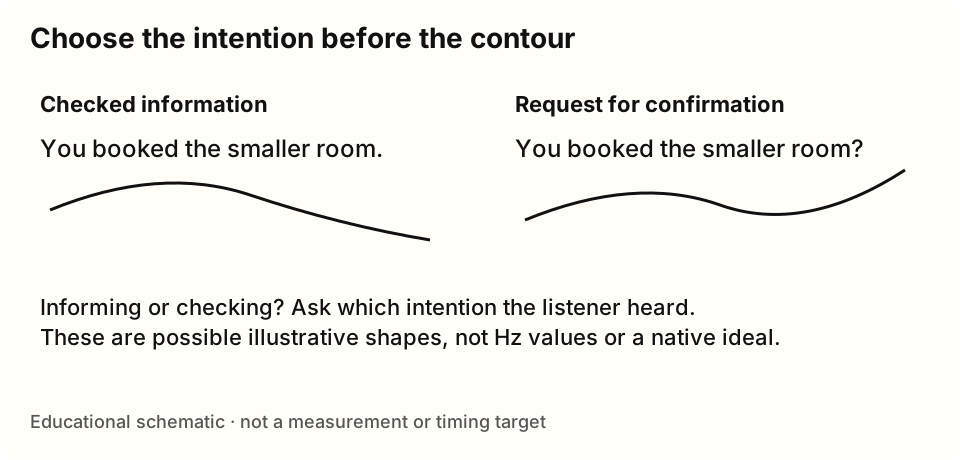
A worked contrast
You booked the smaller room. [intention left undecided]
Checked information: 'You booked the smaller room.' / Confirmation request: 'You booked the smaller room?'
Say which version you mean. Ask a listener whether you were informing or checking; do not ask them to rate how musical it sounded.
Practise one change
- Choose one intention and read the passage.
- Read the short contrast with the other intention.
- Listen for a difference that a person could interpret.
- Return to the full passage and preserve its condition or qualification.
What to listen for
- Did the delivery invite the intended response?
- Did a condition sound attached rather than added after an apparent final answer?
Do not force low endings, chase pitch range or copy another person's voice. A visible contour alone does not establish the intention heard.
Four texts to work through
Read for meaning first. Record with your usual recorder if you want audio. Use the rehearsal to try one change in a short excerpt. Close the full-text disclosure for recall. Use the anchors if you need a cue, and open the answers after your attempt.
01 · A question or a confirmation
Read the full text · close it for recall
Meaning to preserve: Distinguish a checked statement from a request for confirmation. Name the intended version before you read.
The sentence is short: you booked the smaller room. In one conversation, the speaker is giving information that has already been checked. In another, the same words ask whether the booking is correct. The listener needs to recognise the intention before answering. Word order alone does not always settle that difference in conversation. Intonation, timing and the surrounding exchange can all contribute. For this reading, decide which intention you mean and keep it consistent. The task is to make a real distinction audible, not to force every statement down and every question up.
Rehearse one line
you booked the smaller room.
Try. Say the quoted words once as a confirmed update and once as a real question. Let the intention change your delivery while keeping the words the same.
Listen back. Which take invited an answer? If you can, ask someone before you tell them the intended versions.
Recall anchors · less support
- smaller room
- checked fact
- confirmation request
Check meaning after your retelling
Equivalent wording is welcome. These are checks against the fictional source, not automatic scores or proof that a listener understood.
What two intentions can the short sentence carry?
It can give already checked booking information or ask whether that booking is correct.
What must be chosen before this reading?
The intended version: informing or checking. The exercise does not impose one contour on every English sentence.
02 · The condition is still coming
Read the full text · close it for recall
Meaning to preserve: Keep permission and the dry-weather condition together; avoid making the opening sound unconditional.
We can use the courtyard for the evening reading, provided the weather stays dry. The first part sounds like a complete agreement, but the condition changes what has actually been agreed. If the speaker gives the first clause a final-sounding ending and rushes the rest, a listener may remember permission without its limit. Keep the two parts connected while making the condition easy to hear. This does not require one fixed pitch pattern. It requires the listener to hear that the thought remains open until the relevant qualification has arrived.
Rehearse one line
We can use the courtyard for the evening reading, provided the weather stays dry.
Try. Let the words before “provided” lead into the condition. Give “stays dry” time to finish the whole thought.
Listen back. Would the listener understand that the courtyard is available only if the weather stays dry?
Recall anchors · less support
- courtyard reading
- dry weather
- permission plus condition
Check meaning after your retelling
Equivalent wording is welcome. These are checks against the fictional source, not automatic scores or proof that a listener understood.
What limits use of the courtyard?
The weather must stay dry.
What mistaken message could a final-sounding first clause leave?
Unconditional permission, with the weather condition treated as an unimportant addition.
03 · A list with one destination
Read the full text · close it for recall
Meaning to preserve: Make the three requirements recoverable and the end of the list clear without treating each item as a separate speech.
The repair café needs a table, a safe place for tools and someone to welcome visitors. Those are three parts of one plan, not three unrelated announcements. The welcome role comes last, but it matters as much as the furniture. A reader can keep the early items moving and let the final item complete the list. Another reader may use a different natural pattern and still make the structure clear. After listening, check whether all three needs remain recoverable. More melody is not automatically more useful, and a list should not sound like a series of sales slogans.
Rehearse one line
The repair café needs a table, a safe place for tools and someone to welcome visitors.
Try. Let “a table” and “a safe place for tools” lead into the next item. Give “someone to welcome visitors” room to complete the list.
Listen back. Did you hear all three needs, and did the list sound complete only after the last one?
Recall anchors · less support
- table
- safe tool place
- welcome person
Check meaning after your retelling
Equivalent wording is welcome. These are checks against the fictional source, not automatic scores or proof that a listener understood.
What are the three needs in the plan?
A table, a safe place for tools and someone to welcome visitors.
Why does the final item need to remain clear?
The welcome role matters as much as the furniture and completes the list; it is not a disposable ending.
04 · Agreement with a limit
Read the full text · close it for recall
Meaning to preserve: Keep both openness and the smaller-group limit audible; do not turn a possible trial into a commitment to expand.
The proposal could work for the smaller group. That is a real opening, but it is not agreement to expand the project immediately. The speaker is willing to try one session with twelve people and review what happens afterwards. If the reading sounds dismissive from the start, the opening disappears. If it sounds fully settled, the limit disappears. Keep both ideas available: a genuine possibility and a boundary on the decision. Listen for whether the words and the delivery tell the same story. The aim is a useful qualified answer, not a performance of confidence.
Rehearse one line
The proposal could work for the smaller group.
Try. Read the first sentence as a genuine possibility. Give “smaller group” enough room to carry the limit without closing off the idea.
Listen back. Did the listener hear a possible trial with the smaller group?
Recall anchors · less support
- possible trial
- twelve people
- review before expansion
Check meaning after your retelling
Equivalent wording is welcome. These are checks against the fictional source, not automatic scores or proof that a listener understood.
What is the speaker actually willing to try?
One session with a smaller group of twelve, followed by a review.
Which two meanings must the delivery preserve together?
A genuine possibility and a boundary on the decision, rather than either dismissal or full agreement to expand.
Check what carries over
- Repeat without the cue. Return to 01 · A question or a confirmation. Read once in your usual voice with the rehearsal closed.
- Change the text. Try 04 · Agreement with a limit before opening its cue. Ask whether the speaker was open to a trial, dismissing it, or agreeing to expand. Let the listener answer before showing the passage.
- Come back later. Retell the second passage before rereading it on another day. Then check which details survived.
If you already know the second passage, treat it as a familiar repeat. Check what the listener understood and how much effort it took as two separate things.
Practising alone? Close the passage, listen to your take once, and answer the listener question from playback before opening the reference. Without a recording, retell the passage from memory and use the reference to check which ideas you kept.
Compare after listening or retelling
The speaker is open to one trial session with twelve people, followed by a review. They have given no agreement to expand the project immediately.
If the distinction disappears. Say the opening and the qualification as two connected thoughts. Give the qualification room before you let the idea sound complete.
Your recording and Voice Trail
In the desktop development build, open Library → Ptichi Academy → Intonation that carries an intention. Every take belongs to its text and source version. Reopen its recording and supported Voice Trail for review. Missing observations remain unavailable; this website does not record or calculate personal voice metrics.
Exercise identity and content version → lesson item → attempt → immutable recording/hash → supported observation and source-time trail. Missing or mismatched evidence stays unavailable. A web schematic is never a measured Voice Trail.
Use an ordinary, comfortable voice and ordinary breath opportunities. Stop voiced practice for pain, unusual hoarseness, dizziness or breathing difficulty. Persistent voice changes need an appropriate clinician. This is speech practice, not diagnosis, a prescribed breathing treatment or a promise to remove every voice problem.