
Words a listener can distinguish
Repair the particular word a listener could confuse, then put it back into a normal phrase.
Fifteen and fifty, two similar names or a final location word can lead to different actions even when the rest of the reading sounds smooth.
Speaking rule
Repair the one word the listener could confuse
Say “The label says fifteen.” If someone hears “fifty,” say “Fifteen. One-five.” Then put “fifteen” back into the full sentence at your normal speaking pace.
Listen back. Could the listener write down the intended number after hearing the sentence? Use the short clarification again if the two words still sound alike.
Try another text. Choose a name, number or term in the next text and try a short clarification that would help someone recover that exact word.
Short exercise
Make two similar words distinguishable
Please write “coat” on the tag. / Please write “goat” on the tag.
- Choose one version without showing the line. Say it at your usual pace and ask a listener to write the word. Swap the order before trying the other version.
- If a word gets confused, repeat just “coat” or “goat” once in “write ___ on the tag,” then say the full line. If you practise solo, mark any difference you can hear as self-review.
- Try the same phrase-to-sentence repair on the quantity in the linked passage.
Check. Which exact word came through? Keep an unsure answer rather than counting a guess as clear speech.
Compare after trying
The intended answers are coat and goat. If the distinction still gets lost, clarify the word by meaning, such as “coat, the thing you wear.”
The lips, tongue, jaw and vocal tract help shape the sound of words. This course does not infer their movement from a waveform or use similarity to a native accent as a target.
Choose the exact distinction that matters. Read the word in a short phrase, then in the full sentence. If it remains confusing, use a plain verbal repair such as 'fifteen, not fifty'. That is successful communication, not a failure to sound flawless.
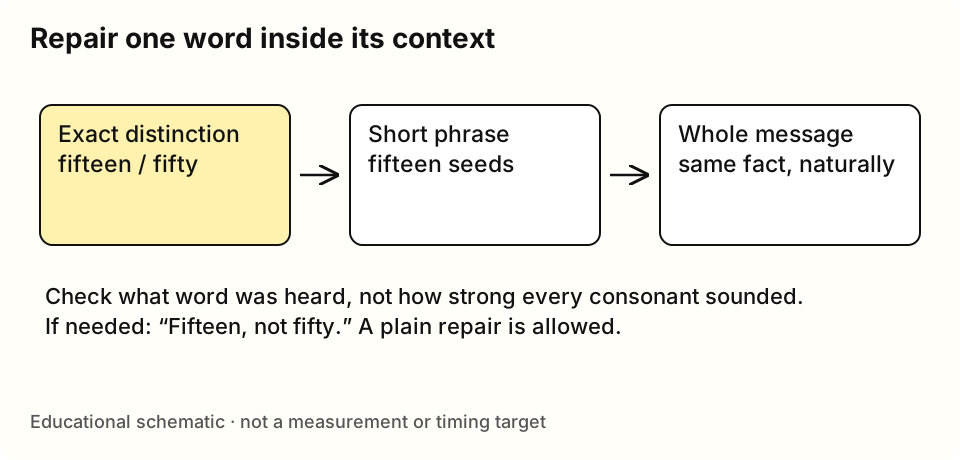
A worked contrast
There are fifty seeds. Sorry, I mean the other number.
There are fifteen seeds — fifteen, not fifty.
The repair names the exact alternative instead of asking the listener to guess which sound was intended.
Practise one change
- Choose one name, number or word from the passage.
- Read it inside its short phrase, comfortably.
- Read the whole sentence without exaggerating the other words.
- Ask what exact word was heard, or mark self-listening as self-listening.
What to listen for
- Which exact word was recovered?
- Did the repair preserve the original fact?
- Could the word stay clear in the surrounding sentence?
Do not drive every consonant harder or treat an accent as an error. If a term is unfamiliar, explanation may help more than pronunciation work.
Four texts to work through
Read for meaning first. Record with your usual recorder if you want audio. Use the rehearsal to try one change in a short excerpt. Close the full-text disclosure for recall. Use the anchors if you need a cue, and open the answers after your attempt.
01 · Fifteen seeds, not fifty
Read the full text · close it for recall
Meaning to preserve: Distinguish fifteen from fifty and preserve the voluntary return. Practise the number in its whole phrase rather than forcing every consonant.
The seed library lends small packets to local gardeners. Each packet holds fifteen seeds, not fifty, and the label names both the plant and the month when it was collected. People return seeds after a successful harvest, but a return is an invitation rather than a condition of borrowing. The volunteer explains the number before describing the wider project. A listener who remembers an inspiring story but takes the wrong amount has missed something practical. The important words need to be distinguishable in an ordinary sentence, without turning the whole explanation into a spelling test.
Rehearse one line
Each packet holds fifteen seeds, not fifty, and the label names both the plant and the month when it was collected.
Try. Isolate “fifteen seeds, not fifty” once. Say it back inside the sentence at your ordinary pace.
Listen back. Could someone write down the packet count from that one reading?
Recall anchors · less support
- fifteen, not fifty
- plant and month
- voluntary return
Check meaning after your retelling
Equivalent wording is welcome. These are checks against the fictional source, not automatic scores or proof that a listener understood.
How many seeds are in each packet?
Fifteen, not fifty.
Must a gardener return seeds in order to borrow?
No. Returning seeds after a successful harvest is an invitation, not a borrowing condition.
02 · A name and a responsibility
Read the full text · close it for recall
Meaning to preserve: Keep Mara and Martin distinct and attach the right responsibility to each name.
Mara chooses the books, and Martin arranges the deliveries. Their names appear next to each other on the notice, which makes a hurried introduction surprisingly easy to misunderstand. If a parcel is missing, Martin is the first contact. If someone wants to suggest a title, Mara can explain the selection process. Neither person is responsible for every part of the library. A useful introduction makes the names and the different jobs clear enough to recover later. It does not need exaggerated pronunciation; it needs a listener to leave with the right person in mind.
Rehearse one line
Mara chooses the books, and Martin arranges the deliveries.
Try. Say each name with its job in one short phrase. If the names blur, repeat “Martin arranges the deliveries” on its own before reading the whole sentence again.
Listen back. Who would the listener contact about a delivery?
Recall anchors · less support
- Mara books
- Martin deliveries
- different contacts
Check meaning after your retelling
Equivalent wording is welcome. These are checks against the fictional source, not automatic scores or proof that a listener understood.
Who should receive a question about a missing parcel?
Martin, who arranges deliveries.
What does Mara do?
She chooses the books and can explain the selection process or discuss a suggested title.
03 · The final word changes the plan
Read the full text · close it for recall
Meaning to preserve: Make east gate recoverable, while keeping the unchanged meeting time separate from the location correction.
The walking group meets at the old station, beside the east gate. A message in the group chat originally said west, so the organiser sends a short correction. The meeting time is unchanged. There is no need to repeat the whole route or apologise for several minutes. The correction must simply make east distinguishable and keep it attached to gate. Someone listening while packing a bag should be able to recover the changed location. A clear final word is useful because it changes where a person goes, not because every sentence must end with a dramatic vocal landing.
Rehearse one line
The walking group meets at the old station, beside the east gate.
Try. Say “east gate” clearly as a unit. If the location is still unclear, give it separately as a short correction and return to the sentence.
Listen back. Can the listener name both the station and the correct gate?
Recall anchors · less support
- old station
- east gate
- time unchanged
Check meaning after your retelling
Equivalent wording is welcome. These are checks against the fictional source, not automatic scores or proof that a listener understood.
Where should the group meet after the correction?
Beside the east gate at the old station.
What did the correction leave unchanged?
The meeting time; only the east-versus-west location was corrected.
04 · A short repair inside a longer thought
Read the full text · close it for recall
Meaning to preserve: Preserve three prints plus one original drawing. Make the category correction clear without restarting the whole explanation.
The exhibition contains three prints and one original drawing. During the introduction, the guide accidentally calls all four pieces prints. She corrects the category in the next sentence and continues with the artist's method. The visitor does not need an entirely new introduction. They need the distinction between a reproduced image and the original drawing. In the repeat, the guide gives that phrase enough room to be heard, then returns to an ordinary pace. A repair can be small and precise. Starting everything again would add more words while leaving the same uncertainty unresolved.
Rehearse one line
The exhibition contains three prints and one original drawing.
Try. Say “three prints” and “one original drawing” as two complete units. Keep the category word audible in each.
Listen back. How many pieces belong to each category?
Recall anchors · less support
- three prints
- one drawing
- local correction
Check meaning after your retelling
Equivalent wording is welcome. These are checks against the fictional source, not automatic scores or proof that a listener understood.
What four pieces are actually in the exhibition?
Three prints and one original drawing.
Why does the guide not need a new introduction?
The exact category can be corrected locally before continuing; the rest of the introduction need not change.
Check what carries over
- Repeat without the cue. Return to 01 · Fifteen seeds, not fifty. Read once in your usual voice with the rehearsal closed.
- Change the text. Try 04 · A short repair inside a longer thought before opening its cue. Ask the listener to write down the two kinds of artwork and how many of each they heard.
- Come back later. Retell the second passage before rereading it on another day. Then check which details survived.
If you already know the second passage, treat it as a familiar repeat. Check what the listener understood and how much effort it took as two separate things.
Practising alone? Close the passage, listen to your take once, and answer the listener question from playback before opening the reference. Without a recording, retell the passage from memory and use the reference to check which ideas you kept.
Compare after listening or retelling
The exhibition has three prints and one original drawing. The visitor should be able to repeat both counts and categories.
If the distinction disappears. Say just the count and category that blurred, then read the whole sentence at your usual pace.
Your recording and Voice Trail
In the desktop development build, open Library → Ptichi Academy → Words a listener can distinguish. Every take belongs to its text and source version. Reopen its recording and supported Voice Trail for review. Missing observations remain unavailable; this website does not record or calculate personal voice metrics.
Exercise identity and content version → lesson item → attempt → immutable recording/hash → supported observation and source-time trail. Missing or mismatched evidence stays unavailable. A web schematic is never a measured Voice Trail.
Use an ordinary, comfortable voice and ordinary breath opportunities. Stop voiced practice for pain, unusual hoarseness, dizziness or breathing difficulty. Persistent voice changes need an appropriate clinician. This is speech practice, not diagnosis, a prescribed breathing treatment or a promise to remove every voice problem.
Sources and limitations
NIDCD — Taking Care of Your Voice · Basic voice production, vocal-care context and avoiding overuse or force. Does not validate this curriculum, a daily vocal dose, a breath diagnosis from audio or a universal pitch/loudness target.
Lam and Tjaden — Intelligibility of Clear Speech: Effect of Instruction (2013) · Twelve speakers and forty listeners: different clear-speech instructions changed sentence transcription accuracy in background babble. A controlled English reading task, not a long-term training trial. Instruction order, individual variation and listening conditions limit transfer; no universal articulation or accent target follows.