

Your rehearsed answer can improve because the wording becomes familiar. That does not yet show you can use the same speaking change on a new question. Check it in stages: the same sentence without one visual cue, new wording, then a comparable new prompt.
Research
The memorized sentence trap: when rehearsal improves the answer but not the skill
Rehearsal can help one answer without proving transfer. Try one cue-free take, then change the wording while keeping the facts.
Try the first check now. Choose one sentence you have practised, put its marked version out of sight and say it once in your usual recorder. Keep the facts and recording setup the same. Listen afterward for the one thing you were practising: a clear condition, an important word or an audible ending. A difficult retry is information about that attempt, not a diagnosis of why it failed.
This is the memorized sentence trap: a useful improvement can remain partly attached to one prepared answer. Repetition still has a job. It can help you find and control a difficult behavior; an exact sentence may also be exactly what you need to deliver tomorrow.
But supported performance, changed-material performance and a later cold attempt answer different questions. Removing a cue is also different from removing your chance to listen and check. You can try the ladder below with any recorder; the Ptichi desktop product is still in development.
Repetition makes the task easier in several ways at once
Suppose you are preparing an interview answer:
I chose the second migration approach because it kept the rollback path open while we validated the new integration.
Take A is awkward.
You pause in the middle of “because.”
You rush “rollback path.”
The final clause arrives without much structure.
You repeat it.
By Take Four, the sentence is smooth.
What changed?
Possibly the speaking control you were training.
But several other things changed too.
You no longer need to decide what to say.
The lexical sequence is familiar.
The difficult phrase is expected.
The conceptual structure is known.
You may remember exactly where you paused last time.
You know the task is about to end.
All of that reduces the processing burden.
That is why a better repeated take is evidence of something useful—but not evidence of everything we care about.
Same-task improvement and skill transfer are different questions
A rehearsal can ask:
Can you produce this behavior under support on this material?
A transfer test asks:
Can you produce the same behavior when the material changes?
Consider a thought-boundary exercise.
Practiced sentence:
The migration is complete / but monitoring is still open.
You train the contrast until it sounds clear.
Now change the wording:
The software is ready / but the access review is not.
If the useful boundary survives, the behavior is less tied to the first sentence.
Change the task again:
Explain one project decision and one condition that could reverse it.
Now there is no slash.
No memorized wording.
No exact location for the cue.
The speaker has to reconstruct the principle.
That is the point of transfer.
Research on task repetition shows why the distinction matters
Second-language speaking research gives a useful warning, even though its population and tasks are not the same as Ptichi's professional-speech use case.
Suzuki and Hanzawa had EFL learners repeat the same oral narrative six times under different schedules. On an immediate posttest using a new cartoon story, massed same-task repetition reduced some kinds of pauses more than the spaced conditions. But the massed group also showed slower articulation and more verbatim repetition on the novel task. Differences between repetition schedules were limited on the one-week delayed novel-story test. Massed task repetition is a double-edged sword for fluency development.
That is not a verdict against repetition.
It is a good example of why “the practiced performance improved” is too broad a summary.
Different aspects of fluency moved differently.
Some benefits carried into new material.
Some costs appeared.
Later effects were more limited.
A second study complicates the story further. Suzuki compared blocked practice—repeating one narrative before moving to another—with interleaved practice across several oral narrative tasks. On new cartoon narratives, blocked practice produced larger gains on some fluency measures, including articulation rate and mid-clause pause duration, while several advantages observed during training did not meaningfully transfer. Optimizing Fluency Training for Speaking Skills Transfer.
The lesson is not:
always vary the task.
And it is not:
always repeat the task.
The more defensible lesson is:
Acquisition and transfer need to be measured separately because a practice schedule can help one aspect and not another.
These were EFL narrative studies, not workplace coaching trials. They do not validate Ptichi's exact transfer sequence.
They give us a useful experimental mindset.
Repetition is good at exposing a control
Why repeat at all?
Because speech is complicated.
When the wording is stable, you can reduce some of that complexity and concentrate on one variable.
For example:
The release is ready / but security approval is still open.
Take A: natural.
Take B: one clearer boundary.
Take C: slightly smaller boundary, trying to keep it natural.
That sequence can teach you what the boundary feels and sounds like.
Changing the sentence too early can make it difficult to know whether you ever acquired the control.
So the Ptichi model does not treat same-material practice as fake progress.
It treats it as a stage.
The mistake is stopping there.
The polished-answer illusion
Interview preparation makes the trap especially visible.
A candidate rehearses:
Tell me about a conflict you handled.
They build a strong answer.
The opening is concise.
The example has structure.
The conclusion is clear.
After several repetitions, the answer sounds spontaneous.
Then the interviewer asks:
Tell me about a time you disagreed with someone who had more authority than you.
The content is related.
The prepared script no longer fits.
Now one of two things happens.
The script takes over
The speaker forces the memorized answer into the new question.
It sounds fluent but slightly wrong.
The script disappears
The speaker starts from zero and loses the structure they had “learned.”
Both reveal the same problem:
the training object may have been the answer, not the skill.
A useful speaking product needs a bridge between those two.
Change the surface, preserve the job
Transfer does not require making everything different.
That would create a new problem: you would no longer know what skill is being tested.
The useful design is:
change the surface while preserving the underlying communicative job
If the trained skill is thought grouping:
- change the topic;
- keep a comparable two-part relationship.
If the trained skill is prominence:
- change the sentence;
- keep one contrast the listener must recover.
If the trained skill is local pace:
- change the numbers and condition;
- keep one dense information region.
If the trained skill is statement finality:
- change the statement;
- keep the speech act definite.
This is why Ptichi's planned transfer stage uses changed wording, not random difficulty.
The challenge should move enough to break memorization while preserving enough structure to test the same skill.
The three-level transfer ladder
You can use a simple ladder with any recorder.
Level 1 — same words, less support
Practise:
We can start Friday / if the security review is complete.
Use one cue.
Then put that one visual cue out of sight and repeat the same sentence. Keep the wording, facts and recorder unchanged. Note which support you removed; “no cue” should not mean removing every kind of help at once.
Before replaying, write a short prediction: “I think the condition was clear” or “I may have rushed the ending.” Then listen once. Keep prediction and playback observation separate. You are still allowed to check the recording after the take.
Question:
Does the behavior survive when the visual support disappears?
This is still close to acquisition.
Level 2 — same meaning, new words
Keep the visual cue hidden, as in Level 1. Now hide the exact sentence too, while keeping its facts available.
Say the same idea in your own wording:
Friday works only after security signs off.
Question:
Does the useful boundary or emphasis survive paraphrase?
Now memorized acoustics help less.
Level 3 — same skill, new situation
Use a different prompt:
Explain a deadline and one condition that could move it.
Question:
Can you recreate the control without the old content?
This asks a more distant transfer question. Choose a situation whose facts you already know, with a comparable listener job. A prompt that requires unfamiliar technical knowledge changes more than speaking control.
If a listener helps, note whether they already know the facts or heard an earlier version. Correct recovery by a familiar listener is useful, but it does not isolate what the new recording supplied.
None of these proves long-term retention.
That needs time.
Transfer should make the metric less comfortable
A poorly designed metric likes repetition.
Same sentence.
Same expected timing.
Same target word.
Same acoustic region.
Everything aligns cleanly.
Transfer creates mess.
The word count changes.
The target moves.
The phrase length changes.
The pitch contour may naturally change.
The speaker chooses different syntax.
That mess is useful because real speaking is messy.
If an automatic metric only works when the exact script is fixed, it may still be useful during acquisition.
It should not silently pretend to measure transferable skill.
Ptichi's technology direction therefore separates exact text alignment from broader relationship-level evidence.
A thought boundary can sometimes be checked without demanding the same words.
Exact word prominence may require much stronger semantic and alignment evidence.
The right response can be:
This automatic check is not available for the transfer attempt. Listen for the boundary instead.
A manual test is better than a fake precise test.
Why new wording can expose overcorrection
Transfer does more than detect memorization.
It also exposes technique that has become too rigid.
Suppose you trained a strong pause before “but”:
The release is ready / but security is still open.
It sounds good.
Now you use the same pause pattern on:
We delayed the rollout because the supplier changed the specification.
There is no contrastive “but.”
The learned choreography may no longer fit the meaning.
This is one reason transfer and the overcorrection problem belong together.
A real skill is not:
insert the trained acoustic event.
It is:
recognize when the communicative function exists and produce an appropriate version of the control.
That requires flexibility.
Reduce a prompt, keep a way to check
A marked script can show where to pause. A live display can provide information while you speak. Playback or another person's response can help you review a finished attempt. These supports have different jobs; removing one does not require removing them all.
Research suggests: Zhang's 2026 review of acoustic spectral feedback discusses possible dependence on feedback shown during vocal practice. It mainly reviews singing and vocal learning. Its guidance-dependency curves are conceptual illustrations, not measured performance trajectories. The review does not establish when to move from live feedback to feedback after a take, or validate a workplace-speech schedule.
A 2025 meta-analysis of self-controlled feedback adds a different distinction: learners choosing when feedback is available is not the same intervention as removing it. Its checked abstract reports 29 motor-learning studies with 1,147 participants: no clear overall advantage during acquisition, but benefits on retention and transfer tests. That does not establish this speech-rehearsal protocol, and the abstract cannot settle the included studies' bias or feedback-dose details.
Our read: Try one attempt without the visible prompt, then give yourself a way to inspect it. The question is whether you can choose and produce the useful change, not whether you can endure practice without help. If you lose the point or begin forcing the voice, restore one useful cue and simplify the task. “Less feedback” is not a prize.
For Ptichi, this means keeping cue presence, feedback timing and wording change separate in a future comparison. We would reconsider this approach if direct adult speech studies showed that these extra checks did not improve training decisions or made practice harder without useful information. No automatic withdrawal schedule is established or released.
A strong Take B is acquisition evidence
Ptichi's internal evidence model uses a deliberately unglamorous distinction.
Suppose:
Take A → one cue → Take B.
Take B improves the target.
Good.
That can justify:
The target behavior changed in this rehearsal.
It should not automatically justify:
You learned this skill.
For that, the result has to survive more attacks.
Different wording.
Less support.
A different but comparable task.
Later time.
Eventually, a real situation.
This hierarchy protects us from turning one successful session into a progress story the evidence has not earned.
A worse transfer attempt can still tell you what to try
Take B is clear. The new answer is harder to follow. That difference can guide the next attempt, but it does not explain itself. New facts, a harder sentence, fatigue, capture changes or the missing cue may all matter.
Use the pattern as a question, not a learner label:
| What you noticed | A bounded next check |
|---|---|
| The same words were easier with the visual cue. | Restore that cue for one retry, then try without it again. One comparison cannot establish feedback dependency. |
| The cue-free sentence worked, but new wording lost a condition. | Check the facts and sentence structure before changing vocal delivery. Use one cue if it helps preserve that condition. |
| A later cold attempt was harder. | Record it separately from today's immediate comparison. A short refresher may help; one pair does not measure a rate of forgetting. |
| The recorder, listener's prior knowledge or task difficulty changed. | Mark the cause as unknown and make the next comparison more comparable. |
An honest note might be: “The boundary was audible in my prepared sentence. In new wording, I left out the condition.” That describes the two observations and gives you a next task. It does not claim a general skill score or a cause of failure.
The memorized sentence can still be valuable
There is a reasonable counterargument.
Prepared material lets people focus.
Actors rehearse lines.
Language learners repeat phrases.
Musicians repeat passages.
Speakers rehearse key moments.
The problem is not memorization itself.
If you need to deliver one exact sentence tomorrow, improving that sentence has direct value.
A legal disclaimer, product name, opening line or difficult phrase may need exact practice.
The mistake is claiming a broader skill outcome than the practice supports.
If your goal is:
deliver this exact sentence clearly,
same-sentence practice can be the right task.
If your goal is:
handle this kind of speaking problem spontaneously,
you need transfer.
The training design should follow the claim.
A practical interview experiment
Choose one question:
Tell me about a project that went wrong.
Record Take A.
Listen for one target only:
Does the answer establish the problem before the details branch?
Make one change.
Record Take B.
Do not repeat it five more times.
Now use a transfer question:
Tell me about a decision you would make differently today.
Keep the same structural target:
main situation first → useful detail second
Do not reuse the first story if you can avoid it.
Then use a third prompt:
Explain one current risk and what you are doing about it.
Can the structural behavior survive a completely different answer?
That is a much more interesting result than polishing the first answer until it sounds effortless.
A practical voice-control experiment
Use one sentence:
The next step is the security review.
Train phrase-end stability until security review remains clear.
Now change only the final item:
The next step is the customer sign-off.
Then change the sentence shape:
Before we proceed, the customer still needs to sign off.
Finally, explain the same next step without a script.
At each stage ask:
Did the final useful information survive?
Do not demand identical pitch, duration or loudness.
The function should transfer.
The waveform does not need to.
Later is a different test again
Immediate transfer can still benefit from the session you just completed.
The cue is fresh.
The target is fresh.
Your attention is focused on the skill.
A later check asks whether you can retrieve the behavior after that temporary support has faded.
Research on learning and retention is complicated, and speech-specific evidence often comes from tasks unlike professional communication.
For example, a 2026 systematic review of speech-perceptual learning found that sleep-related effects were more consistently associated with stabilization than with universal enhancement or generalization. The review was heterogeneous and mainly concerned perception, not Ptichi-style speech production.
So Ptichi should not build a “sleep improves your voice” feature.
The useful methodological consequence is smaller:
do not call immediate transfer retention.
If the product eventually says a skill is retained, it should have a later observation that actually tests that claim.
Our read
Speech training products have a natural bias toward the practiced take.
That is where the cleanest data lives.
The script is known.
The target is known.
The user is engaged.
The model can align everything.
The improvement looks impressive.
Real speech begins when those conveniences start disappearing.
That is why Ptichi's training architecture increasingly looks like:
perceive → control → vary → transfer → retain → apply
The first two stages make learning possible.
The later stages prevent the product from mistaking its own exercise for the user's skill.
The product should become less certain as the task becomes more realistic unless the evidence catches up.
That is a healthy direction.
What would change our view
We would simplify the transfer machinery if evidence showed that same-material improvement reliably predicted performance on new wording for a particular skill and population.
We would also narrow it if users found changed-wording checks confusing and the added complexity did not change training decisions.
And the task-repetition evidence itself argues against simplistic rules.
Blocked repetition outperformed interleaving on some transfer measures in one L2 study.
Massed repetition produced both advantages and costs in another.
There is no honest basis for:
variation is always better.
The Ptichi claim is weaker and more testable:
If we want to claim a skill transferred, we should observe it under some form of changed material rather than infer transfer from the practiced sentence alone.
What this does not prove
The task-repetition studies cited here involve second-language learners performing oral narratives.
They do not validate Ptichi, workplace interview rehearsal, thought-group training or our exact transfer ladder.
The feedback and sleep research comes from different learning domains and should not be combined into a fake universal learning theory.
The exercises on this page are Ptichi editorial protocols.
A better transfer attempt does not establish real-world benefit.
A worse transfer attempt does not establish that the original practice was useless.
Each observation answers a bounded question.
Stop polishing before the sentence becomes the skill
Repetition has a job.
It helps you discover and control a behavior.
Then the material should start moving.
Change the wording.
Change the example.
Change the prompt.
Remove a cue.
Come back later.
The goal is not to make Take Six beautiful.
It is to make the useful behavior available when Take Six no longer exists.
For the broader product method, read How Ptichi works.
For one simple changed-wording exercise, use Two thoughts. One useful pause..
And if your second take looks better because you changed too many things at once, start with Can you really compare two voice recordings?.
The question after a good rehearsal is not only:
Did I improve this answer?
It is:
What survives when the answer changes?
What you can verify on this page
This page includes a Ptichi-authored example built for explanation or rehearsal.
What it does not support: It is an editorial example, not an observed-user result, experiment or proof that Ptichi improves speech.
This page includes a bounded listen-and-compare exercise that you can run with your own recorder.
What it does not support: The exercise does not prove that Ptichi improves speech or that a second take will generalize to other listeners or situations.
Sources and boundaries
Where shown, check notes record what Ptichi's editorial agent read for this article. They are separate from the source's registered review date and do not establish expert approval or show that an exercise works.
Massed task repetition is a double-edged sword for fluency development: An EFL classroom study primary-research · 2026-10-03
What it supports: EFL learners repeated the same oral narrative six times under massed or spaced schedules. On an immediate novel-story posttest, massed repetition reduced mid-clause and clause-final pauses most, but was associated with slower articulation and more verbatim repetition; schedule differences were limited on the one-week delayed novel-story test.
What it does not support: Short classroom study with Japanese university EFL learners and cartoon narratives. It does not establish an optimal repetition schedule for professional speech, prove Ptichi transfer or retention, or show that changed wording should replace useful acquisition practice.
Optimizing Fluency Training for Speaking Skills Transfer: Comparing the Effects of Blocked and Interleaved Task Repetition primary-research · 2026-10-03
What it supports: EFL learners practised three oral narrative tasks for three days under blocked or interleaved repetition. On new cartoon narratives, blocked practice produced larger pretest-to-posttest gains on some fluency measures including articulation rate and mid-clause pause duration, while several training advantages did not transfer.
What it does not support: Specific L2 narrative tasks and short training period. The study does not validate a universal blocked-practice rule, Ptichi's changed-wording transfer design, professional-speaking outcomes or long-term retention.
Acoustic spectral feedback in vocal learning: a systematic review of psychological mechanisms and skill outcomes systematic-review · 2026-09-14
Editorial check for this article: Full text ·
What it supports: A 36-study narrative systematic review describes a trade-off between the immediate guidance offered by concurrent acoustic/visual feedback and possible guidance dependency after feedback removal; it recommends treating a gradual shift toward terminal feedback as a testable practice direction rather than an established universal rule.
What it does not support: The evidence is mostly vocal-learning and singing research, not professional workplace speech. The review reports major mechanism-testing gaps and explicitly does not establish the optimal timing of feedback withdrawal or Ptichi efficacy.
Self-Controlled Feedback and Behavioral Outcomes in Motor Skill Learning: A Meta-Analysis meta-analysis · 2026-09-27
Editorial check for this article: Abstract only ·
What it supports: A meta-analysis of 29 motor-learning studies (1,147 participants) reported no clear overall self-controlled-feedback advantage during acquisition, but benefits on retention and transfer tests compared with passively received feedback conditions.
What it does not support: The included tasks and populations were heterogeneous and mostly not speech tasks; publication and design biases remain. This does not establish that learner-requested feedback improves professional speech rehearsal or Ptichi outcomes.
The Differential Impact of Sleep-Dependent Consolidation in Speech Perceptual Learning: A Systematic Review systematic-review · 2026-09-27
What it supports: A qualitative review of 30 speech-perceptual-learning studies (1,646 participants, primarily healthy young adults) found sleep most consistently supported stabilization against wake-related degradation. Enhancement appeared in approximately half of studies; generalization was most consistent with sufficient training variability.
What it does not support: Heterogeneous designs and measures prevented meta-analysis. The reviewed tasks were mainly speech perception, not professional speech production; this does not establish a Ptichi training effect, optimal practice schedule, sleep intervention or transferable workplace skill.
Reviewed:
Related

Practice
Two thoughts. One useful pause.
A short listening exercise: record a contrast, make the boundary audible, then try it with new words.
Product
How Ptichi works: the speech-practice technology we are building
Inside Ptichi: programmes, prepared practice text, two-take comparison, local recording, bounded feedback, retests and a history of the skill.
Research
The overcorrection problem: when speech training makes you sound worse
Why more pause, more pitch, more articulation or more volume can improve a metric while making speech less natural or less useful.
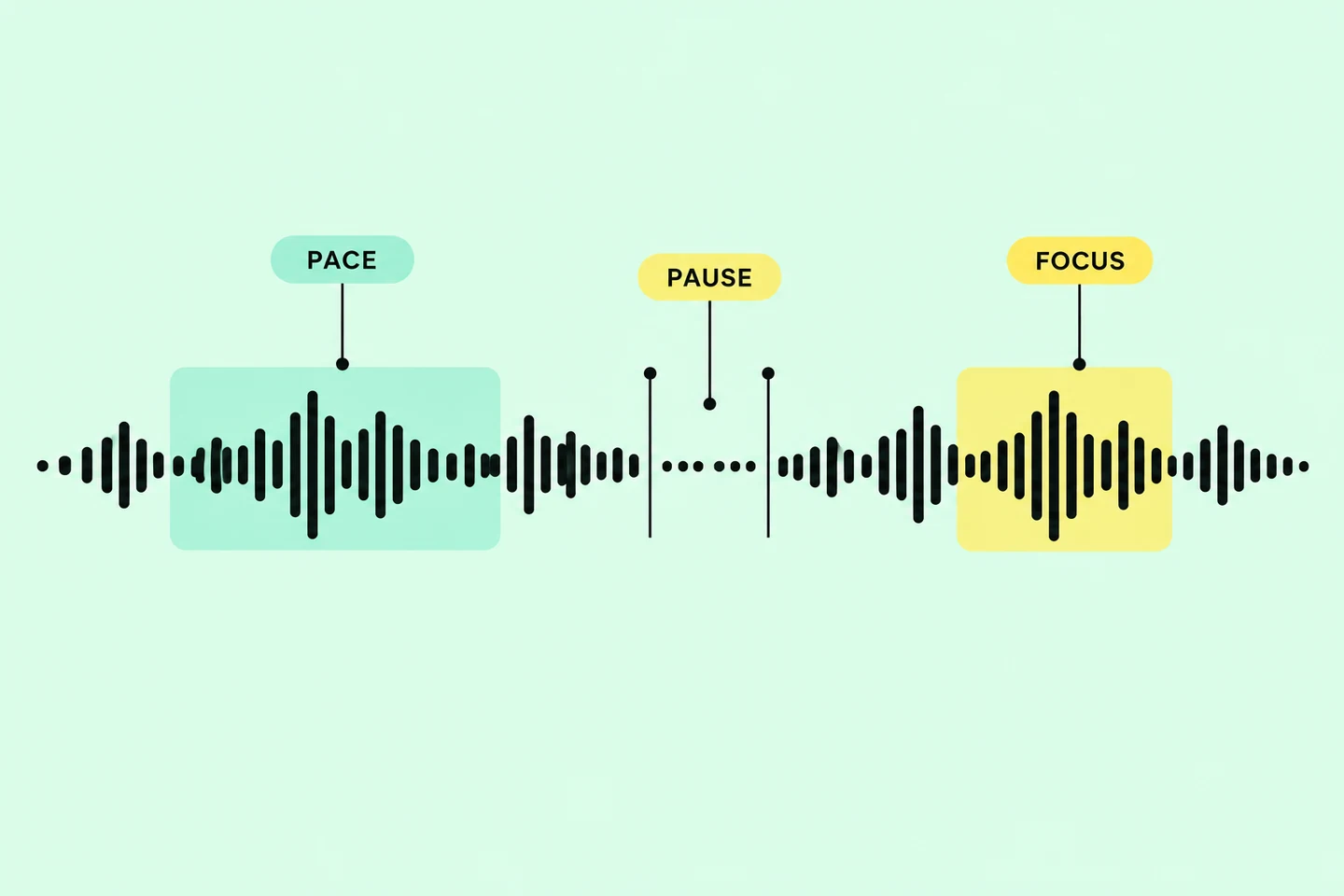
Techniques
How to adjust your speaking pace without an ideal WPM target
Try one timing change around a key fact, then compare listener understanding, effort and naturalness. A WPM count alone cannot choose the best pace.
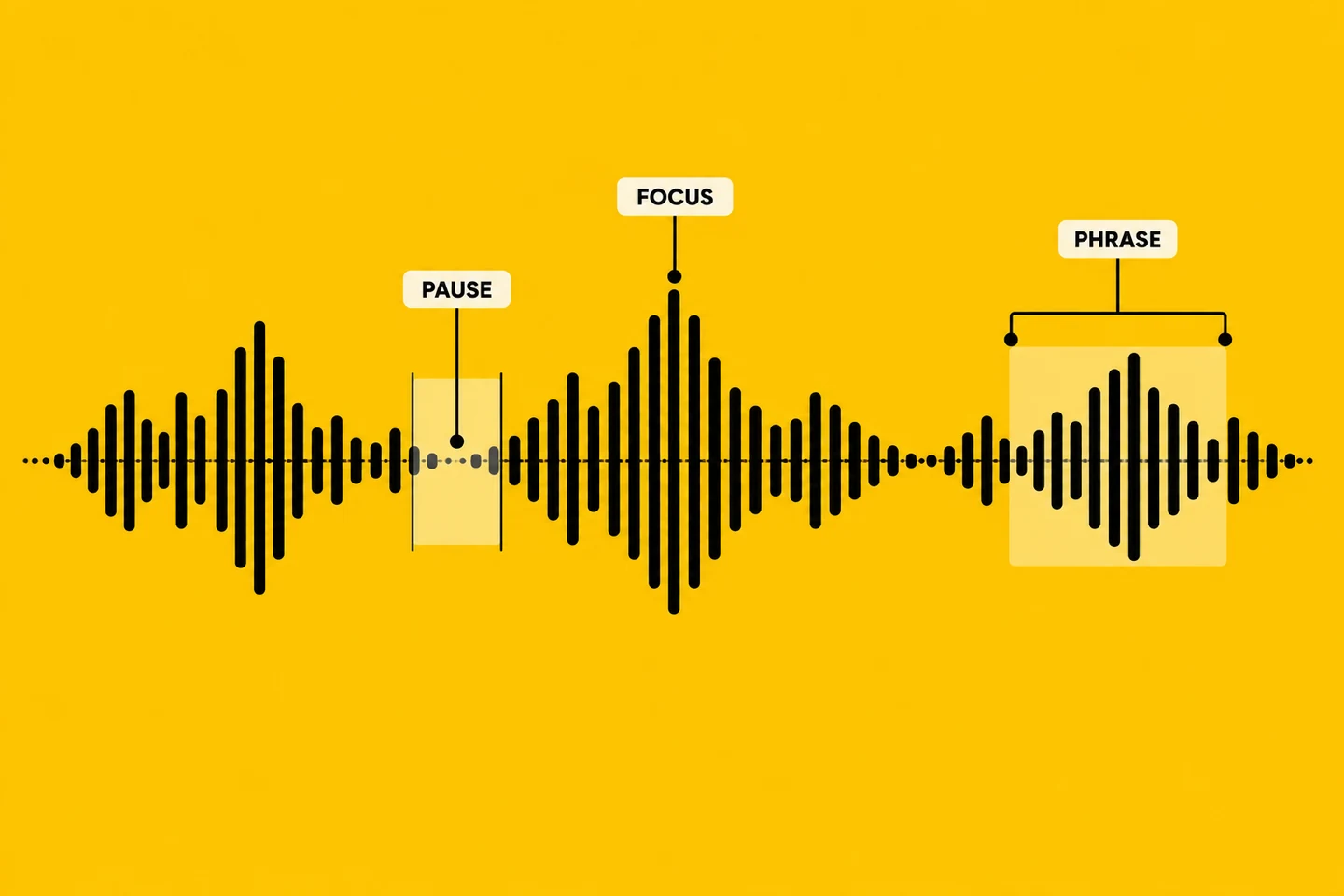
Techniques
Thought groups: why a useful pause is about meaning, not milliseconds
Make boundaries between ideas audible without slowing every word or turning pause duration into a score.